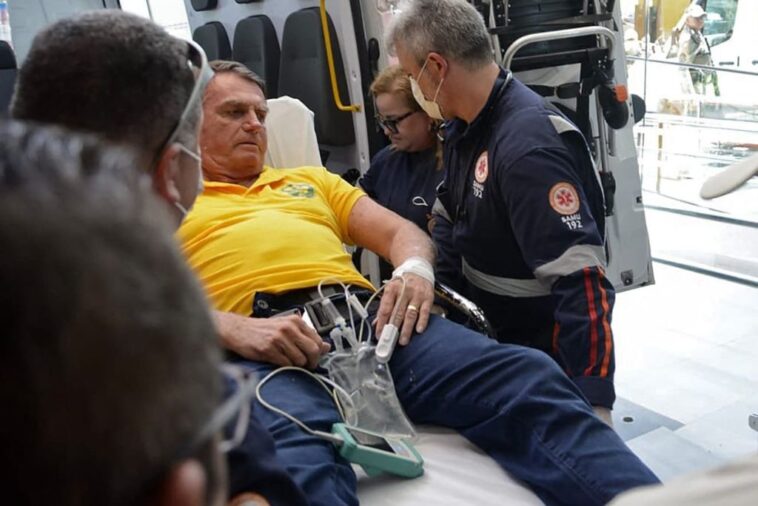
The decision by Brazil’s Federal Council of Medicine to open a formal investigation into the healthcare received by former President Jair Bolsonaro is neither a routine administrative procedure nor a hasty reaction to political noise.
It is a serious institutional act, undertaken following formal complaints that raise doubts about whether the Brazilian state ensured adequate medical care for a patient with a complex and widely known clinical history.
The initiative comes from the highest regulatory body of the medical profession and occurs at a particularly sensitive moment, both due to the personal situation of the individual involved and the country’s political climate.
The events prompting the investigation are concrete and verifiable. According to the Council itself, there are reports and public statements describing acute crises of various types, a traumatic episode caused by a fall, persistent hiccups, and a long chain of accumulated abdominal surgeries over recent years.
These are compounded by other comorbidities typical of an elderly patient. This combination of circumstances, far from being anecdotal, requires strict protocols for continuous monitoring, immediate care, and coordinated involvement of multiple medical specialties—something any responsible healthcare system must guarantee without exceptions.
SEE:
Bolsonaro is not only a former President of the Republic, with all the institutional implications that entails, but also a citizen who, like any other, has the right to receive medical care according to the highest standards.
The question under investigation is clear: whether that right was fully guaranteed or whether there were failures, negligence, or interference that compromised his care.
The Council has been explicit in stating that the doubts raised have generated “extreme concern” in Brazilian society—a phrase not used lightly in official documents.
The timing and procedure are also defined. The Federal Council has instructed the Regional Council of Medicine of the Federal District to immediately launch a formal investigation, in accordance with current legislation and the Code of Ethical-Professional Procedure.
This is not a media trial or a premature condemnation, but a regulated process aimed at clarifying the facts, assigning responsibility if applicable, and, above all, reinforcing trust in healthcare institutions.
There is one particularly relevant point that the Council has emphasized: the autonomy of the treating physician. In a context of extreme political polarization, it is a necessary reminder that clinical decisions must remain free from ideological pressures, partisan interests, or political calculations.
Medicine cannot and must not become an instrument in political disputes. Professional judgment, based on science and experience, must be sovereign and respected.
This case goes beyond Bolsonaro himself. What is at stake is the credibility of the state and its ability to ensure safety, including in healthcare.
A serious country is defined by institutions that function, that act when justified doubts arise, and that do not look the other way for political convenience. The health of a person—especially someone who has held the highest responsibility in the state—cannot be exposed to improvisation or hidden vendettas.
SEE:
The investigation opened by the Federal Council of Medicine is, in this sense, a sign of institutional strength. It shows that there are still counterbalances willing to act with rigor, order, and responsibility, even in uncomfortable scenarios. Ensuring adequate medical care is not a privilege; it is a public obligation and a moral requirement.
The political backdrop cannot be ignored. In too many countries, the left has normalized the ideological colonization of institutions, relativized the law, and degraded essential services by subjecting them to partisan interests.
The consequences are visible: social distrust, deterioration of order, and unprotected citizens. Against this model, defending legitimate authority, institutional respect, family, and individual and collective responsibility is not conservative rhetoric—it is common sense. When the rule of law erodes, the same people always pay the price—and almost never those who make the decisions.
READ MORE:
Stay informed with the most important news and reliable analysis!
Subscribe to our newsletter: https://gatewayhispanic.com/sl-newsletter
About The Author

Rafa Gómez-Santos Martín
Rafael Santos is a Portuguese writer and political analyst dedicated to educating Hispanics on traditional values and the importance of protecting children and families. With years of experience in media and public discourse, he has been a strong advocate for cultural preservation and moral principles in an ever-changing world. Passionate about culture, sports, and current affairs, Rafael brings insightful analysis to political and social debates, striving to empower the Hispanic community with knowledge and a deeper understanding of the issues that shape their lives.