
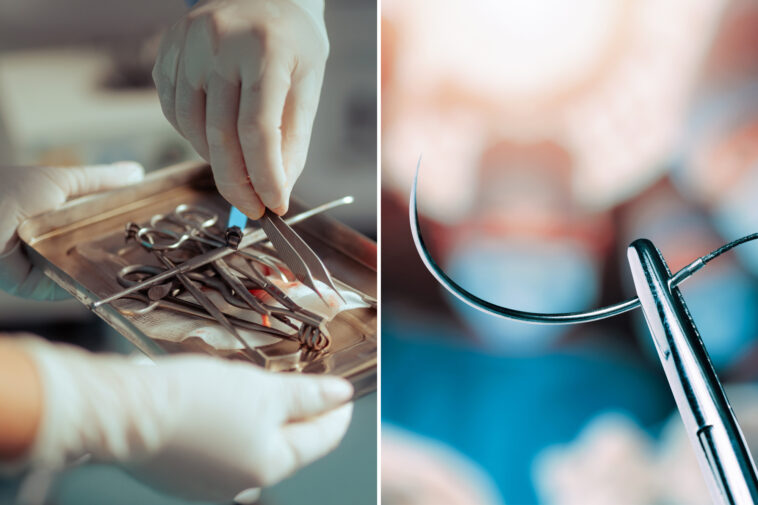
Surgeons are givers, not takers — sometimes they even leave a little souvenir behind in a patient’s guts.
Doofus docs mistakenly drop sponges, needles, a bit of gauze, a wire or even a stray screwdriver inside bodies, then go on to stitch up the op.
The shameful list of forgotten doodads — called Surgically Retained Items (SRIs) — also includes springs, syringes, suction bulbs, nails, screws, drill bits, broken pieces of equipment, marking pens and cotton swabs.

In rarer — but more disturbing — cases, bigger tools like scalpels, knife handles and retractors land inside a patient’s anatomy and linger around like infuriating house guests for months or even years.
A recent UCLA study estimates that surgical items are unintentionally left inside patients in roughly one out of every 5,000 inpatient surgeries, or about 1,500 cases annually nationwide.
And those study estimates do not include outpatient surgeries and operations at veterans hospitals.
The UCLA research sample only included cases where objects were detected before the patient was discharged from the hospital, not the ones where the perplexed patient is home and slammed with strange symptoms and sometimes excruciating pain before the festering debris is finally detected.
“Rates of forgotten items after surgery have persisted for decades,” Atul Gawande, professor of surgery at Brigham and Women’s Hospital told the Albany Times Union. “We have estimates that have gone back decades — they have been very consistent over time.”
The exact number of stupid surgical blunders has been tough to pin down because they’re often unreported, but a 2024 Joint Commission study reported that out of 772 events in the US,16 were fatal.
The incidents can be expensive for the hospitals.
Each case can cost them tens of thousands of dollars for medical care and hundreds of thousands in resulting litigation.

One woman who had undergone an emergency cesarean section experienced abdominal pain for years before surgeons discovered a sponge surrounded by 300 cc’s — 10 ounces — of pus nearly a decade later.
Fortunately, she recovered.
In another case, a woman expelled part of a surgical forceps three years after liver surgery.
Imaging later revealed a corroded surgical instrument still inside her abdomen.
“We do know we continue to have a problem, so we can’t give up working on it,” Victoria Steelman, associate professor emeritus at the University of Iowa’s College of Nursing, an expert on SRIs, told the Times Union.