
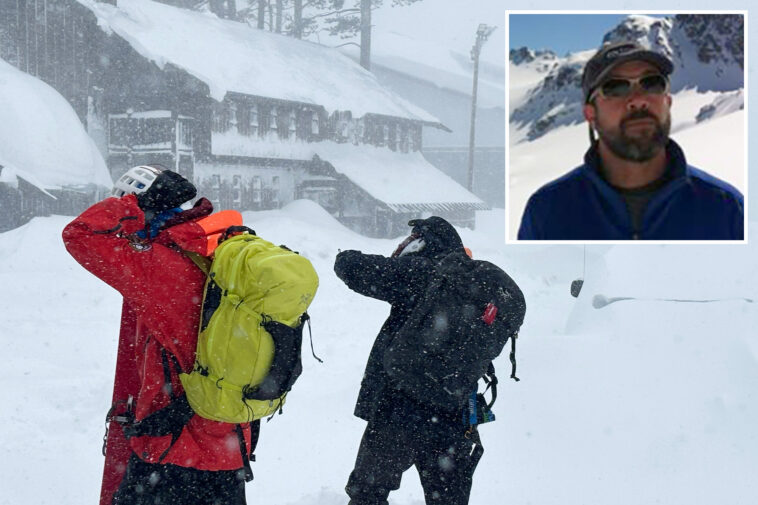
A top doctor has revealed why avalanches have such a high mortality rate -– after eight skiers were killed near Lake Tahoe.
Eric Stendell, an emergency physician in Truckee, near the site of Tuesday’s tragedy, said people either die from blunt force trauma, asphyxiation or hypothermia.

He said many who survive the initial impact tend to suffocate because when the snow settles it forms a solid “cement like” pack, making it impossible to move or breath.
Stendell said if a victim finds an air pocket under the surface they still need to be rescued within the first 15 minutes, adding a “generous estimate” would give them an hour before the cold sinks in.
Eight people were killed in the avalanche at Castle Peak, near Truckee, on Tuesday, with another still missing but presumed dead.
Cops and the state have launched separate investigations into the disaster, with the organizers Blackbird Mountain Guides under the microscope.

Stendell, who has worked in healthcare for over two decades, told the California Post on Friday that time is the main enemy when trying to dig out avalanche victims.
He said: “If we’re going to save somebody, you really need to dig them up within the first 15 minutes. Very few people will survive beyond an hour buried under the snow.
“Sometimes an avalanche will wash you through trees or into rocks and you can suffer a traumatic injury. The most common is asphyxia, where you can no longer breathe because you’re below the snow.”
He said: “When an avalanche is moving, it looks like it’s flowing like water, but then as it stops, it sets up and gets extremely solid.

“This is why lots of people can be a couple inches under the snow and it’s like you’re encased in cement — you can’t move anything.”
If a person survives these two factors, the odds of freezing to death increase dramatically the most time passes.
Stendell continued: “As the core body temperature cools, you will shift from intense shivering to confusion and loss of shivering.

“Eventual loss of consciousness, and muscles becoming rigid. Breathing will slow or stop, as will cardiac activity.”
Hypothermia is a less common end for those caught in avalanches. Stendell added: “The two most common reasons people die are trauma or asphyxiation, not hypothermia.”
The doctor added this week’s disaster was “beyond tragic,” saying in the small mountain town “either we’re going to know the victims or have a friend who’s closely affiliated with them.”