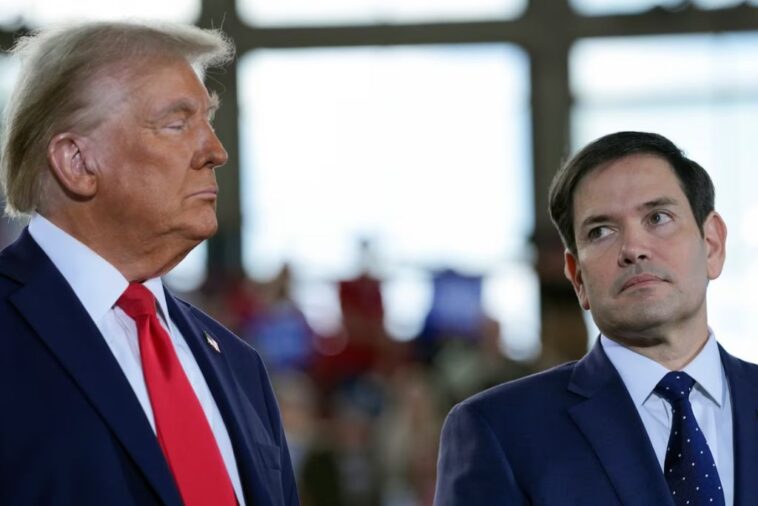

President Donald Trump and Secretary of State Marco Rubio are pushing an economic agreement with the Cuban regime that includes an “off-ramp” —a negotiated exit— to allow the Castro family and President Miguel Díaz-Canel to cede power without forced exile, according to an exclusive report from The Telegraph.
The plan would allow these leaders to remain on the island in exchange for concessions in ports, energy, and tourism, with possible selective relief in sanctions.
The conversations involve Raúl Guillermo Rodríguez Castro, grandson of Raúl Castro, who maintains key influence. Rubio, son of Cuban immigrants, leads the high-level negotiations, as confirmed by Trump in public statements.
The president has said that “Cuba is in its final moment of life as it is” and that an agreement will be reached “very easily”.
This pressure intensified after the capture of Nicolás Maduro and his wife Cilia Flores on January 3, 2026, in Caracas by U.S. forces.
SECRETARY RUBIO: Americans cannot be used as a commodity to grab onto and then trade in the future. That cycle has to stop, and that’s why the State Sponsor of Wrongful Detention designation now exists. pic.twitter.com/1psESG8gzx
— Department of State (@StateDept) March 9, 2026
After rejecting offers of exile, they were transferred to the Metropolitan Detention Center in Brooklyn, New York, facing charges of narcoterrorism and drug trafficking, according to CNN coverage from January 4, 2026. The cutoff of Venezuelan oil shipments caused an energy crisis in Cuba with massive blackouts.
Trump declared at a press conference in Doral, Florida, on March 9, 2026, that the agreement “may be a friendly takeover or not,” but that the regime is “without energy, without money” and in “deep humanitarian problems.” In previous interviews, such as with CNN on March 6, he stated that “Cuba will fall soon” and assigned Rubio to handle the talks.
The approach combines economic force with a realistic offer, contrasting with past policies of engagement without results. Trump emphasized that Cuba “wants to negotiate desperately” after losing allies like Venezuela.
The U.S. is sending the first humanitarian shipment to Cuba to help people in need as they continue to recover from Hurricane Melissa. We are working with the Catholic Church and partners to ensure aid reaches the Cuban people directly—not the illegitimate regime. The Trump…
— Secretary Marco Rubio (@SecRubio) January 14, 2026
This development seeks to accelerate the end of communism in Cuba after decades of repression, taking advantage of the current weakness of the regime to promote freedom and prosperity.
Previously, we had reported it on Gateway Hispanic about the national emergency declaration against the threats of the communist Cuban regime.
About The Author

Joana Campos
Joana Campos es abogada y editora con más de 10 años de experiencia en la gestión de proyectos de desarrollo internacional, enfocada en la sostenibilidad y el impacto social positivo. Anteriormente, trabajó como abogada corporativa. Egresada de la Universidad de Guadalajara.