

President Trump said Iran is seeking a deal with the United States as Washington considers possible strikes while increasing its military presence in the Middle East to pressure Tehran into negotiations.
The United States has recently moved a large naval force, including the USS Abraham Lincoln carrier strike group, into the Arabian Sea and the Persian Gulf. U.S. officials have identified specific red lines for military intervention, focused on Iran’s domestic crackdown on nationwide protests that began in late 2025 and the potential restart of its nuclear enrichment program following Israeli and U.S. strikes in June 2025.
Trump said both sides have signaled readiness to resume talks but that he has not made a final decision on the use of force, reiterating that he hopes an agreement can be reached.
He has warned of military action while calling on Iran to halt its crackdown on protesters and agree to a deal that excludes nuclear weapons.
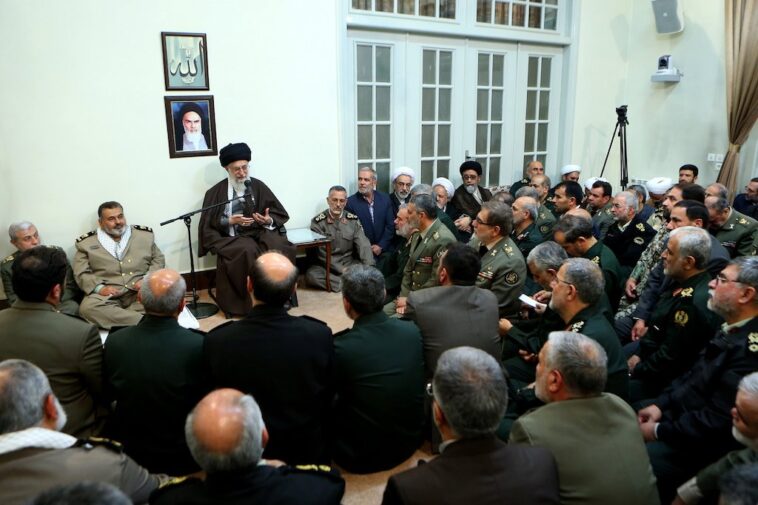
Iran’s Supreme Leader Ayatollah Ali Khamenei responded that any U.S. attack would lead to a regional war, stating that Iran does not seek conflict but would respond if attacked.
While both sides claim to be open to a “fair deal,” the United States is also applying pressure through measures such as 25 percent tariffs on countries trading with Iran.
Warnings that U.S. strikes could trigger a regional war require clarification.
Israel is likely the only other state actor that would become directly involved, and it would do so in support of the United States.
From a U.S. perspective, this would not constitute escalation in terms of drawing additional hostile state powers into the conflict.
Iran would likely receive no direct military support from other state actors.
Although Iran conducted naval drills with Russia and China in the Sea of Oman in early 2026, experts note that neither Moscow nor Beijing has demonstrated a willingness to provide direct military assistance in the event of war.
The situation is further shaped by Iran’s loss of key regional allies. With the fall of Syria’s Assad regime in late 2024, Iran lost a critical partner that had played multiple roles in its regional strategy.
Syria provided a geographic corridor for Iran to move weapons, supplies, and funds to Hezbollah in Lebanon and served as a forward position in the Levant from which Iran could project power toward the Mediterranean.
This arrangement supported Iran’s ability to threaten Israel’s northern border and allowed for potential retaliation from Syrian and Lebanese territory in the event of U.S. or Israeli strikes.
Syria was also the only sovereign state, rather than a militia or proxy, within Iran’s “Axis of Resistance,” giving the network a degree of international standing that non-state actors could not provide.
As Iran has no state-level actors to rely on for direct support, it would increase its dependence on proxy forces in Iraq, Lebanon, and Yemen. U.S. strikes on Iran would likely trigger responses across multiple regional theaters through a combination of proxy activity and geographic exposure.
In Iraq, Iranian-aligned militias such as Kataib Hezbollah operate openly and have already threatened “total war.” These groups have a record of attacking U.S. bases in Iraq and Jordan when Iran comes under pressure, creating a risk of internal destabilization.
In Yemen, the Houthis have reactivated their “Soon” campaign, threatening maritime chokepoints in the Red Sea and the Strait of Hormuz as a means of imposing economic disruption.
While operating independently, they remain closely aligned with Iranian objectives.
In Lebanon, Hezbollah remains Iran’s most capable proxy despite being severely degraded by Israeli strikes in late 2025, and continues to function as a force intended to shift conflict onto Israel’s northern border.
Across the Gulf, U.S. military assets stationed in Qatar, the United Arab Emirates, and Bahrain place host countries directly at risk. Iran has warned that any state permitting its territory to be used for U.S. attacks would be considered a legitimate target, prompting Gulf governments to pursue mediation efforts to avoid becoming the site of escalation.
On the other hand, while an attack on Iran would generally activate proxy forces and trigger terrorist attacks, regime change in Iran would cut the lifeline to these groups and could end or at least significantly reduce their capabilities and the threat they pose.
Groups such as Hezbollah in Lebanon, the Houthis in Yemen, and various Iraqi militias are ideologically and financially tied to Tehran.
Estimates from 2012 to 2020 suggest Iran spent more than $16 billion supporting these groups. By 2026, Iran’s economic crisis, with the rial trading at roughly 1.4 million to the dollar, has fueled domestic protests, with demonstrators chanting, “Not for Gaza, not for Lebanon, my life for Iran.”
Without the IRGC providing training, weapons transfers, and revenue from black market oil sales, these proxy groups would likely lose their ability to operate as regional power brokers.
They would be reduced to localized political or criminal entities and would no longer benefit from the protection and reach provided by Iranian state sponsorship.
This dynamic intersects with broader regional economic priorities. Despite enduring Sunni–Shia and Arab–Persian divides, economic considerations increasingly drive regional decision-making.
Saudi Arabia and the United Arab Emirates are focused on large-scale economic diversification projects, including tourism, technology, and infrastructure.
Iranian proxy activity is viewed as a direct threat to these efforts, as missile or drone attacks from Yemen or Iraq raise insurance costs and deter foreign investment.
Although Saudi–Israeli normalization stalled publicly after 2023, reporting in early 2026 indicates continued indirect engagement.
Despite the numerous potential benefits of regime change in Iran, President Trump is correct to proceed with caution.
Regional governments recognize that reduced Iranian influence would remove a major obstacle to deeper cooperation involving U.S. technology and Israeli security expertise.
At the same time, regional diplomats, particularly in Riyadh and Abu Dhabi, remain wary of a sudden regime collapse in Iran.
One concern is the risk of a power vacuum, similar to Syria or Libya, in which the loss of central control leaves advanced weapons systems unsecured and vulnerable to black market distribution.
Another concern is the possibility that a weakened Iranian regime could retaliate by launching missiles at Gulf energy infrastructure, leading Gulf states such as Qatar, the UAE, and Oman to avoid becoming launch platforms for U.S. strikes.