
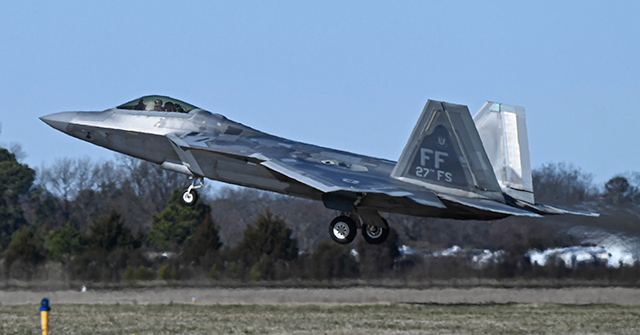
The United States deployed stealth F-22 fighter jets to Israel on Tuesday as part of what has been described as the largest American military buildup in the region in more than two decades, with high-stakes nuclear talks set for Thursday in Geneva and Iranian officials warning that any strike would inflict “heavy casualties.”
The advanced Raptors landed at an Israeli Air Force base after departing Royal Air Force Lakenheath in the United Kingdom, marking a rare and highly visible deployment of aircraft that the United States has never sold to any foreign military under longstanding legal restrictions.
The fifth-generation F-22 — designed primarily for air superiority but capable of precision strikes and electronic warfare — is considered a cornerstone of U.S. deterrence. Its arrival in Israel underscores the seriousness of Washington’s posture as tensions with Tehran escalate.
The move comes amid a sweeping surge of U.S. air and naval assets into Europe and the Middle East following a second round of nuclear talks that ended without a breakthrough last week. Open-source flight tracking data and satellite imagery indicate that more than 150 American aircraft — including refueling tankers, cargo planes, fighter jets, and airborne early warning platforms — have repositioned to bases across the region in recent days.
Two additional U.S. military refueling aircraft landed Tuesday at Ben Gurion Airport, bringing the total number documented in Israel over the past two days to four, following tanker and cargo arrivals reported Monday.
At sea, the USS Gerald R. Ford transited near Crete en route to the eastern Mediterranean, where it is expected to operate alongside the USS Abraham Lincoln, already positioned off the Omani coast. The concentration of carrier strike groups, destroyers armed with Tomahawk missiles, and combat aircraft represents the most substantial U.S. regional force posture since the 2003 Iraq War, though without a comparable ground invasion component.
The military positioning comes as Washington and Tehran prepare for what officials have characterized as a critical round of negotiations in Geneva scheduled for Thursday.
Iranian Foreign Minister Abbas Araghchi said Tuesday that “a deal is within reach, but only if diplomacy is given priority,” reiterating Tehran’s longstanding claim that Iran “will under no circumstances ever develop a nuclear weapon” while refusing to relinquish what it describes as its right to peaceful nuclear technology.
Israeli media reports indicated that Araghchi received approval from Supreme Leader Ayatollah Ali Khamenei on a draft counterproposal ahead of Thursday’s talks.
President Donald Trump, according to Fox News, told anchors at a traditional pre-State of the Union lunch that “important negotiations” are scheduled for Thursday and that “Iran desperately wants a deal,” but added that Tehran “just can’t say the sacred phrase ‘we won’t build nuclear weapons.’”
Last week, Trump said he was giving Tehran “10 to 15 days” to reach an agreement and warned that failure to do so would bring serious consequences. On Monday, he also pushed back on reports suggesting senior military officials had cautioned against action, insisting that if military force is ordered, it could be “easily won.”
Ahead of Tuesday night’s State of the Union address, Secretary of State Marco Rubio and CIA Director John Ratcliffe briefed the bipartisan “Gang of Eight” on potential U.S. options. Senate Minority Leader Chuck Schumer said afterward that “closed-door briefings are fine, but the administration has to make its case to the American people as something as important as this.”
Earlier Tuesday, White House press secretary Karoline Leavitt reiterated that “President Trump’s first option is always diplomacy,” while adding that he is prepared to use “the lethal force of the United States military if necessary.” Referencing Tehran’s rhetoric, she told reporters, “Iran chants ‘death to America.’ So you tell me if that’s a threat.”
Meanwhile, Tehran paired its diplomatic messaging with visible military demonstrations.
Iran’s Revolutionary Guard conducted ground force drills along the country’s southern coast Tuesday, airing footage of missile and drone launches as well as amphibious maneuvers. State media described the exercises as demonstrating modern combat technologies and new missile systems designed to confront current threats.
In the same context, Chief of Staff of Iran’s Armed Forces Abdolrahim Mousavi warned that while Iran has not initiated war, the United States would suffer “heavy casualties” if it “makes a mistake,” declaring that Iran’s armed forces are prepared to stand “to the end.”
Iranian Deputy Foreign Minister Majid Takht-Ravanchi similarly cautioned that a U.S. strike would be “a real gamble,” warning that while starting a war may be possible, ending one would not be easy.
Adding an intelligence dimension to the escalating standoff, the U.S. Central Intelligence Agency on Tuesday published a Persian-language video on X directly addressing Iranians. “The CIA can hear your voice and wants to help you,” the agency wrote, providing instructions on how to establish secure virtual contact and inviting individuals with access to relevant information to come forward.
Israeli media on Tuesday cited senior officials who described a U.S. strike as “unavoidable,” with one warning it would be the “surprise of the year” if Iran agreed to what he characterized as a genuine diplomatic resolution.
For his part, Prime Minister Benjamin Netanyahu warned Monday that if Iran makes “perhaps the most serious mistake in its history” and attacks Israel, it would face “a force they cannot even imagine,” stressing that coordination between Jerusalem and Washington has never been closer.
With advanced stealth aircraft now stationed in Israel, carrier strike groups positioned across surrounding waters, and negotiations set for Thursday, attention remains fixed on both the diplomatic track and the decisions emerging from Washington as the administration weighs its next steps.
Joshua Klein is a reporter for Breitbart News. Email him at jklein@breitbart.com. Follow him on Twitter @JoshuaKlein.