

By Adelle Nazarian January 7, 2026 at 11:41am
The fatal beating, lynching, and burning of Bangladeshi Hindu Dipu Chandra Das, followed days later by the mob killing of fellow Hindu Amrit Mondal, was not spontaneous violence. It was a failure of the state: clear, deliberate, and lethal.
Dipu was a 25-year-old garment worker, a husband, a father, and the sole provider for his family, including two elderly parents, one disabled. Above all, he was a Hindu in a Muslim-majority country, a member of a vulnerable minority. His life mattered. And the state failed him.
On December 18, a rumor spread that Dipu had spoken negatively about Islam. There is no verified evidence that he did. What is verified is that he begged the police for protection and was instead handed over to an Islamist mob.
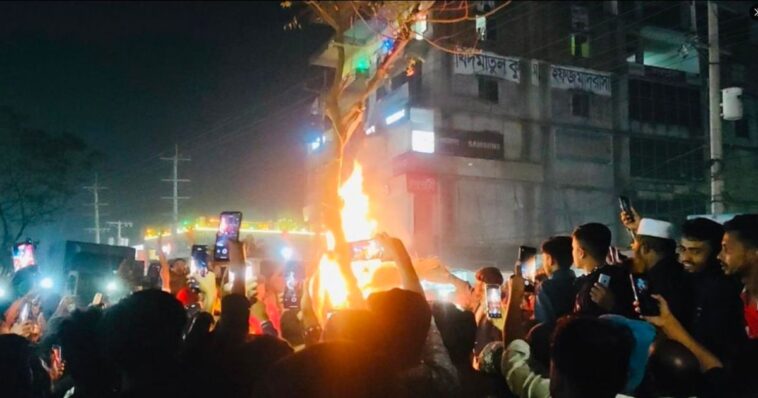
He was beaten to death, stripped naked, tied to a tree, and burned along the Dhaka-Mymensingh highway, in full public view. This did not happen despite the police. It happened because they allowed it.
The mob killed Dipu because they did not need proof. That is the danger of blasphemy-driven violence: When rumor replaces evidence, fear replaces law.
Dipu Chandra Das, a hindu, was brutaIIy lynch*d and burnt aIive in Bangladesh.
Dipu Chandra Das was a young garment factory worker who lived in the area as a tenant. He was accused of blasphemy and tied to a tree where they bur*t him to dea*h.
No formal case has been… pic.twitter.com/lfqxzHyW8c
— Shubham Sharma (@Shubham_fd) December 19, 2025
Days later, Amrit Mondal was beaten to death. Authorities rushed to downplay communal motives, but pattern matters more than intent. Two Hindu men. Two public killings. Two mobs. Two state failures.
That is not a coincidence. It is a trajectory.
There is no confirmed evidence that Dipu’s and Amrit’s killers were formal members of a single political organization, and that distinction matters legally.
But it does not erase reality. Both killings bear the hallmarks of Islamist mob violence: the weaponization of accusation, the targeting of minorities, and the social permission to kill without consequence.
This is how plausible deniability works. Leaders remain insulated while mobs do the dirty work.
Bangladesh has seen this before. In 1971, at least 2.8 million Hindus were massacred by the Pakistani Army and allied Islamist forces in less than a year.
That trauma never fully healed. It merely went dormant, resurfacing whenever political authority weakens and extremist actors sense opportunity.
In 2022, the U.S. Congress introduced House Resolution 1430, “Recognizing the Bangladesh Genocide of 1971,” a resolution seeking to formally recognize those atrocities as genocide and crimes against humanity. The effort that stalled legislatively, even as international genocide scholars officially affirmed that designation in 2023. That opportunity is now visible.
The return of Tarique Rahman of the Bangladesh Nationalist Party after roughly 16 years in exile is not a neutral political development. It signals the reactivation of old power networks at a moment of institutional fragility.
His arrival ahead of the upcoming elections coincides not with stabilization, but with a surge in street-level intimidation, communal violence, and state paralysis. And it brings with it the likelihood that Bangladesh will soon be run by the radical Jamaat-e-Islami, which means no minorities will be safe.
Even if the BNP gains ground, Tarique Rahman’s leadership from exile leaves him ill-positioned to govern or unify the country.
That weakness creates an opening for Jamaat-e-Islami to gain outsized influence through coalition politics, advancing Islamist priorities without winning outright.
The danger is not a sudden takeover, but the quiet erosion of Bangladesh’s secular foundations from within the government.
Fear is the factor that shapes elections in fragile democracies. When minorities are publicly brutalized, and the state hesitates, a message is sent about who is protected and who is expendable.
For India, this is not merely a human-rights crisis. It is a strategic warning. Bangladesh sits on India’s eastern flank, and when the rule of law collapses there, India feels it first through instability, radicalization, and refugee pressure.
Anti-Hindu violence in Bangladesh does not exist in isolation. It feeds directly into India’s internal security calculus, particularly in border regions already vulnerable to extremist Islamist influence.
For years, New Delhi invested heavily in a stable, secular Bangladesh as a regional partner, one that stood in contrast to Pakistan’s chronic instability and Afghanistan’s descent into Islamist rule.
The ousting of Prime Minister Sheikh Hasina placed that assumption in jeopardy. What India is now witnessing is not simply a political transition, but the early signs of a dangerous drift toward religious majoritarianism, institutional erosion, and extremist accommodation.
In a recent interview with New India Abroad, Prime Minister Sheikh Hasina underscored why her leadership had helped make Bangladesh a more stable and prosperous nation.
Reflecting on her departure amid escalating unrest, she stated, “My instinct has always been to protect our country and our citizens, and it was not an easy decision to leave while my country erupted into lawlessness. I regret that I was compelled to leave, but it was a decision I took to minimize any further loss of life, and to ensure the safety of people around me.”
She went on to outline the conditions necessary for her return, emphasizing that legitimacy must rest on law, not force.
“For me to return, Bangladesh must restore constitutional governance and the rule of law,” she wrote. “This means lifting the unlawful ban on the Awami League, releasing political prisoners detained on fabricated charges, and holding genuinely free elections. You cannot claim democratic legitimacy while banning the party elected nine times by the people.”
The killings of Dipu Chandra Das and Amrit Mondal are not isolated crimes. They are indicators. With elections approaching and authority fragmented, Islamist street power is testing how far it can go. And the answer they are giving is far enough.
That erosion of trust places responsibility on the United States as well. On Dec. 28, the U.S. State Department issued a statement condemning the killings and urging Bangladesh to protect religious minorities and uphold the rule of law.
The statement was necessary. It was correct. And it now requires tangible follow-through.
For generations, America has claimed the mantle of democracy, pluralism, and freedom of belief. Those ideals only retain meaning when defended under pressure. Jamaat-e-Islami and groups associated with them must be actioned accordingly.
Instability does not begin with coups or wars, but with the normalization of violence against the defenseless.
When mobs replace courts, democracy becomes theater. When the state fails to protect its weakest citizens, it signals to extremists that the cost of violence is low.
These were not random deaths. They were warnings.
India is watching because it must. The United States is watching because it still has the capacity and the responsibility to stand for justice at a moment when the meaning of human rights is being challenged and steadily eroded.
The views expressed in this opinion article are those of their author and are not necessarily either shared or endorsed by the owners of this website. If you are interested in contributing an Op-Ed to The Western Journal, you can learn about our submission guidelines and process here.
Adelle Nazarian has over 15 years of experience in journalism, geopolitics, and the media world. She is also an entrepreneur who has founded and served as CEO of several organizations including a geopolitical consulting firm. Adelle is also a Senior Fellow at the Gold Institute for International Strategy (GIIS) in Washington, D.C. She enjoys traveling, is constantly learning and is inquisitive by nature. Adelle speaks English, Persian (Farsi), French and Mandarin Chinese. Follow Adelle Nazarian on X @AdelleNaz.
Adelle Nazarian has over 15 years of experience in journalism, geopolitics, and the media world. She is also an entrepreneur who has founded and served as CEO of several organizations including a geopolitical consulting firm. Adelle is also a Senior Fellow at the Gold Institute for International Strategy (GIIS) in Washington, D.C. She enjoys traveling, is constantly learning and is inquisitive by nature. Adelle speaks English, Persian (Farsi), French and Mandarin Chinese. Follow Adelle Nazarian on X @AdelleNaz.
Advertise with The Western Journal and reach millions of highly engaged readers, while supporting our work. Advertise Today.