
MIAMI GARDENS, Fla. — As No. 1 Indiana entered Hard Rock Stadium on Monday night to compete for the school’s first national title on No. 10 Miami‘s home turf, the Hoosiers carried with them the confidence of their head coach, Curt Cignetti — and the baggage of the program’s heavy history as one of the worst in college football.
In order to understand just how improbable Indiana’s 16-0 season was, punctuated by its gritty 27-21 win against Miami before a crowd of 67,227 — a majority of whom were clad in cream and crimson — a history lesson is required. Indiana football had lost 715 games — the second most in FBS history, just one behind Northwestern.
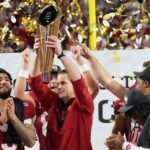
With one thrilling win on Monday night, though, a seesaw game that went down to the wire, the Hoosiers left Miami as the best team in the country, completing one of the most remarkable two-year turnarounds in coaching history. Though there are sure to be debates about where this Indiana team ranks among college football’s greatest teams, including the 2001 Miami Hurricanes, the simple fact is nothing like this has been done before with a roster filled with unheralded recruits.
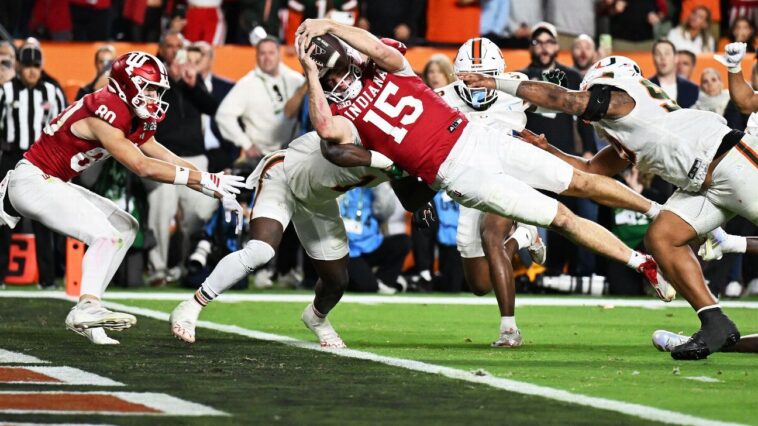
That includes the Hoosiers’ Heisman Trophy winner, quarterback Fernando Mendoza, who willed himself 12 yards into the end zone on fourth down with 9:18 left in the game to give the Hoosiers a 24-14 lead. The last player to win the Heisman Trophy and national championship in the same season was Alabama receiver DeVonta Smith in 2020.
And yet that 12-play, 75-yard drive ended with a jaw-dropping, fourth-down touchdown run by a Hoosier from Miami who was never recruited by the Canes.
Mendoza was hardly alone. Indiana’s national championship roster included eight four- or five-star players, while Miami boasted 45 who earned four- or five-star rankings out of high school. For four quarters, they went toe-to-toe on the sport’s great stage, a showdown of two teams that were long shots to get here, let alone win it all.
Cignetti now has an FBS-best 27-2 record over the past two seasons after Indiana went 9-27 in its final three seasons before he was hired. He has led the Hoosiers to their first two 10-win seasons in program history. Indiana has joined Yale in 1894 as the only teams in major college football history to finish 16-0.
In such a tight game, the Hoosiers needed more than another Heisman moment from Mendoza to accomplish the feat. With 44 seconds left in the game, Miami quarterback Carson Beck was intercepted by Jamari Sharpe to stifle the Canes’ final attempt at a comeback. With 5:04 left in the third quarter, Indiana defensive lineman Mikail Kamara got his left hand on the ball and knocked it down to block a punt, and linebacker Isaiah Jones recovered it for a touchdown, giving the Hoosiers a 17-7 lead. It was the first blocked punt returned for a touchdown in the CFP era. Beck put both of his hands on his helmet in disbelief and frustration.
Indiana led the whole game — but not in dominant fashion as it had all season. The Hoosiers entered Monday night having outscored opponents by 473 points this season, which tied with 2019 Clemson for the most entering the national championship game in CFP history.
With 6:32 left in the game, Miami closed the gap to 24-21 with an eight-play, 91-yard drive that ended with a 22-yard touchdown pass from Beck to Malachi Toney. The Hurricanes were constantly within reach, but could never take the lead — or stop enough of the Hoosiers’ explosive, timely plays.
A 57-yard touchdown run for Mark Fletcher Jr. with 11:06 left in the third quarter closed the gap to 10-7. The Canes, who survived six lead changes in their Fiesta Bowl win against Ole Miss, needed just two plays and 47 seconds to score, and the Hoosiers came up empty on the following possession.
Miami, which was playing for its sixth national title and the program’s first since 2001, was the visiting team in its home stadium because the Hoosiers earned the higher seed. And just as they had done through the entire playoff, Indiana fans packed the stadium, filling what appeared to be about 60% of the seats.
As Mendoza took his seat on the bench following a 12-play drive that ended in a 34-yard field goal and a 3-0 lead, he pressed a white towel to his bloody lip. He had gotten hammered from his blind side earlier in the drive, and Miami’s defense was aggressive early.
Cignetti took issue with the officiating, telling ESPN’s Holly Rowe at the half that he believed there were three personal fouls not called on Mendoza that “cross the line” and were “black-and-white calls.”
There was one call, though, that changed the game early.
Miami defensive end Rueben Bain Jr., the No. 13 player in Mel Kiper’s latest Big Board ranking, made one critical mistake when he jumped offside on a third-and-13 at midfield in the second quarter. One the following play, Kaelon Black rushed up the middle for a 20-yard gain and a first down at the Miami 23-yard line.
For Miami, penalties have been an issue all year. The Hurricanes entered Monday night averaging seven penalties accepted against them per game, which is 104th in the FBS.
With 6:13 remaining in the first half, Indiana had the ball on Miami’s 1-yard line. Mendoza handed the ball to Riley Nowakowski, an unheralded tight end who embodied everything about Indiana’s roster. Nowakowski, a former walk-on at Wisconsin with the background of a fullback, powered through for the touchdown and the 10-0 lead.
Including that touchdown, the Hoosiers scored 198 points in the second quarter, the most of any FBS team in any quarter this season. For all of the attention on Mendoza, though, the defense was equally as impressive in the first half, holding Miami to 69 yards, earning the Canes the dubious distinction of having the fewest by a team in the first half of a CFP championship game.
Miami’s offense at times struggled to move the ball a yard early. The Canes’ offensive line, which had an advantage of about 53 pounds per player, was getting outplayed, and Beck became visibly frustrated until the Canes converted on a fourth-and-1. Their most productive drive of the first half ended with a missed 50-yard field goal that clinked off the right upright.
Indiana’s win was also a victory for the Big Ten, as it was the first time since 1940-42 (Minnesota in ’40 and ’41 and Ohio State in ’42) that the Big Ten won three straight national titles (AP and Coaches Poll titles only).