
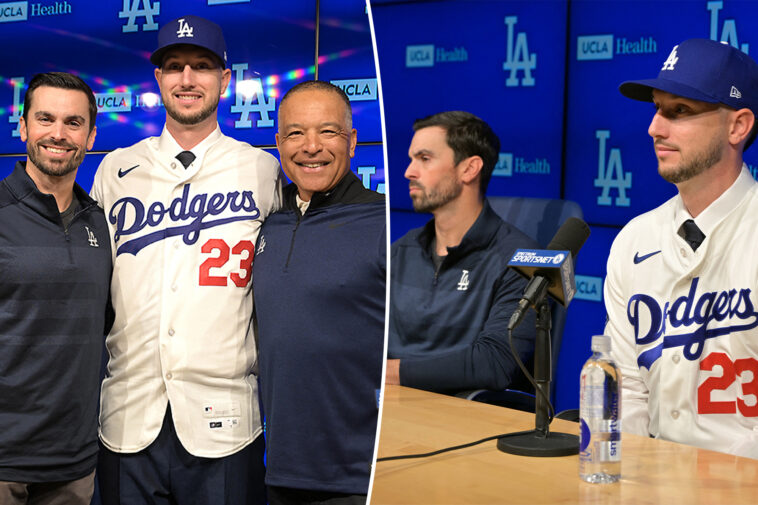
The Dodgers did not go into this offseason anticipating they’d ultimately sign Kyle Tucker.
Even up until a couple weeks ago, their chances of nabbing the four-time All-Star –– given their preference for a shorter-term deal –– seemed more wishful than expectant.

Yet, here Tucker was on Wednesday afternoon: Shaking hands with Dodgers manager Dave Roberts and general manager Brandon Gomes. Slipping into a white No. 23 Dodgers jersey and a blue LA cap. Being formally introduced at a Chavez Ravine press conference, shortly after his blockbuster four-year, $240 million contract with the club was finalized and announced.
“When we started the offseason and [were] talking about various fits on the trade market, free agent market, there was really nobody that moved our World Series odds for 2026 more than Kyle Tucker,” president of baseball operations Andrew Friedman said.

And in the end, despite the early uncertainty, the Dodgers once again prevailed in a high-priced sweepstakes.
To the two-time World Series victors, go the spoils of another superstar acquisition.
“It’s a first-class experience,” Tucker said of joining the Dodgers. “Playing here is exciting.”
As Tucker officially joins the Dodgers, here are three takeaways from Wednesday’s press conference about how the signing came to be, and how the outfield slugger will aid their bid for a World Series three-peat.
A late, but fitting, match
At the start of the offseason, the Dodgers’ plan for pursuing Tucker was simple.
They would reach out with interest, as they do with almost all top free-agent players. They would let it be known up front they were looking for a shorter-term pact (initially, their preference was for up to three years, per sources, given their pre-existing long-term commitments and the looming uncertainty of next winter’s CBA negotiations). Then, they would see how Tucker’s market developed, and whether or not he received the 10-plus year, $400-plus million type offers he was widely projected to field.
“At the beginning of the offseason, you don’t know what the likelihood of that is,” Friedman said. “All you can do is kind of state your strong interest and sell as much as you can.”
Other clubs made their own enticing pitch to the two-time Silver Slugger and Gold Glove-winning right fielder.

In December, Tucker had an in-person meeting with his perceived top suitor, the Toronto Blue Jays –– who gave him a tour of their spring training facilities (conveniently located near his offseason home in Tampa) and would eventually pony up the longer-term offer he was believed to be seeking (albeit, at 10 years and only $350 million, per The Post’s Jon Heyman).
By early January, the New York Mets had entered the picture, too, pursuing Tucker with a shorter-term proposal sweetened by an eye-popping $50-plus million in annual salary (their final offer was four years and $220 million).
The Dodgers, however, stayed in contact with Tucker’s camp throughout. Early last week, they held a video call with the 29-year-old in which he expressed an encouraging “level of engagement,” Friedman said. Suddenly, hopes were raised that the sides could find a pathway to a deal.

“When we’ve seen these kinds of shorter-term, higher-AAV deals, I don’t think they’ve ever come when [the player] also had a really long, significant deal [they were considering] as well,” Friedman said. “He had that opportunity. And so for us, it was about selling the opportunity to play with these guys, to play in front of these fans, to play in this city, to connect with this community.”
And, of course, to make a lot of money while doing it.
An ‘easier’ decision in the end
While Friedman acknowledged negotiations with Tucker’s camp “started lower” than the eventual $240 million agreement the sides would eventually strike, the Dodgers ramped up their efforts in the closing days of Tucker’s free agency –– buoyed by the financial windfalls that have come with their back-to-back titles and Ohtani-driven revenue boosts.
Their final bid included $60 million in annual salary (the second-highest in the sport, behind only Shohei Ohtani), a $64 million signing bonus (which will help offset the $30 million in payments that Tucker agreed to defer) and opt-outs after both the second and third seasons of the deal (which will allow Tucker to test the market again in a couple years).
Based on net-present value, which accounts for deferrals, Tucker’s $57 million AAV is a new MLB record.
“Really, it’s as simple as, we’re in a really strong position organizationally, financially, and we feel an immense pressure to pour back into our fans,” Friedman said.

Added Gomes: “When we had the opportunity to do it –– and this was a real chance to fill a hole that would really impact our team –– we did it. So it was one of those things where we were waiting around and being in contact, and then things developed pretty quickly over 5-7 days.”
Still, Tucker cited the Dodgers’ organizational success and talent-laiden roster as a primary appeal to him, as well.
“The team these guys put together and assembled, to give a great product for the fanbase and the city, to go out there and compete for a championship, kind of speaks for itself,” Tucker said. “Taking all of that into account, wanting to be a part of it, I think it’s very special.”
The California Post is coming soon. Sign up for updates.
Get in early. Be the first to know about launch and home delivery.
Thanks for signing up!
Thus, Tucker came to his final decision last Thursday night, describing his decision to pick the Dodgers as “a little bit easier” in the end.
“That was ultimately what we wanted to do,” he said, “is come here, and be a part of that, and try to win another World Series.”
The new right fielder
The reason the Dodgers were willing to splurge on Tucker (whose signing pushes their luxury tax payroll back above $400 million for a second-straight season, a threshold no other MLB team has ever crossed) is because he instantly addresses their only remaining area of need for 2026.
Before, the Dodgers had a corner outfield opening, with a potential Alex Call/Ryan Ward platoon representing their best in-house option. Now, Tucker will be the primary right fielder, shifting Teoscar Hernández to left with Andy Pages in center.
Tucker also gives the Dodgers lineup –– at times too top-heavy and inconsistent last year –– another impact hitter capable of being both a slugging and on-base threat.
He will likely either second or third in the batting order, according to Roberts.
“He brings power, discipline, athleticism and consistency, all qualities we feel strongly help contribute to winning championships,” Gomes said.
Roberts set expectations for Tucker –– who has been one of the game’s most consistent producers over the last five seasons, but has recorded just one top-five MVP finish in his career –– even higher.
“Do I think [he could be] an MVP candidate?” Roberts asked rhetorically. “Absolutely.”