
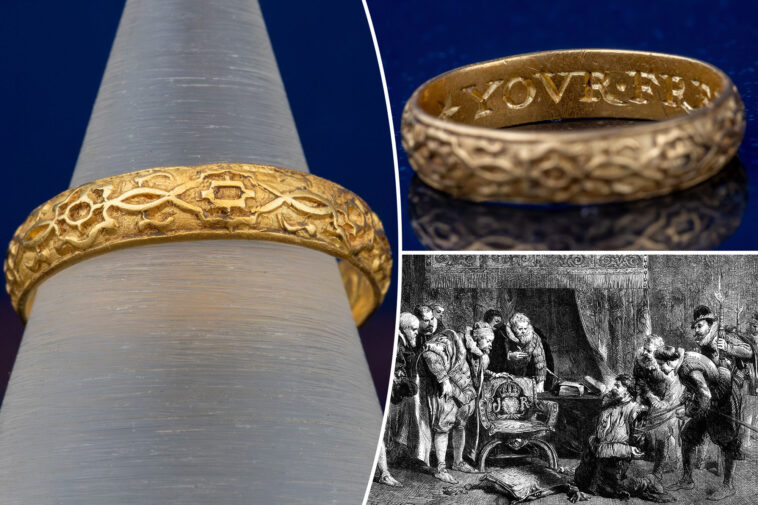
A historic gold ring from the English countryside will go under the hammer this month — and experts believe it may be linked to one of the most infamous conspiracies in British history.
The piece of jewelry was uncovered by metal detectorist Andrew Rose, who found it six inches in the ground in Bushwood, Warwickshire, about 20 miles southeast of Birmingham.
The artifact features an inner inscription reading “Your Frende in Deede,” a message thought to symbolize loyalty.
The 16th-century band may be tied to the 1605 Gunpowder Plot, an attempt by English Catholics to blow up the Houses of Parliament and kill King James I.
James I’s court got wind of the plans and eventually located Guy Fawkes hiding among 36 barrels of gunpowder on Nov. 5 — foiling the plot.
Though the Gunpowder Plot is remembered through Fawkes and the rhyme “Remember, remember the fifth of November,” the mastermind behind the scheme was actually Robert Catesby.
Rose found the ring near Bushwood Hall, where Catesby was born, as news agency SWNS reported.


The hall was also used as a hideout and weapons storage facility for the conspirators.
“The hall where Catesby was born can only be accessed down a track, which means it is even more likely the ring, which was found only yards from the moat, was connected to the hall or was owned by someone who lived there,” Rose told SWNS.


He added, “The words ‘in deede’ suggest [that] whoever gave the ring was prepared to prove his loyalty in actions rather than just words. It was a great find and hugely exciting.”
The ring is expected to fetch up to £12,000 (about $15,800) when it’s auctioned on Nov. 27, Hanson Auctioneers said.
Start your day with all you need to know
Morning Report delivers the latest news, videos, photos and more.
Thanks for signing up!
Speaking to SWNS, auctioneer Charles Hanson noted that the local area had a considerable Catholic population at the time of the Gunpowder Plot.

“Guy Fawkes, Catesby and their network — many of whom were related by blood or marriage — moved between safe houses in the Midlands,” said Hanson. “They were protected by the region’s large Catholic base, which, like them, [were] against the king.”
“Given the remoteness of the hall’s location, its link to Catesby [and] the date and inscription of the ring, it is tantalizing to imagine it belonging to one of the plotters,” he added.
“Imagine it glinting by firelight as they planned one of the most audacious attacks in U.K. history.”