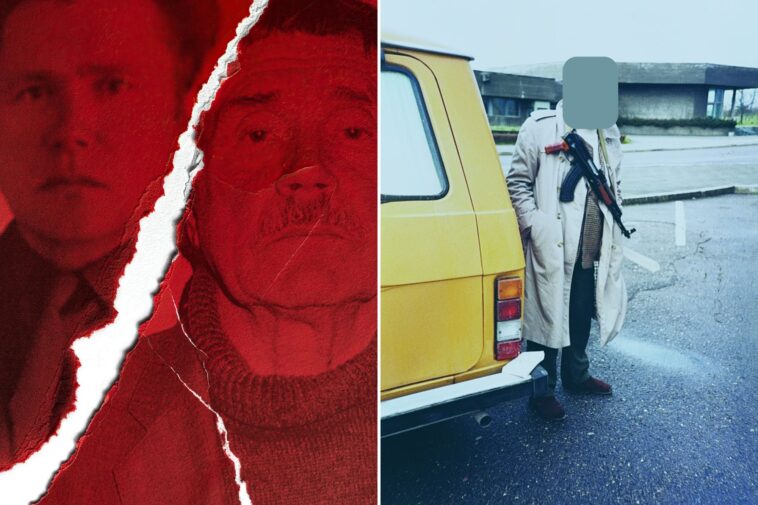
On Nov. 7, 1992, exactly 75 years after the Bolshevik Revolution, a yellow minibus with a fading “Baltic Tours” sign pulled up to the decaying docks of Klaipėda, a Lithuanian port city on the frigid Baltic Sea.
The Cold War had officially ended a year earlier, but old habits died hard. Armed men with bulges beneath their coats watched from the shadows as a peculiar tour group disembarked: two British intelligence officers, an elderly woman with a cane, a younger man in a wheelchair and a quiet, intense figure in his 70s carrying the Soviet Union’s darkest secrets in his head.

“There was shouting. And swearing,” writes Gordon Corera in his new book, “The Spy in the Archive: How One Man Tried to Kill the KGB” (Pegasus Books), out now. “It came from a figure who was hard to see. It sounded like it was in Russian. A lie had been uncovered and a life turned upside down.”
The man in the wheelchair — Vladimir Mitrokhin, who’d been told this was a medical trip—had just realized it was a defection. His father, Vasili, a retired KGB archivist, was escaping to Britain with the most comprehensive collection of Soviet intelligence secrets ever compiled: handwritten notes documenting 12 years of KGB operations, identifying hundreds of spies, revealing atomic espionage networks and exposing the methods Moscow used to crush dissent and infiltrate Western governments.
Vladimir looked at his father, the betrayal sinking in. “You’re a spy,” he said. Then came the word that cut deeper: “Traitor.”
The wheelchair was too wide for the gangplank leading to the escape boat. Vladimir clutched the armrests, refusing to move, his Russian curses echoing across the docks. Time was running out. KGB agents could be watching from anywhere in the port. The British operative, James, barked at his Russian partner, Robert: “I don’t care what you have to f–king do. Just get him on board.”
Robert raised his fist and brought it down hard on Vladimir’s hands. The young man’s grip released. “With that, Robert picks up the seated figure,” Corera writes. “Vladimir is hauled over a shoulder with a fireman’s lift and carried up and onto the boat.”

Behind them, Vasili followed calmly aboard. He “never looked back,” Corera notes — a reference to the old Gulag superstition that if you looked back while leaving a prison camp, you were doomed to return.
Vasili’s journey to that Lithuanian dock had begun decades earlier in the cellars of the Lubyanka, the KGB’s notorious Moscow headquarters. Born in 1922 in rural Russia, he joined Soviet intelligence after World War II, working as a prosecutor in Ukraine during Stalin’s brutal postwar crackdown. But his career as a field operative stalled after botched assignments in Israel and Australia. In 1956, he was banished to the archives, a dead-end posting for KGB washouts.

“I imagined that the bosses decided that I had exhausted my potential in the field,” Vasili later recalled, as Corera writes. “It was a very upsetting experience for me.”
But the archives opened his eyes. “Down there in the depths, just a few feet from where the prison had once been, was where the archives were housed,” Corera writes. As Vasili processed hundreds of thousands of files during the KGB’s 1972 move from the Lubyanka to new headquarters at Yasenevo, he witnessed the full scope of Soviet intelligence operations: atomic spies, deep-cover “illegals” living under false identities in the West, the crushing of dissidents, the infiltration of churches, the blackmail of diplomats.

“I could not believe such evil,” Vasili said, according to Corera. The files documented what he called a “trail of filth,” including betrayals, denunciations, torture and murders, all in service of maintaining Communist power.
Vasili began his secret rebellion. “He would pull out the tiny notes he had written in his special code and then sort them according to subject,” Corera writes. “He would then rewrite the smaller fragments into larger notes.” At his dacha outside Moscow, he typed up his handwritten notes on a portable typewriter he nicknamed “Erika,” using homemade ink brewed from concentrated fruit juice. He buried the typed pages in milk churns and metal containers beneath the floorboards.
“I didn’t have any friends or people I was particularly close to,” Vasili later explained, as Corera recounts. “I always felt I was on my own. I couldn’t tell anyone about my work, even at home. Especially at home.” Not even his wife, Nina, a successful doctor, knew about his double life.

For 12 years, Vasili accumulated his secret archive, never certain what he would do with it. “Writing for the drawer,” Russians called it — writing without hope of publication, trusting that someday circumstances might change.
That change came in 1991 when the Soviet Union collapsed. In March 1992, Vasili walked into the British Embassy in Vilnius with a grubby duffel bag. A young diplomat offered him tea. “While he sipped, she read,” Corera writes. “Her Russian meant she could see it appeared to be material related to the KGB.”
What emerged from that meeting would become the most comprehensive intelligence windfall of the Cold War. Mitrokhin’s notes identified hundreds of KGB agents and operations across decades — from the Cambridge spy ring to atomic espionage to deep-cover illegals still operating in America. “The CIA described the archive as ’the biggest CI [counter-intelligence] bonanza of the postwar period,’” Corera writes.

But getting Vasili out was the challenge. He insisted his entire family — Nina, Vladimir and Nina’s elderly mother — come with him. British intelligence crafted an elaborate exfiltration plan using a medical trip as cover. The problem was Vladimir and his grandmother had no idea they were defecting until that moment on the Klaipėda docks.
After a harrowing 33-hour boat journey through a Baltic storm, the Mitrokhin family arrived in Britain. Vladimir eventually made peace with his father’s choices. Nina died of motor neurone disease in 1999, just as Vasili’s archive was finally published.
Vasili spent his final years in quiet exile near London, still working on his notes, still hoping Russians would learn the truth about their past. “They are still there. It is the same people, the same organizations, the same aims,” he warned in 1999, as Corera recounts. He was talking about the successor agencies to the KGB, and about a rising politician named Vladimir Putin, a former KGB officer who would soon become Russia’s president.
Vasili died in 2004, and his warning went largely unheeded. Twenty years later, as Putin’s Russia wages war in Ukraine and hunts dissidents worldwide, his archive stands as both historical record and cautionary tale. The old archivist understood what few others could see, that the beast he’d fought his entire life had never truly died. It had simply changed its name.