
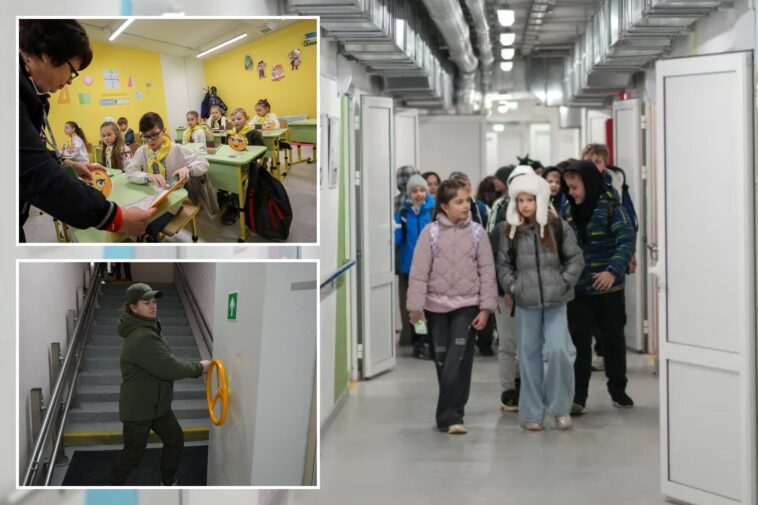
In “Fortress Kharkiv,” on the front lines of Ukraine’s fight against Russia, much of public life has gone underground.
After four years of constant bombardment by Russia, the city has opened eight schools in subterranean subway stations.
Plays and other shows are also taking place underground — where residents can gather and have some semblance of normalcy without the fear of Moscow’s deadly drones and missiles.

“We are the only city in the world with so-called metro schools. Those are underground schools. We have modified seven underground metro stations to allow our kids to study beneath the ground,” Mayor Ihor Terekhov told The Post.
Each underground school accommodates 1,200 students.
The Post previously reported on how kids in the city have been forced to study online or in shelters underground.
Terekhov said he and every citizen of Kharkiv are yearning for peace — but he warned that it will require 100 years of security guarantees from the US and allies to keep the peace.
“Guarantees of security [are needed], not for 2027 or 2 years beyond, but for a century, at least,” Terekhov said.


“Real guarantees of security yield peace dividends,” he added, while praising the efforts of Presidents Trump and Zelensky to end the war.
Speaking from Ukraine’s second-largest city, just hours after an attack on a market, Terekhov expressed his gratitude for American support for his country, and described how Kharkivites have adapted to the reality of the war four years after Russian President Vladimir Putin’s full-scale invasion began.
“Kharkiv is the fortress, and Kharkiv for those four years of the war has been the barometer of Ukrainian resilience,” Terekhov told The Post.
“We have been under perpetual shelling for the last four years and constant attacks. Just prior to our talk. One more drone, which is called in Russian, Molniya, which is translated into English as Lightning, has hit the markets,” he said.

“Two people have been wounded. The building of the market has been damaged. Fortunately, no casualties,” he added.
Kharkiv, which had 1.4 million residents prior to the February 2022 invasion, has been one of the most damaged Ukrainian cities since the start of the war.
Start your day with all you need to know
Morning Report delivers the latest news, videos, photos and more.
Thanks for signing up!
Lying just 18 miles from the Russian border in northeast Ukraine, by April 2024, almost a quarter of the city had been destroyed, Ukrainian President Volodymyr Zelensky said at the time.
Kharkiv remains under intermittent shelling today, with the war rumbling on into a fifth year.

“In Kharkiv since the start of the war, more than 48 multi-apartment housing [buildings] have been damaged. On top of that, 3,500 private houses,” Terekhov explained.
For Terekhov, the priority is ending the conflict, but he warns that it cannot be achieved without US support.
“Dream number one is, put an end to the war. Other dreams are that our kids come back to surface school, not to the schools which are located underground,” Terekhov said.


“We are dreaming about authentic life, full of happiness. Unless international support is in full swing. Unless United States assistance is provided, those dreams would not come true,” he said.
He said that President Trump deserves credit for helping to end the war.
“We are confident that thanks to President Trump, thanks to the foreign policy of President Zelensky, and thanks to the incessant efforts of our negotiating teams, our dreams would come true,” Terekhov said.
However, he remains skeptical that Putin is serious about ending the war.

“The first litmus test for us would be to stop the shelling. But also, of course, we would try to see the tangible desire of Russia to put an end to the war,” Terekhov said.
A further warning sign about Russia’s bad faith was seen on Tuesday when Putin’s troops broke an energy ceasefire brokered by President Trump after just four days.
Ukrainian power plants in Kharkiv, Kyiv, Sumy, Odesa, Dnipro and Vinnytsia were bombarded with more than 450 drones and 70 missiles, just halfway into a truce that was supposed to last a week.
“Statements, like promises, are made and then forgotten. In reality, Ukrainian cities continue to suffer from strikes on energy infrastructure and on peaceful civilian life,” Terekhov said of the strikes on energy targets.
“When power plants become targets of attacks, it becomes clear who this war is truly being waged against. The war has taught us not to take words at face value. We will believe in genuine intentions when the shelling stops and people stop dying,” Terekhov said.