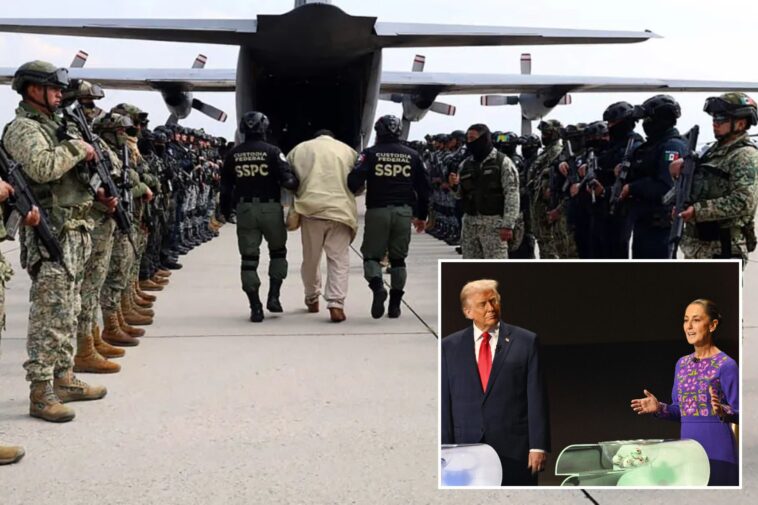
Mexico sent 37 cartel members to the United States at the request of the US Justice Department, with President Claudia Sheinbaum saying Wednesday that it was a “sovereign decision” by her government.
Sheinbaum responded to criticism from analysts and opponents who said that the transfers on Tuesday were the result of mounting pressure from Washington.
US President Donald Trump has threatened to take military action on cartels.

Sheinbaum said that although the transfers were made at the request of the US government, the decision was taken by the National Security Council after analyzing what was “convenient for Mexico” and in terms of its “national security.”
“Mexico is put first above all else, even if they ask for whatever they have to ask for. It is a sovereign decision,” she said at her regular morning news briefing.
Sheinbaum, who has been praised for her level-headed management of relations with Trump, has been forced to walk a fine line between making concessions to the Trump administration and projecting strength both domestically and internationally.
Observers say that the Mexican government has used the transfers as a sort of pressure valve to offset demands by Trump and show authorities are cracking down on criminal groups.
Tension has only mounted since the US carried out a military operation in Venezuela to capture then President Nicolás Maduro to face charges in the United States in an extraordinary use of force that set leaders across Latin America on edge.

Those sent to the US on Tuesday were alleged members of the powerful Jalisco New Generation Cartel, known by its Spanish acronym CJNG, and the Sinaloa Cartel, which Washington has designated as terrorist organizations, and a number of other groups.
It’s the third such transfer of capos over the past year. Mexico’s government said it has sent 92 people in total to the US in total.
US Attorney General Pam Bondi on Wednesday said that the transfer was a “landmark achievement in the Trump administration’s mission to destroy the cartels.”

The US Justice Department said that the move was an “important step” by Mexico’s government and that collaboration was in both countries’ shared interest.
“These 37 cartel members — including terrorists from the Sinaloa Cartel, CJNG, and others – will now pay for their crimes against the American people on American soil,” Bondi said in a statement with other US Justice Department officials.
On Tuesday, the US Justice Department said it had already indicted at least one of the people transferred, Armando Gómez Núñez, who was accused of being a senior leader of CJNG.
He is charged with drug offenses and the possession of weapons like machine guns and “explosive devices.”
In August, Mexico’s security minister acknowledged that some of the cartel leaders sent to the United States at that time were continuing criminal operations from prison and that their transfer was agreed upon because there was a risk they could be released because of judicial rulings.