
B[ ][ ][ ][ ]
B[ ]E[ ][ ]
BLE[ ][ ]
BLE[ ]S
BLESS
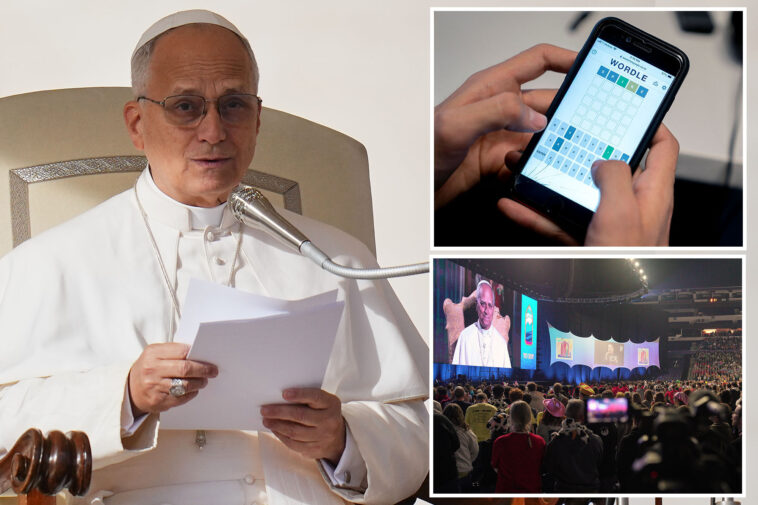
Pope Leo XIV revealed to a group of young American Catholics that he’s a bit of a rogue when it comes to playing Wordle — choosing a different starting word with every game.
“I use a different word for Wordle every day, so there’s no set starting word,” Leo said at the start of a Q&A session with the National Catholic Youth Conference when asked about his tactics.

He shared his strategy at the start of a virtual meeting with the conference, held this year in Indianapolis, with the pontiff dialing in via video feed from Catholic broadcast network EWTN.
Leo’s predilection for the popular word game became known soon after he was elected pope in May, when his brother John Prevost shared that the Holy Father is an avid devotee of the daily New York Times puzzle, and that the siblings regularly compare scores.
The free online word game, played by millions around the world each day, gives players six guesses to divine a five-letter word without providing any clues.
Many players opt to start with the same word every day, particularly a vowel-heavy word — such as “adieu” — hoping to gain an edge right out of the gate.


The rest of the hour-long video conference session included questions for the Chicago-born Pope about young people’s relationship with technology.
Leo, who was an X user before becoming head of the Catholic Church, pointed to St. Carlo Acutis, a teenager who was canonized in September as the first saint of the millennial generation.
“I encourage you to follow the example of Carlo Acutis,” Leo said. “Be intentional with your screen time. Make sure technology serves your life and not the other way around,” he urged.
He also spoke about the emergence of artificial intelligence, advising that although it’s a powerful technology, it must be wielded responsibly.
“Using AI responsibly means using it in ways that help you grow,” he said. “AI can process information quickly, but it cannot replace human intelligence. And don’t ask it to do your homework for you,” he said to laughter from the audience.