
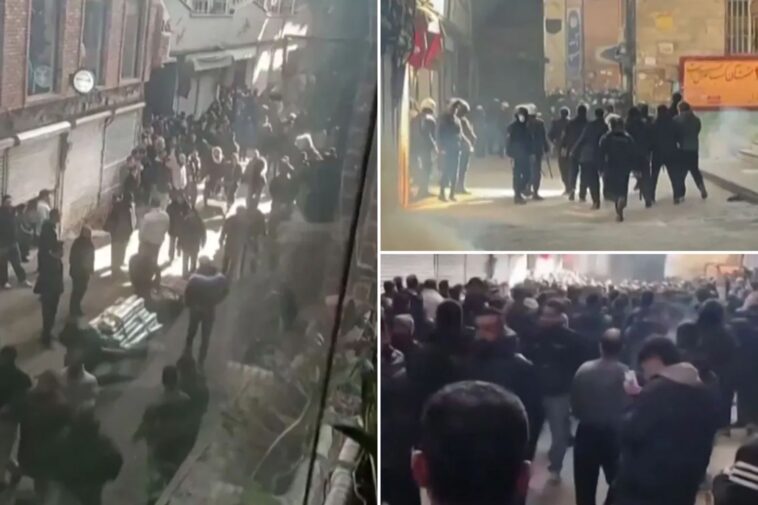
DUBAI, United Arab Emirates — Protesters angry over Iran’s ailing economy conducted a sit-in Tuesday at Tehran’s Grand Bazaar, witnesses said, with security forces ultimately firing tear gas and dispersing demonstrators as the rest of the market shut down.
The protest at the Grand Bazaar, the beating heart for centuries of both Iran’s economic and political life, represents the latest signal that the demonstrations likely are to continue as the country’s rial currency fell to a record low Tuesday. Already, violence surrounding the protests has killed at least 35 people with authorities detaining more than 1,200 others, activists abroad say.
Meanwhile, the situation is likely to worsen as Iran’s Central Bank drastically reduced the subsidized exchange rates for dollars it offers to importers and producers in the country. That likely will see merchants pass on price hikes in the coming days for goods directly onto consumers, whose life savings already have dwindled over years of international sanctions targeting the Islamic Republic.


Iran’s reformist President Masoud Pezeshkian, while ordering a government investigation into one incident involving the protests, otherwise signaled Tuesday the crisis may be rapidly moving beyond the control of officials.
“We should not expect the government to handle all of this alone,” Pezeshkian said in a televised speech. “The government simply does not have that capacity.”
Turmoil shakes Grand Bazaar
In the Grand Bazaar, a labyrinth-like warren of covered passages and alleyways, demonstrators sat down in one passage in front of security forces as other shops nearby shut down on Tuesday, online videos showed and witnesses said. Other demonstrations similarly have seen people sit down in front of police after a photo circulated earlier of a man seen sitting alone in front of security forces.
Authorities later fired tear gas to disperse the protesters. Iranian state-run media did not immediately acknowledge the incident, which has been common in the days since the demonstrations began on Dec. 28.
Iran has faced rounds of nationwide protests in recent years. As sanctions tightened and Iran struggled after a 12-day war with Israel in June, its rial currency collapsed in December, reaching 1.4 million to $1. Protests began soon after, with demonstrators chanting against Iran’s theocracy.

On Tuesday, $1 traded at 1.46 million rials, a new low, with no signs of slowing. Prior to Iran’s 1979 Islamic Revolution, the rial was broadly stable, trading at around 70 to $1. At the time of Iran’s 2015 nuclear deal with world powers, $1 traded for 32,000 rials.
Exchange rate change points to more pain coming
More pain may be coming for Iranian consumers. Iran’s Central Bank in recent days greatly reduced a preferential, subsidized dollar-rial exchange rate. Iran’s government offer that rate to importers and producers to try to ensure the flow of food, medicine and other essential goods despite international sanctions over its nuclear program and other issues.

However, many of those firms took advantage of the difference in rates, pocketing ever-greater profits as normal Iranians watched their savings rapidly lose value against the dollar. That’s led to the Central Bank drastically reducing that rate.
The currency and rate depreciation has directly impacted what’s available in stores — and at what price. The average bottle of cooking oil just doubled in price, the state-run IRNA news agency reported. Many have complained about shelves being empty in stores, likely as suppliers and merchants fear selling cooking oil at a loss. Cheese and chicken prices also spiked, while imported rice hasn’t been available in some shops.
Start your day with all you need to know
Morning Report delivers the latest news, videos, photos and more.
Thanks for signing up!
Pezeshkian in his speech blamed inflation, sanctions and other woes for causing the depreciation — and warned tougher times may be coming.
“If we do not make realistic decisions, we ourselves will push the country toward crisis and then complain about the consequences,” he warned.
Iran promises Ilam investigation
Late Monday, Pezeshkian assigned the interior ministry to form a special team for a “full-fledged investigation” of what had been happening in Ilam province. Protesters in Malekshahi County in Iran’s Ilam province, some 515 kilometers (320 miles) southwest of Iran’s capital, Tehran, were killed as online videos purported to show security forces firing on civilians.

The presidency also acknowledged an “incident in a hospital in the city of Ilam.” Online video showed security forces wearing riot gear raiding a hospital, where activists said they were seeking demonstrators.
The hospital assault drew criticism from the U.S. State Department, which in Iran’s Farsi language called the incident “a crime.”
“Storming the wards, beating medical staff and attacking the wounded with tear gas and ammunition is an clear crime against humanity,” a post on the social platform X read. “Hospitals are not battlefields.”


A report by the semiofficial Fars news agency earlier alleged without offering evidence that demonstrators carried firearms and grenades.
Ilam province is mainly home to the country’s Kurdish and Lur ethnic groups and faces severe economic hardship.
Protester deaths a focus of Trump
The U.S.-based Human Rights Activists News Agency offered the latest death toll of 35 for the demonstrations. It said 29 protesters, four children and two members of Iran’s security forces have been killed. Demonstrations have reached over 250 locations in 27 of Iran’s 31 provinces,
The group, which relies on an activist network inside of Iran for its reporting, has been accurate in past unrest.
Fars, believed close to Iran’s paramilitary Revolutionary Guard, reported late Monday that some 250 police officers and 45 members of the Guard’s all-volunteer Basij force have been hurt in the demonstrations.
The growing death toll carries with it the chance of American intervention. U.S. President Donald Trump warned Iran on Friday that if Tehran “violently kills peaceful protesters,” the United States “will come to their rescue.” Supreme Leader Ayatollah Ali Khamenei on Saturday said “rioters must be put in their place.”
While it remains unclear how and if Trump will intervene, his comments sparked an immediate, angry response, with officials within the theocracy threatening to target American troops in the Mideast. The comments took on new importance after the U.S. military on Saturday captured Venezuelan President Nicolás Maduro, a longtime ally of Tehran.