
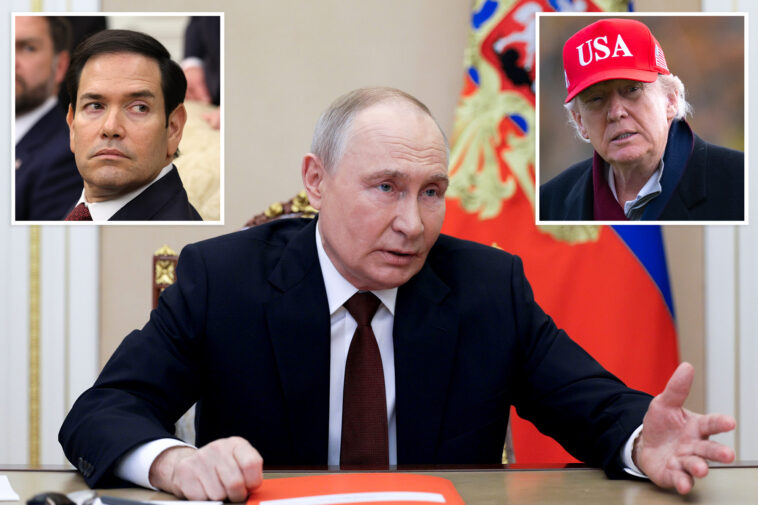
WASHINGTON — Secretary of State Marco Rubio insisted that the controversial, Russia-friendly 28-point Ukraine War peace plan was authored by the US, despite a group of senators suggesting otherwise, and the European Union raising concerns.
“The peace proposal was authored by the U.S. It is offered as a strong framework for ongoing negotiations,” Rubio claimed on Saturday. “It is based on input from the Russian side. But it is also based on previous and ongoing input from Ukraine.”
Questions had swirled after the blueprint emerged last week — with experts noting how it appeared to have been translated from Russian to English.

Then, on Saturday, reports emerged from a bipartisan delegation of senators — including Sen. Mike Rounds (R-SD) — that met with Rubio Halifax International Security Forum in Canada, claiming that the Secretary of State informed lawmakers the 28-point blueprint was really Russian wishlist.
State Department spokesperson Tommy Pigott flatly denied claims that the plan was crafted by the Russians, calling it “blatantly false.”
However, Pigott did not provide an explanation for the confusion.

The controversial 28-point plan would have war-torn Ukraine make dramatic concessions, including ceding the entirety of the Donbas region, which the Russians have been unable to fully take over by military force for over a decade.
Ukraine would also have to commit to never joining NATO, slimming down its military force from roughly 900,000 to 600,000 personnel and give amnesty to everyone involved in the war — meaning that Russians couldn’t face war crime claims.
Critically, the Russian side would make very few concessions, per the plan.
Key EU members quickly raised apprehension about the plan, which had reportedly been developed by special envoy Steve Witkoff, in consultation with both Ukrainian and Russian officials.
“Any credible and sustainable peace plan should first and foremost stop the killing and end the war, while not sowing the seeds for a future conflict,” European Commission President Ursula von der Leyen said in a statement Sunday.
She laid out three main criteria for a peace deal to end the war.
“First, borders cannot be changed by force. Second, as a sovereign nation, there cannot be limitations on Ukraine’s armed forces that would leave the country vulnerable to future attack and thereby also undermining European security,” von der Leyen said.
“Third, the centrality of the European Union in securing peace for Ukraine must be fully reflected,” she continued. “Ukraine must have the freedom and sovereign right to choose its own destiny. They have chosen a European destiny.”
Poland’s Prime Minister Donald Tusk raised concerns about who authored the 28-point plan.

“Together with the leaders of Europe, Canada and Japan, we have declared our readiness to work on the 28-point plan despite some reservations,” Tusk posted on X. “However, before we start our work, it would be good to know for sure who is the author of the plan and where was it created.”
Notably, after President Trump’s meeting with his Ukrainian counterpart Volodymyr Zelensky last month, the US president publicly called for ending the war along the current battle lines.
White House press secretary Karoline Leavitt stood by the plan during a press briefing last week.
“President Trump has made it very clear since day one, and even on the campaign trail, that he wants to see this war come to an end. He has grown increasingly frustrated with both sides of this war, Russia and Ukraine alike, for their refusal to commit to a peace agreement,” she said last week.
“It’s a good plan for both Russia and Ukraine, and we believe that it should be acceptable to both sides, and we’re working very hard to get it done,” she said.
Zelensky has publicly raised concerns about the concessions the plan asks from Ukraine.
“We are facing one of the most dangerous periods in Ukrainian history, a choice between losing our dignity and freedom and losing US support,” he said, per a translation. “We choose dignity. My answer is my oath of office. I did not betray Ukraine in Feb 2022 and we won’t betray in now.”