
TERNIVKA, Ukraine — This quaint coal-mining town roughly 30 miles from the frontlines in Eastern Ukraine is bustling with life — when it’s not under direct attack by Russian forces.
There’s a sushi restaurant with a bright neon sign begging passersby to come in, and trendy cafés and coffee shops line the hardened streets.
All this new growth comes despite 5,000 of its residents — roughly a sixth of its entire population — evacuating Ternivka since Russia’s full-scale invasion in 2022.
While others fled the risk of war, about 10,000 more refugees have come into the town. The influx of people, mainly a wave of miners from central Donbas, has created an unlikely population boom amid the expanding battlefield.

“Everyone has a place to stay. Everyone has a job. Taxes are paid. The city is living,” Ternivka’s deputy mayor Taras Tarkovski told The Post.
Asked how the town adapted to the influx of new life, Tarkovski said: “War doesn’t ask.”
But many of its neighbors have been turned to ruins. Just 15 miles away from the Donetsk Oblast, where Russian forces are occupying between 80 and 85% of the territory, other towns have been reduced to nothing.
It’s that reality — that a peace deal ceding territory to Russia would also cede the lives of 200,000 Ukrainians living in those towns and villages — which makes Ukrainians resistant to such an agreement.
“Just imagine we give them [the Donbas cities of] Kramatorsk, Sloviansk — it only makes Russians come closer to us, and this area will become what we described as ‘dead cities,’” Tarkovski said. “How do you tell someone who is from Kramatorsk, who is fighting now, ‘OK man, we will give this place, this area, your homeland, to Russians, but it’s gonna be a peace.”
“They cannot be trusted. The Russians have betrayed us over and over. They lie; there is no international law for them — they don’t respect it. And they won’t stop there.”

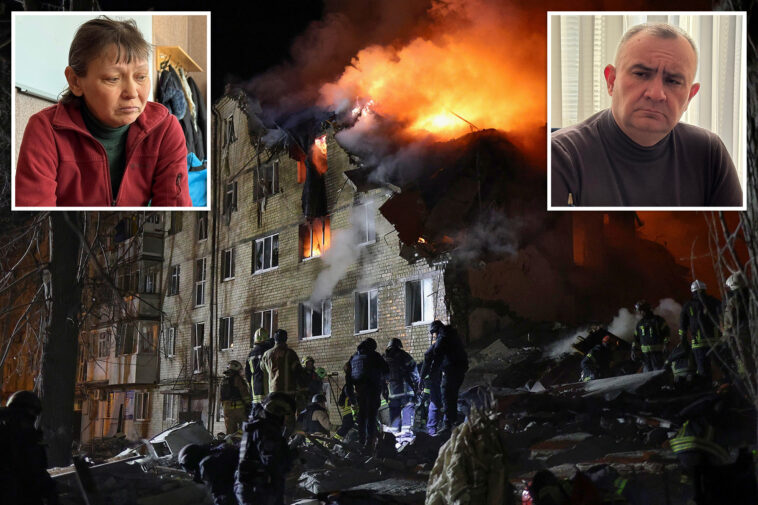
Though the town buzzes with energy, Ternivka’s citizens are regularly under attack. Just last month, 12 miners were killed, and 16 were injured when Russia struck a bus taking them to work at the local DTEK coal mine.
Still, Tarkovski has no intention of evacuating his city should the fighting draw closer.
“I will be here until the last moment,” he said, noting his elderly mother lives nearby. “But I will stay there till the end because it’s my land, and I want to stay in my land.”

Kostia Yaremenko for NY Post
Refugee Alla Ryabtseva, 57, once thought the same about her home near Dobropillia in Donetsk Oblast — before Russians took it over. Now, she winces to think about the lives of her friends and loved ones back in her hometown.
“In my mind, my town is blooming,” she said. “But for the moment, my settlement is temporarily occupied. I cannot even imagine what life is like there now. I cannot even imagine. I don’t want to.”
Contact is limited with people inside occupied Ukraine, but escapees have reported stories of rape, forced labor, executions and Russian “re-education” — all horrors that brought tears to Ryabtseva’s eyes with the thought of it happening to her neighbors.

On the prospects of a deal that would trade Donetsk for peace, Ryabtseva became animated.
“Why should we give anything?” she said, noting the Ukrainian military is “defending so courageously the land.”
“Just imagine: You’re living; you’re building a life with plans for the future. You raise children. You’re doing your job, and at some stage, someone decides to invade — to attack you, to kill you,” she added.
“Why should we give to someone what belongs to us. Imagine if that happened with my neighbor, and he comes to my yard telling me how to live and what to do. Sorry, but no.”

Other Ukrainians, including a 55-year-old woman named Ivanna who was staying in a shelter in nearby Pavlohrad after evacuating from home in Dobropillia, Donetsk, are less defiant. Now in its fifth year, the war has made many feel powerless — and hopeless — about the future.
“What can we do? Nothing depends on us,” she said of discussions of trading her hometown for peace with Russia. “The missiles and drones explode, flying above, whistling and can get you anytime.”
“The only positive thing in Dobropillia was to go to these humanitarian points where you charge your phone, take a shower and talk to other people who still stay,” she said.

Ukrinform/Shutterstock
That was her life for the past four years, she said, before making the decision to leave the home she was born in — and her beloved dogs and cats — after her husband died of natural causes this year, leaving her alone in the barren town.
Now, she is waiting for her adult son to take her to live with him in Kyiv, where she will become yet another of the millions of refugees displaced in their own country, waiting for Russia to go back home.
“We don’t need this war,” she said.