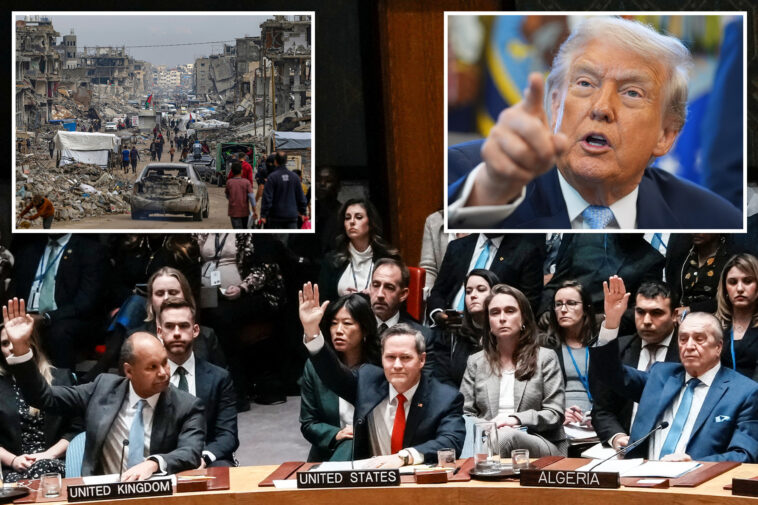
The United Nations Security Council voted to adopt President Trump’s peace deal on Monday, and establish an international force to govern and secure the Gaza Strip.
The Security Council resolution officially backs Trump’s so-called Board of Peace to form a transitional government for the Gaza Strip, as well as establish an International Stabilization Force (ISF) to handle security and oversee the disarmament of Hamas.
The vote came as the White House denied reports in Israeli media that the US was backing away from its commitment to force the terror group to lay down its guns and rockets.

“This is fake news… President Trump’s administration is committed to a demilitarized, deradicalized, prosperous, and self-governing Gaza supported by broad regional participation,” Anna Kelly, a Natrional Security Council spokeswoman, said.
How exactly that will be achieved remains to be seen as Hamas refuses to give up its weapons and Israel remains opposed to any agreement that would set a pathway toward a Palestinian state — the same disagreements that have caused all previous cease-fire deals to collapse.
The lack of a clear path forward suggests that the current situation in Gaza could remain frozen in place for the foreseeable future, said Colin Clarke, a counter-terrorism expert at the New York-based Soufan Group.
“I think things in Gaza are still as fragile as ever,” Clarke told The Post, adding that the first phase of freeing all the hostages may be as far as the deal ever gets.

Under the terms of Trump’s 20-point peace plan, a peace-keeping force would be formed in Gaza to oversee the political transition and reconstruction period.
The US has reportedly been in talks with Azerbaijan, Egypt, Indonesia, Qatar, and Turkey to donate troops for the effort.
Many of the nations, however, have expressed concerns for their soldiers if Hamas refuses to disarm.
The United Arab Emirates, a key power in the region, has declined to provide troops for the effort, with officials stating that they have not yet seen a clear framework for the International Stabilization Force.
“As long as Hamas retains its weapons and continues a low-level insurgency in Gaza, it will be extremely difficult to marshal the forces for an international peacekeeping force,” Clarke, the counter-terrorism expert, said.
“Its militia fighters will be difficult to extract from Gaza’s labyrinth-like underground tunnel structure, and I could see some kind of rump territory within Gaza that functions as an ungoverned territory of sorts,” he added.

With Hamas, Israel, and international forces at odds, Clarke predicted that Gaza would remain permanently divided, with the Israeli military currently occupying 53% of the Strip.
Following the vote at the UN, Hamas said it opposed any plan that would see international forces directly operate inside Gaza.
“The resolution imposes an international guardianship mechanism on the Gaza Strip, which our people and their factions reject,” the group said in a statement.
The vote came after Netanyahu reiterated on Sunday that if the US or ISF failed to disarm Hamas, then the Jewish state would take it upon itself to see the Gaza Strip demilitarized.
Netanyahu’s vow was a direct response to reports in Israeli media that the White House was reportedly backing away from demands for Hamas to disarm, allegations that US officials slammed as “fake news.”
“As the United States’ Resolution under consideration by the UN Security Council conveys, President Trump’s administration is committed to a demilitarized, deradicalized, prosperous, and self-governing Gaza supported by broad regional participation,” National Security Council spokesperson Anna Kelly told The Post.