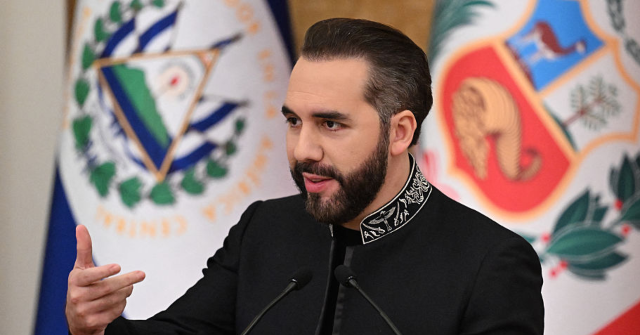
President of El Salvador Nayib Bukele on Wednesday published video footage of Salvadoran forces marching through the streets of Port-au-Prince, Haiti, remarking, “it seems the gangs don’t want to fight us.”
El Salvador recently deployed 2,000 of its troops to Haiti to support a United Nations-endorsed security operation against the deadly Haitian gangs that have intensely terrorized the nation over the past years. The deployment of Salvadoran forces occurred just days after four Salvadoran aircraft technicians were ambushed while inside a military vehicle. The four officials have remained missing since October 18.
On Wednesday, President Bukele published four different videos on his official Twitter and other social media accounts containing footage of the deployed troops in the Haitian capital. The first video, which features no audio, shows aerial drone footage of some of the armed soldiers, while the second video show some of the locals saying clapping at the soldiers and saying gracias (“thank you” in Spanish).
The third video shows a group of locals saluting the soldiers, repeating Bukele’s name while speaking in Haitian Creole, while the fourth video published by the Salvadoran president shows a Haitian man riding a motorcycle who says in Spanish, “Nayib Bukele, that’s my friend, that’s my father,” before thanking him in Spanish.
Bukele accompanied the four videos with a Haitian Creole caption that reads, “It seems the gangs don’t want to fight us,” alongside the Salvadoran and Haitian flag emojis.
The Haitian National Police (HNP) detailed this week that the remains of the military vehicle carrying four missing Salvadoran aircraft technicians were located during a joint security operation alongside Salvadoran forces and the U.N. Security Council-approved Gang Suppression Force (GSF). The technicians are believed to have been attacked by gang members; their whereabouts remain unknown.
The burned vehicle, the police detailed, was found on Monday morning in the Santo commune of Croix-des-Bouquets, located near the outskirts of Port-au-Prince in what the Haitian police described as an operation without any major incident or resistance experienced by the law enforcement forces beyond “some barricades that were removed.” The four missing officials, however, were not found during the operation.
Bukele has threatened to destroy the Haitian gangs if the four missing officials are not safely returned. Monday, November 2, reportedly marked the first “large-scale” operation for the Salvadoran troops deployed in Haiti. On that day, the troops engaged in skirmishes across Plaine du Cul-de-Sac, a location northeast of Port-au-Prince, with the reported goal of dismantling two of Haiti’s most dangerous gangs, Chen Mechan and 400 Mawozo.
On November 2, Wilson “Lanmò San Jou,” Joseph, the leader of 400 Mawozo and a man actively wanted by the FBI, issued a plea to the United Nations, asking for the international body to intercede and mediate with the Salvadoran government. Wilson claimed that his gang did not kill the four missing officials. While the United Nations acknowledged that it received Wilson’s missive, Spokesperson Stéphane Dujarric explained that the reception of the letter does not constitute an endorsement of its contents, “nor an acknowledgment of its author, nor a position taken by the United Nations.”
Hours before Bukele published the four video pieces, the Salvadoran President issued a new message to the people of Haiti written in Haitian Creole in which he affirmed that his nation can help fight the violent Haitian gangs. Bukele stressed that the deployed Salvadoran troops are not “invaders.”
“We can help you beat them, but we are not invaders. We are people just as courageous as you,” Bukele’s message read in part. “We must stand up, take back control of our communities, and bring the people who are making us endure all this pain, all this suffering, under our control.”
“We will be right there beside you. We will help you take back our country from the traitors who betrayed the legacy of [Jean-Jacques] Dessalines,” he continued. “And, finally, Haiti will be free.”
Although Haitian government authorities affirmed this year that the country would finally hold new elections in December 2026, the Provisional Electoral Council of Haiti (CEP) ultimately announced in October that the elections have been indefinitely postponed in light of the continued instability and rampant gang violence in the country.
Although no new date for the elections has been confirmed by the CEP at press time, Le Nouvelliste detailed this week that the electoral officials have reportedly secured $80 million out of the budgeted $120 million for the elections, aiming to tentatively hold a first round on July 18, 2027. Haiti has not held elections since Jovenel Moïse was elected in 2016. Moïse was assassinated in July 2021.
Christian K. Caruzo is a Venezuelan writer and documents life under socialism. You can follow him on Twitter here.