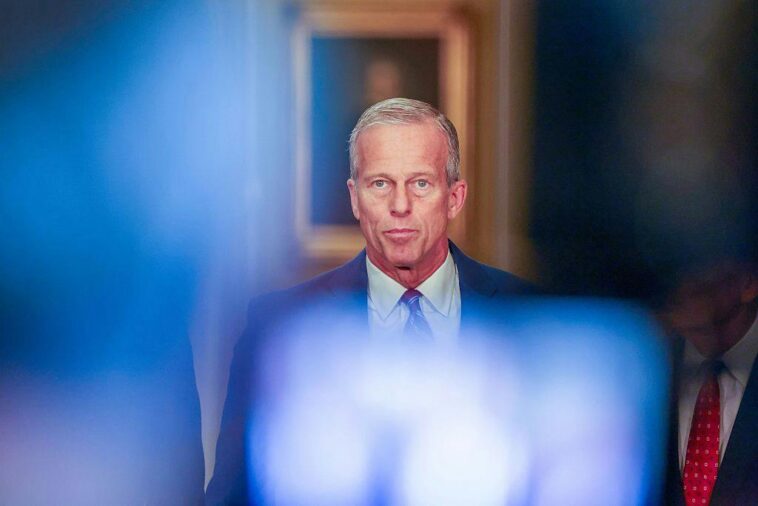
Just before Christmas last year, I sat down with Senate Majority Leader John Thune to reflect on Republicans’ banner year and look ahead to 2026. A lot has changed since. When Democrats clinched a 56-seat Senate majority, many on the Right were quick to blame Thune, largely for his perceived failure to pass the SAVE America Act. But just days after the blue wave hit, Senate Republicans voted to keep Thune on as leader. Perhaps that’s why Thune was all smiles when I returned last week to the Republican Leader’s suite, where one of three working fireplaces greets you with crackle and smoke. As I arrive, Thune is telling his staff that they don’t have to make such strong coffee just because that’s how he likes it — the word “thick” is used a lot. After I try the coffee and assure the staffers it wasn’t too strong, Thune leads me into his office where, flanked by pictures of his grandkids and a portrait of Ronald Reagan, we discuss why Republicans lost, what accomplishments he’s most proud of, and why he’s optimistic about spending two years in the opposition.
***
TIM RICE: Senator, thank you for taking the time to speak with me. There’s a lot to talk about, but I want to start with this: I went back today and listened to the interview that we did basically this time last year. It was right before Christmas. And we started off by talking about how 2025 was the most productive Senate ever, other than one year in the 1970s. And the theme of that interview last year was, basically, that because of the One Big Beautiful Bill, the caucus had a hard time messaging just how much it had done. We’re in a bit of a different place this year. What happened?
JOHN THUNE: Well, that continued to be a problem in the election year. There were live, shiny objects that we got distracted with. There was so much done there, but that’s part of the modern media ecosystem: it’s, you know, what have you done for me lately? And I think that for the American people, there was a lot of stuff in [the OBBA], and we should have been able to kind of, over a period of time, drive a message out there that talked about that. But, you know, the conversation we had, obviously, was before Iran and what happened with fuel prices. And so there were a lot of things that got a little bit overtaken by events, and they’re always things that were outside your control. Those things that were outside of control, they became the focus. The Democrats did a really good job of homing in on that, and hammering it, and I don’t feel like we did a very good job of talking about our record accomplishments, the things that we got done. The Big Beautiful Bill is the most consequential piece of legislation that we’ve done in my time in public life, going back to my days in the House. It was the first meaningful entitlement reform in three decades … newborn accounts, school choice, childcare credits. I mean, it was a farm bill. And so, the challenge you have, of course, is once it’s in the rearview mirror, it was like, okay, now what are you doing for me? And I think when 2026 started and Iran became a very relevant political issue — particularly as it pertained and translated into the economy and how it impacted, most specifically, fuel prices. That’s just one of those things that you didn’t really, wasn’t within your control. But I mean, I still think in 2025, as you pointed out, we cast more votes than any Senate in history with one exception, which was 1976, and we’re in more hours. And 2026, you know, built on that. We did a lot of good things in 2026, some of which didn’t get all of that much attention, but the road housing bill was transformational legislation, something that’s been backed up for a long time. Russia sanctions got a big bipartisan vote. We got the Protect College Sports Act, which is sitting in the House right now, 77 votes for that. I hope I’m gonna get 70 tomorrow on permitting reform, which would be a major legislative accomplishment, too. So it’s not like we haven’t been busy. And then there’s this notion that somehow we’ve ignored the courts. If there’s a judge anywhere who’s been nominated, we’re putting them in the queue and processing them. The same thing is true with executive branch nominees. But the change we made last year [allowing certain nominees to get processed in groups], has been, I think, incredibly effective in ensuring that the president has his team in place, and that the ranks of the nominated but not confirmed is always around single digits.
TR: If last year’s challenge was that the Big Beautiful Bill made it hard to message on accomplishments. On March 20th you wrote an op-ed titled “The SAVE America Act Is Just Common Sense.” But you’ve also said it’s just common sense that you couldn’t get it passed. And then, faced with the external forces of the White House and the conservative activist class, this just became the drumbeat. And, you know, I think a lot of people think that was unfair to you and to Senate Republicans, but to you especially. What do you have to say about that?
JT: Well, I mean, I think that you’re right. We put it on the floor. It was on the floor for over two weeks in March. And, you know, when it became clear that we obviously weren’t going to get any Democrats to vote for it, but notwithstanding that, we did have seven different votes. We voted on it in all different permutations on it. You know, the entire SAVE Act was: photo ID to vote, citizenship to register, ban on mail-in voting, no boys in girls sports, and no trans surgeries for minors. That was the president’s Save America Act. He wanted them to vote on it. So we had that vote twice, and we didn’t even get all Republicans on that. We got, I think, 48, partly because there are a lot of Republican states now who have adopted mail-in balloting, and didn’t want to ban it. And so that version of it failed. Well, then we put photo ID to a vote on the floor as a rifle shot, and every single Democrat voted against it. We did photo ID and citizenship to register maybe twice. And then the most recent time, we did a photo ID to vote and the insider training ban, the STOCK Act. So we tied those two together on the last one, but seven times now, we have voted on photo ID to vote. Every single time, every single Democrat voted no. I think what happened, unfortunately, is that there were false expectations created about what was achievable. And I made it pretty clear from the beginning that we weren’t gonna get Democrats to vote for this. So then it’s like, okay, well, then you can nuke the filibuster. Pass it with 51. And it was also made pretty clear that wasn’t gonna happen. We didn’t have the votes for that, either. And instead of accepting that reality, and yielding to the very clear arithmetic that surrounded that issue, everybody just started attacking me or attacking Senate Republicans, the Senate leadership. And he started creating this Republican rift. And that was unfortunate, because we were going to an election year, and the last thing you want to do in an election year is have an intra-family fight. And unfortunately, we have a lot of people out there who continue to feed this narrative that somehow that it’s the Senate’s fault that we haven’t passed this — even though it was very clear from the get-go that we didn’t have the vote. And then there’s a paid influencer world out there. And a lot of keyboard warriors who adopted this issue got a lot of clicks and eyeballs and raised a lot of money by attacking Republicans. And I just think that if you’re playing a team sport, one thing you don’t do is attack your fellow team members, especially going into a big game.
TR: How decisive do you think that sort of family fight was in what happened on Election Day?
JT: I’m not going to say it wasn’t a factor for some voters, perhaps, but I think most voters get that Republicans didn’t vote. And if you look at history, this was, I think, with one exception going back to 1914, the biggest turnout ever in a midterm election, Democrats were motivated to vote. Republicans, maybe not quite as much as they normally are, so it was down a little bit. But the place we got crushed, as I pointed out, is among independents. Independents now represent a third of the electorate. They were a third of the electorate this time, according to exit polls. And according to exit polls, we lost that third of the electorate in every single one of the targeted Senate races, and in some of them, by more than 30%. So we lost Texas, Kansas, North Carolina, South Carolina, by over 30%, among independent voters. You cannot make that up with Republicans. So the idea that somehow, you know, Republicans were depressed or didn’t turn out because we didn’t pass the SAVE America Act, there were Republicans who, according to exit polling, said they didn’t like the war. They didn’t like fuel prices, they didn’t like inflation. And so I think it’s a combination of things. I am not saying it wasn’t out there, but I’m just saying it wasn’t a determining factor. You know, I traveled a lot with candidates the last few weeks. I travel in my state all the time. You might get an occasional somebody say, “What about the SAVE Act?” But as a general rule, that wasn’t a top-of-mind issue for people. And frankly, it wouldn’t have made any difference in this election. A lot of the races we lost had really strong voter ID laws. You have 36 states who have it. So [illegal voters] didn’t decide this election. But there are people who want to continue that narrative, if you will, because it shifts the blame to us, instead of, maybe, where it should be.
TR: Yeah, that’s a good point. And it’s notable that this is what we would call a very online phenomenon in a lot of ways, right? Obviously, all of the data points that you just pointed out suggest the truth of that fact. Another major data point that suggests people really weren’t as mad about the SAVE Act as the internet said, is that you very handily won reelection as Republican leader. Congratulations, by the way. Senator James Lankford (R-OK) said it’s because nobody else wanted the job. Is that true? Or did you try to get somebody to take the cross from you?
JT: You know, maybe after a while, maybe somebody emerges, but it was pretty clear coming out of it [that no one else wanted the Republican leader job]. And I think, to be fair — with all the incoming you take, especially now you’re taking fire from all sides, I think people look at it and say, “do I really want to do that for the next year?” So, yeah, it’s a job that nobody else wants. I’m not sure how I should take that [laughs]. But I feel like in a lot of ways for me, it’s a calling, and I think I have something to contribute and offer. And I’ve always felt like you want to be in a position where you can make a difference. And it seems to me, at least, that this is the place. Now, it would have been much better to have continued in the majority, but now we’ve got the opportunity to draw the contrasts and make sure the Democrats don’t end up doing things that are going to put the country in a ditch. And so it’s gonna be up to us to be the opposition party now, to figure out where areas where we can do some things together — obviously, if it’s important to the country — but also to ensure that that the far-Left DSA wing of the Democrat Party doesn’t succeed in changing the direction of this country in a way that we can never come back from.
TR: You mentioned the far-Left Democrats. Unlike Republicans who, again, reelected you as leader, there is already a fight brewing across the aisle. [Maryland Senator] Chris Van Hollen is going to just challenge [Senate Minority Leader] Chuck Schumer. [Vermont Senator] Bernie Sanders is in the mix [endorsing Van Hollen. What do you think this says about where Democrats are, and what do you think it says about the prospects for any kind of bipartisanship in the 120th Congress?
JT: Well, I hope what comes out of that isn’t — I mean, if they bend to the far-Left wing of their party, and it is kind of the ascendant, dominant wing now, the progressive Left, not only in the country, but here in the Senate, that is a really dangerous path for us. So I hope that the more moderate elements, to the degree that they exist — I have a definition of a moderate Senate Democrat, somebody who’s always with you when you don’t need them — and so I hope that particular wing, doesn’t get to the point where they’re dictating or driving the agenda for the Democrats. If they do, they will have completely misread what happened [on Election Day]. Now, they had a big win, but I think what the American people were clearly saying is we should have been listening more to them. And internalizing the message was, we want you to focus. I have to focus on the economy, on jobs, wages, cost of living, and things like that. And instead, if they perceive this election outcome as, “gee, we want you to socialize everything in this country,” I think that will be a misinterpretation, an overreach, and one that’ll enable us to really draw the contrast, because it’s not where the American people are. The American people didn’t vote for the Democrats. They rejected us because we weren’t talking to them. And especially those independent voters, who decide general elections, which they did in spades this time. I mean, if you look back in the 2022 elections, you lost these by two points. And like I said, in all those key Senate races where we were, you know, we had places like Kansas and Texas, North and South Carolina, Georgia. We were losing the independents by over 30%. You just can’t make that up. So this idea that if the Republican Senate had done this or done that, it would have been a different outcome. I mean, there were things that were not within the control of the Republican Senate, including the war, and inflation and gas prices and tariff policy and all that, which were, in many cases, issues that people voted on. So I think you have to get to a place where you diagnose the problem and then come up with a prescription for fixing it.
TR: Do you think the White House and the president’s messaging on things like Iran and tariffs and inflation and affordability, did that hamstring Republicans, both on the Hill and up and down the ballot?
JT: Well, I think the lack of a clear message on those issues hurt all of us, whether you attribute that to the White House or all of us. But there were things out there that are hard to explain. If you say, okay, the war in Iran and closing of the Strait of Hormuz has constricted the global supply of energy, and therefore the price has gone up. That is something that’s frankly not within the control of the Republican senators. But I do think that we have an obligation to try and pivot, talk about things that we are doing, that are going to move the country in the right direction. And I think that the policies we put in place will create an economic environment for people in this country that long-term is going to be incredibly beneficial. I think the tax policy, the regulatory policy, the energy policy — if we do this permitting reform, for example, there’s still a lot of things here that I think set the country up for success, but it was all kind of hypothetical. And you’ve got to play the long game to appreciate that. And the immediate concern was “I don’t like what’s going on with this war in Iran. I don’t like what it’s doing to my fuel prices.” Couple that with tariff policies that people perceive to be driving up the cost of imports, and some of the trade policies with respect to beef and corn and soybeans, things like that. It wasn’t any one thing, but yeah, for sure, it came back to economic issues, pocketbook issues, which is what we need to keep our eye on.
TR: It’s one thing for an opposition party to oppose, right? It’s pretty, pretty straightforward how you do that: you vote no on the excesses. But President Trump is in the White House for two more years. How does the caucus plan to legislate? What are the plans for the active role? Stopping Democrats is important, but how do you plan to enact things?
JT: You want to stop the extreme, radical impulses of the Democrats, particularly the DSA wing of the party. But if there are Democrats who want to work with us, for example, on some things that we need to address. AI is a good example — SI, sorry.
TR: We’ll edit that out.
JT: [laughs] yeah, don’t want to get a call from the White House. But I think that the issue of data centers, for example, was a huge issue in some states. There were a lot of Democrat campaign commercials attacking public concerns on the issue of data centers. And there was a perception that Republicans were for [data centers], Democrats weren’t. I think dealing with that issue in a thoughtful way, particularly putting the safeguards in place when it comes to super intelligence, how it’s used, and what some of those riskier applications are, is something we need to be involved with. And I’ve got a bill that deals with that. But I think that the White House is going to have to — and the president and his team — engage with Democrats, House and Senate. We will work with them, and we’ll be a willing partner, but in the end, if we’re going to get stuff done, it’s going to have to be things the president’s willing to sign. And I think he’s perfectly prepared to use the veto pen, which he should be. And we should be perfectly prepared to use the 60 vote threshold in the Senate — which now works to our advantage, shockingly! — to stop bad stuff, but then try to identify and figure out those areas where we can work together. There are also some issues with respect to China, and how we ought to be dealing with some of the cyber threats. So I’m saying there are some here, some zones of agreement, I think, if the Democrats are willing not to be crazy. But it’s going to require the president and his team to be able to sit down with them and work together.
TR: So as we get closer to 2028, I know you said that you’re going to remain neutral in the race, and I won’t push you on that. But it’s likely that at least, let’s say, two, maybe more members of your caucus are going to throw their hats in the ring in 2028. In the very likely event that Democrats don’t really want to work with the White House, and the White House doesn’t really seem like it wants to work with Democrats, what’s your answer when one of your members comes to you and says, “we need to start breaking with the White House, or there’s no way we win in 2028.”
JT: Probably the biggest motivation in politics is self-preservation. I think that most senators have a pretty good sense of their home states and what it takes to win there. And I think, you know, even this time around, I said [to senators running in the midterms] you need to do what you need to do. You know your state. And obviously, nobody believes that any senator is going to agree with the White House, the president, 100% of the time. You know, pick and choose your times when it’s important to your state. But to the degree that we can, I think we’re always better when we’re working as a team and where we’re united. And so the core set of values, principles that unite Republicans, we shouldn’t lose sight of. And so if Democrats go down a path, for example, where they want to socialize everything — well, that’s completely at odds with our belief in limited but effective government, personal freedom coupled with individual responsibility, economic freedom, free markets, free enterprise, that you achieve peace through strength, that you protect life in all forms. Those are core Republican values. And if Democrats start going down a path that leads us into the Left ditch, I think we have to stand up and fight. But we will find out, I think fairly quickly, whether or not there are areas in which they want to work with the president. But the president’s very ready to use his veto pen. And we’ll find out soon enough what the posture of the Democrats is going to be as you look at 2028, knowing full well that there are going to be people on both sides, Republican and Democrat in the Senate, they’re going to be running for that. I think there’s probably a good handful of Democrats who very likely could be in that race, too.
TR: You just mentioned a number of things — peace through strength, free markets, limited government — increasingly, Republicans can’t take for granted that Republicans hold those values. And certainly Republicans who are going to try to run in 2028, are going to be a little critical of capitalism. They’re critical of anything that smacks of a forever war. How do you manage that dynamic? What do you do when the call is coming from inside the house?
JT: I think that on a policy level, there’s a real tendency in the country right now to respond to this sort of populist yearning. The Democrats capitalized on this, again, because they have the advantage of $7 diesel, which I think is — sometimes you get a mood in the electorate that’s just really hard to overcome. And I do think that you will find, probably, yes, there are areas where you’re finding Bernie Sanders agreeing with, you know, [Missouri Republican Senator] Josh Hawley, or whomever on our side of the aisle on a particular issue. So there’s this sort of realignment, if you will, going on in American politics, but I still think at its core — at least I believe this — I think it’s out there, it’s not usually all that vocal, but that Reagan wing of the Republican Party is still there. And I think that there’s a reckoning going on right now and a conversation going on about, what kind of party do we want to be in the future? And what kind of alternative do we want to offer to the American people? If the Democrats are offering up some sort of European socialism, I still don’t think that’s where the American people are. There’s a wing of that, no question about it, but I still think that the majority of Americans, at their core, believe in some of those basic principles I talked about. What we have to do is show how those translate into policies that are good for them and their families. But I still think that — you know, Ronald Reagan used to say there are no easy answers, but there are simple answers. I just don’t think the government’s going to be the answer. And at some point, people will come to that conclusion, as they have in the past, and you’ll start to see this thing realigning back in our direction. But I think we have to give people a reason to be for us. And that means speaking to their basic needs. And I don’t think we did that well enough in this last election. Hopefully we learn from that lesson.
TR: Alright, parting shot. A lot of people think the world’s going to end today [Wednesday, November 19]. This interview is going to go to print on Sunday. So if the world ends today, no one will ever get to read this. But if the world doesn’t end, what is your message to Daily Wire readers who survived the not-apocalypse?
JT: Well, hang in there. There are better days ahead, and you’ve got allies and advocates who, like you, believe in the greatness of this country, and we’re not ready to tear it down and replace it with some weak version of European socialism. The American tradition, the American way — our heritage, our legacy — those who came before us paved this way so that we could have a better, brighter future for our kids and grandkids, and it’s worked really, really well in a lot of ways. We just have to capture what’s good about it, jettison some of the crazy stuff, and figure out how to work together for the better in the country. In some cases, that may be working with reasonable Democrats. But for sure, it means that we’ve got to articulate a vision, and the policies that support that vision, in a way that makes sense to the American people and speaks to their daily needs.