There is always a reason to go back to the ’80s. The decade carries memory of economic prosperity, cultural enrichment, and technological advancement that made the world feel much more colorful, more aspirational, and, at the same time, much smaller. Of course, I cannot speak from personal experience, having been born in the late ’90s. I grew up in the decades following, where I was just old enough to misunderstand the 2008 housing bubble, became an adult during the polarization of everything, and along with the rest of you, navigate the modern day where technology carries a sense of hostility on par with its most idealistic promises. But even now, the ’80s, an era that ended nearly 40 years ago, has clear staying power in the hearts and minds of millions, even those who were never there. And this is once again proven through the recent resurgence of Pizza Hut Classic, a scattered collection of restaurants that have retained the iconic 1980s look and feel.
The famous chain with the piping hot za and iconic bright red roofs opened in 1958. The roofs came in ’69. But it wouldn’t be until the 1980s that the Hut pushed for the ultimate family dining experience. If you’re reading this, you remember, or maybe you’re just pie-curious. And frankly, so was I. In my adolescence, the world had already long shifted away from the dine-in pizza experience, with over-the-counter and delivery taking over the zeitgeist (well before we had apps that made it that much easier). The reason? Money. Money saved in production, money earned off families staying home. It simply became more rewarding to prep and deliver than to accommodate and serve. Even my local Midwestern chain, Pizza King, seemed to close more franchises than it opened.
But I’d heard tell of the almost-mythic eateries, with elders swearing by the atmosphere and with a fondness recounting birthday parties and team hangouts following hard-fought games. In interviews with former Pizza Hut executives, it’s even revealed that Ronald Reagan’s literacy initiative inspired their 1984 Book It! program, further solidifying the Hut as a gathering place for the community, young and old. So when I discovered an original location only three and a half hours away, I was quick to fill my tank, convince a few friends to join me, and hit the road.
It was overcast on the open road as we dodged and weaved between cars, trucks, and the mountains of Tennessee. Immediately the group began sharing music, cracking jokes, and doing what people do on a road trip — enjoying each other’s company. All of us work in production in one way or another and are all used to chasing the news feed, being terminally online, and locked into often competing narratives about what’s real and what matters. So this, a trip focusing on what obviously doesn’t, was a great reprieve. One I imagine many Americans could use as well.
We saw several landmarks on our way out of Nashville, pointing to the Grand Ole Opry and Nissan Stadium as they passed us by. We progressively left behind the offshoots of modernity, replaced instead with the winding backroads leading into Kentucky. Where small towns had fewer and fewer of the otherwise ubiquitous megastores, where only Dollar Generals were allowed to encroach upon their mom-and-pops. But the Bluegrass State was the shortest leg of our journey, a mere 14 miles before turning back and finding on the edge of Tennessee the silhouette we had been searching for. And as we rounded the building and saw it cast in a single beam of sun, we rejoiced. The Pizza Hut Classic was still bright red and open for business.
The lot was empty except for a few rusted cars, likely belonging to the employees, and the glass was tinted so as not to reveal its inner secrets. Would it be as the elders foretold? Would the pizza taste as good as in memories recounted? Would the location itself change our perceptions? With more questions than answers, we pushed through the single entrance door.
First came the smell of pepperoni and deep-dish crust, the kind that before tasting or seeing you could fully imagine the way it crunched, the glaze of butter practically on your tongue. My eyes adjusted to the warmly lit interior, and I looked at my compatriots, their smiling faces, then smiled myself as I fully took it in.
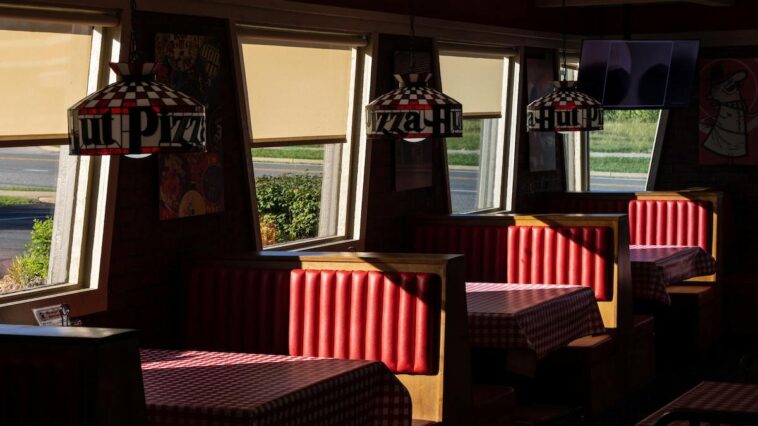
It was a homey space with rows of tables, each covered neatly by white and red checkered tablecloths. Around the edges of the interior were built-in booths made of pristine wood that matched the angularity of the famous roofs and were cushioned in tufted burgundy vinyl. Each table came with napkins, condiments, and a convincingly vintage pair of dredge shakers filled with parmesan and red pepper flakes. Hanging above each was a large stained-glass light, bold black against white and red. “Pizza Hut” was written in curving old-school font around them, and from where I sat at our corner booth, in the back-corner seat, I could read only “Zza,” but it was enough.
“So, deep-dish pepperoni?” I offered the group.
“Oh, yes! And a Meat Lover’s!”
The waiter appeared moments later with four red pebbled plastic cups and a pitcher of water. She placed one in front of each of us, filled them, then before we could speak repeated back, “That’s one deep-dish pepperoni and one Meat Lover’s pizza? Large OK?”
“That’s perfect!” I said, and she left our table with a smile. We’d see her a few more times as she refilled our drinks. And then finally, after 250 miles and a mere 20-minute wait, she brought our food. Two puffed discs with steaming cheese and vibrant slices of pepperoni, the second loaded with bacon, ham, and Italian sausage crumbles.
“Careful with the trays,” the waiter said. “They’re still hot!”
She left behind a triangular spatula, and the more courteous of our group served slices one by one, cheese stretching before snapping in perfect strings. For the first time in our trip, a silence fell over the group. No jokes or stories, no music but for the soft restaurant radio playing “Royals” by Lorde. A few mmms now and again, enough to say the food was well received. And when I finally asked my friends to rate it, there was no hesitation.
“Ten.”
“Ten.”
“Nine … OK, ten.”
Conversation resumed thereafter between slowing bites. I leaned back, full and content, going quiet as my friends carried on. And it was here I think I finally understood why I had wanted to take this journey. The world keeps speeding up at a rate we can barely predict. As systems change and what’s left of our monoculture continues to fray, it’s no small thing to find a place to sit down with the ones you love, to share good food and conversation, to find a dumb reason to drive over three hours both ways. And it’s not even that the ’80s is some mythic place that was better. I can make no such claims, even as so many so confidently do.
But what I experienced is something stranger, a nostalgia I had no right to. Distant and reclusive, yet still reachable. And it was good. In a world obsessed with what matters, it’s trips like these that might matter most.
If you need a starter idea for your own pilgrimage, consider ours. There is always a reason to go back to the ’80s — and you might not be far from a Pizza Hut Classic.
***
Erby Char is the pseudonym of a writer and audio producer whose work ranges across culture, technology, travel, and the strange fringes of modern life. He also writes fiction and designs games. You can follow him on X @ErbyCharWrites.
This article is part of Upstream, The Daily Wire’s new home for culture and lifestyle. Real human insight and human stories — from our featured writers to you.