
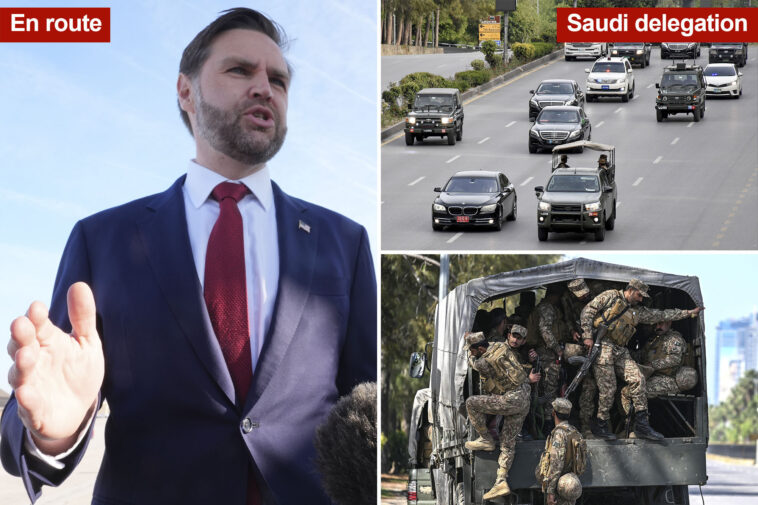
WASHINGTON — Vice President JD Vance boarded Air Force Two early Friday, warning Iran not “to play” the US, ahead of what he expects to be “positive” negotiations in Pakistan to wind down the war.
“As the president of the United States said, if the Iranians are willing to negotiate in good faith, we’re certainly willing to extend the open hand. If they’re going to try to play us, then they’re going to find the negotiating team is not that receptive,” Vance told reporters at Joint Base Andrews.
“So we’re going to try to have a positive negotiation. The president gave us some pretty clear guidelines, and we’re going to see,” he added.


The vice president is leading negotiations for the US with special envoys Steve Witkoff and Jared Kushner in Islamabad.
Meanwhile, the Iranian delegation will include Foreign Minister Abbas Araghchi and parliamentary speaker Mohammad Bagher Ghalibaf, the Wall Street Journal reported.
Ghalibaf warned US negotiators on Friday ahead of peace talks in Pakistan that Tehran was still expecting two conditions to be met.
“Two of the measures mutually agreed upon between the parties have yet to be implemented: a ceasefire in Lebanon and the release of Iran’s blocked assets prior to the commencement of negotiations,” Ghalibaf posted on X.

“These two matters must be fulfilled before negotiations begin.”
President Trump and US officials have declared victory in the more than 40-day war, touting the destruction of most of the Iranian regime’s missile and drone systems.
But Tehran’s closure of global shipping lanes through the Strait of Hormuz has spiked oil prices and delayed the exporting of other critical goods.
A preliminary, two-week cease-fire was agreed to on Tuesday between the US and Iran, premised on the reopening of the strait, through which roughly one-quarter of the world’s seaborne oil passes.
“Iran is doing a very poor job, dishonorable some would say, of allowing Oil to go through the Strait of Hormuz,” the president posted on his Truth Social Thursday night. “That is not the agreement we have!”
Iran has delayed a full reopening of the waterway, and pointed to Israeli strikes in Lebanon against Hezbollah as proof that the cease-fire agreement was not being honored.
The Israelis have maintained that the pause in fighting wasn’t based on their own military actions in Lebanon, though Vance said that the IDF is willing to “check themselves” to let negotiations move forward.
Foundation for Defense of Democracies Executive Director Jonathan Schanzer told The Post that Iran and the US were still “worlds apart” in their messaging on the cease-fire.
“When you look at what the Islamic Republic has published about this, they’re claiming that the United States has capitulated on everything, that there’s going to be sanctions removed, etc.,” he said. “There’s a war of messaging going on right now.”
On Thursday, just nine commercial ships exited the strait — far fewer than the roughly 135 per day that were transiting the Persian Gulf before the war started on Feb. 28.

“You have to look at which countries were able to get ships out. A lot of them had to do with their diplomatic stance, could also be financial as well, but you know, I mean, we know that China was able to get a number of tankers out, the Turks were able to,” Schanzer added.
“These are countries that were in good standing with the Islamic Republic throughout the war. So they may not have been charged as much,” he also said.
“Nobody is going to want to admit that they effectively paid ransom in order to get their oil shipments out of the Strait of Hormuz,” he noted. “I’m not sure the Iranians are gonna admit to shaking everybody down.”