
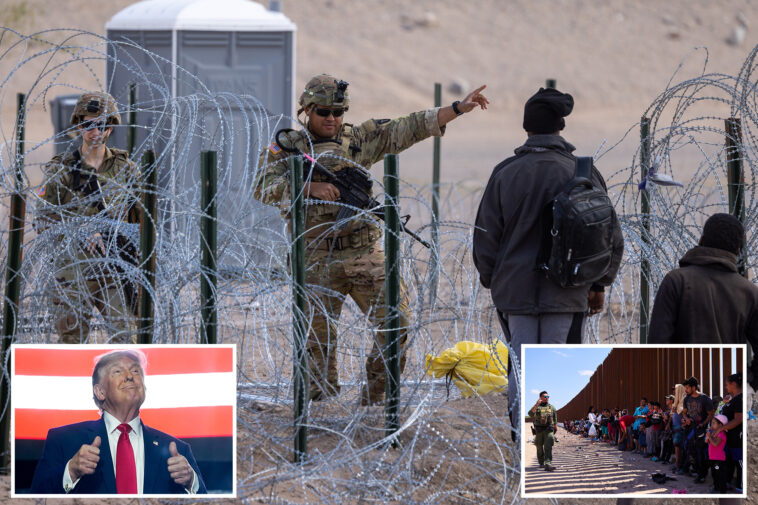

WASHINGTON —The Supreme Court ruled Thursday that the Trump administration can turn away migrants who show up at the US-Mexico border before they apply for asylum, in a victory for the White House’s immigration crackdown that prompted a tense exchange between two justices.
The high court ruled 6-3 in favor of a policy known as “metering,” in use during President Trump’s first term as well as Barack Obama’s administration, which capped the number of people who could apply for asylum each day.
Immigration advocates had argued the policy violated federal law, which states that migrants can apply for asylum after they “arrive” in the US regardless of whether they entered legally or illegally, and claimed that aliens should be considered to have done so once they reached the border.
Conservative justice Samuel Alito disagreed, writing in the majority opinion: “In ordinary speech, no one would say that a person ‘arrives in’ a place—for example, a house, a city, or a country—before the person enters that place.


“The context in which the phrase ‘arrives in the United States’ is used in the immigration statutes at issue here supports an ordinary-meaning reading.”
The administration had argued that the policy was necessary to deal with a massive influx of migrants at the southern border, adding that people who were initially turned away could always come back and attempt to apply later.
To qualify for asylum, migrants must show a fear of persecution in their homeland for specific reasons, like race, religion, nationality, membership in a particular social group or political opinion.

Once granted asylum, migrants are protected from deportation and can legally work, bring in immediate family, apply for legal residency and seek citizenship.

All three Democrat-appointed justices dissented. Justice Sonia Sotomayor took the rare step of reading her dissent from the bench, adding extemporaneously that her colleagues’ ruling “regrettably and tragically extinguishes the light of the torch of the Statue of Liberty.”
“The consequences of today’s decision are predictable,” Sotomayor wrote. “More people will die. More people will attempt to cross the border illegally, and some will make it while others will not. More people will be forced to walk along the U.S.-Mexico border in dangerous conditions, trying to find a port that will inspect them. More people will turn back and be subjected to violence because of something they cannot or should not have to change about themselves … Because this is neither what Congress said nor what its words permit, I respectfully dissent.”
A visibly annoyed Alito rejoined that there “was much he would have added” to the reading of his opinion had he known the Bronx-born jurist would read her dissent and pointed out the policy had been used during two presidential administrations of opposing parties.
“I won’t add anything more to that,” concluded Alito, who finished his opinion by reminding: “”The wisdom of the policy of metering alien arrivals at the southern border is not before us. We decide only that an alien standing in Mexico does not ‘arriv[e] in the United States.’ The [law] neither entitles such an alien to apply for asylum nor requires an immigration officer to inspect him.”
This is a developing story; check back for more updates