
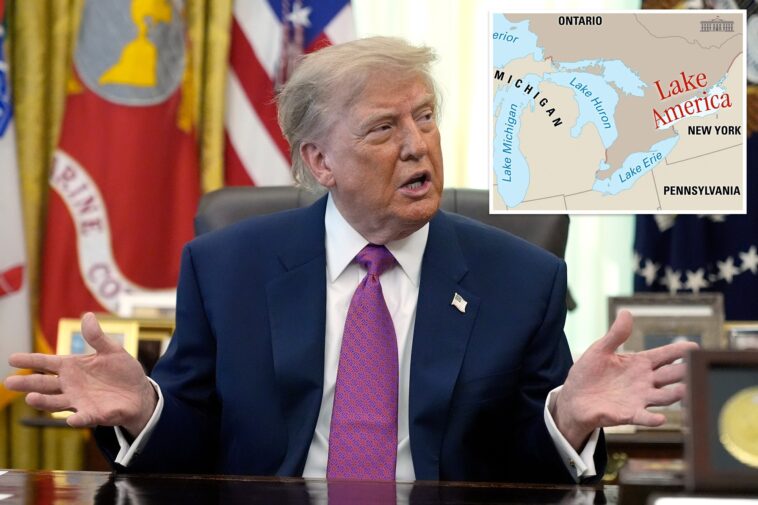

WASHINGTON — President Trump signed documents Thursday ordering that Lake Ontario be renamed “Lake America” — as he and Canadian Prime Minister Mark Carney escalate their tariffs-driven trade war.
“We’re going to be changing the name of Lake Ontario, effective immediately, to Lake America,” Trump told reporters in the Oval Office.
“We filed all the necessary papers, documents, everything else. We notified all of the various people that we have to notify. So we’ve done everything that you have to do, and this is official, effective immediately.”


Trump said that “the Canadian officials have created this very badly. They’re nasty people. They charge our farmers 400% tariffs.”
Trump previously renamed the Gulf of Mexico the “Gulf of America” last year.
“If you think about it, we have a gulf and we have a lake. Now, all we need is an ocean. So maybe we’ll have to change the name of the Atlantic and/or the Pacific,” Trump said.
Carney broke off trade talks with the US on Friday and claimed that “America is trying to break us so that they can own us,” but that so long as he was in charge it would “never, ever happen.”

Trump imposed a new 50% tariff Saturday on $20 billion of Canadian goods, including beer, cheese, wine, hockey sticks, cement and electronics.
He also threatened to hike tariffs to 50% on all vehicles, automotive parts and steel coming from Canada.
Carney vowed to fight back with retaliatory tariffs beginning on Sept. 8.

Canada’s population of 41 million is about 12% the size of the US and its economy is much smaller, meaning it would disproportionately feel the effect of a trade war.
More than 70% of Canada’s exports go to the US and about half of its imports come through its southern border.
The US is much less reliant on Canada, with about 14% of US exports going to Canada. Canadian goods amount to about 11.5% of overall American imports.

Vice President JD Vance visited Maine on Monday and hammered Carney.
“Canada is a country that has underinvested in its military that quite literally would get invaded by a foreign country were it not for the umbrella of protection provided by the United States,” Vance said.
“Canada allows itself to be used as a backdoor for Chinese goods. They treat Chinese goods more fairly than they do [those] that come from the people of Maine.”

The trade fight could have a disproportionate impact on US border states.
“We produce a lot in Maine — our blueberries, our potatoes, our lobster, our lumber — that is processed across the border,” Sen. Susan Collins (R-Maine) told News Center Maine. “If it comes back with a huge tariff on it, perhaps as much as 50 percent, that increases the cost of eating, building homes and merch[andising] our best-known products.”