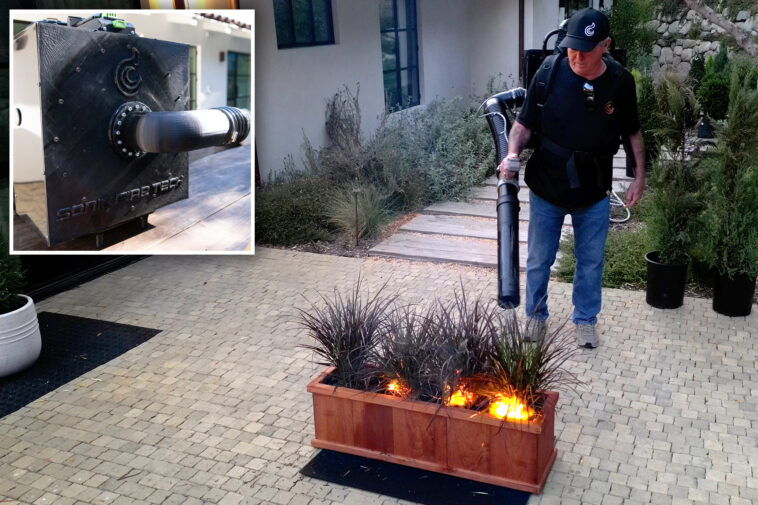
The sound you can’t hear might just save your house.
It sounds like something out of a sci-fi blockbuster, but firefighters in California are firing up a fascinating new way to fight flames — with sound waves.
The San Bernardino County Fire Department recently showed off a futuristic system that detects and extinguishes flames without water or chemicals.

Instead, it uses powerful — but completely silent — sound vibrations to snuff out the fire itself.
The red-hot technology, inspired by NASA experiments and developed by Sonic Fire Tech, works by first spotting flames with infrared sensors and AI.
Once a fire is detected, the system instantly releases specially tuned sound waves aimed right at it.
It isn’t magic, it’s physics, said the developers.
“For a fire to burn, you need three things — fuel, heat and oxygen,” Remington Hotchkis, chief commercialization officer at Sonic Fire Tech, told the Post. “Sound waves vibrate the oxygen faster than the fuel can use it, and break the chemical reaction of the flame.
“The system uses thermal detectors to sense the flame, or conditions for the flame and initiates the acoustic defense.”

The flame fizzles out in seconds.
During a live demo on March 31, firefighters at the San Bernardino County Fire Department tested the device, which is worn like a “Ghostbusters” Proton Pack-type backpack, and showed how the technology could extinguish trouble before it grows.
And firefighters loved it.
“If you keep a fire small because it was detected right away, that’s going to save money, that’s going to help insurance rates,” said Ryan Beckers of the San Bernardino Fire Dept.
The fire-fighting technology could be a game-changer, especially in wildfire-prone areas and inside homes by helping stop small sparks from turning into full-blown infernos, Sonic Fire Tech explained.


Unlike traditional methods, it won’t soak buildings with water or leave behind chemical residue.
The system’s low-frequency infrasound is harmless to humans and household pets.
In fact, some newly built homes in Altadena, Calif., are already starting to include the at-home system, which begins emitting sound waves instantly when its sensors detect fire.
“Wildfire danger isn’t abstract for me, it’s personal,” said Hotchkis. “When my former home in Altadena burned in the Los Angeles fires … I saw firsthand that it wasn’t the wall of flame that destroyed homes, it was the embers. In that moment I realized that this part of the global wildfire crisis is solvable.”
Hotchkis joined forces with Geoff Bruder, the company’s co-founder and CEO, who had worked at NASA’s Glenn Research Center in Cleveland, where he and a colleague invented a new type of thermo-acoustic engine that could generate power on planets like Venus.

Bruder left NASA in 2015 to develop and market his thermo-acoustic engine for putting out wildfires.
The January 2025 California wildfires killed at least 31 people, forced more than 200,000 to evacuate, destroyed more than 18,000 homes and structures, and burned more than 57,529 acres of land.
The National Safety Council assessed the civilian fire death toll at 3,920 in 2024, up 6.8% from the 3,670 total in 2023.
While the new tech is not ready to replace fire hoses just yet, Sonic Fire Tech said it is working to commercialize the technology for home defense to replace water sprinkler systems while doing demos of their backpack systems to fire departments nationwide.