
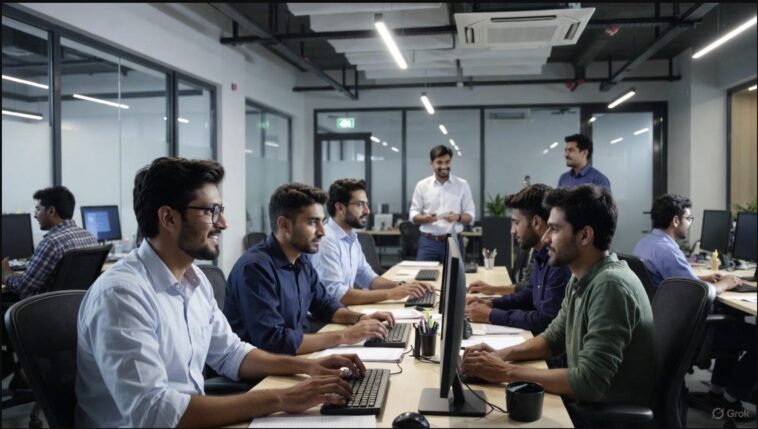

A Saturday Fox News segment and the subsequent burst of viral posts on X have reignited the fight over America’s highly controversial H-1B visa program, placing renewed attention on visa fraud, fake academic credentials from India, low-wage foreign labor, and the growing anger among American STEM graduates who say they have been sold out by corporate America.
The segment focused heavily on H-1B filings tied to India, counterfeit-degree scandals, and claims from a former US consular officer who said she encountered widespread fraud while reviewing applications years earlier. The controversy comes as Republican Rep. Chip Roy of Texas pushes legislation designed to overhaul what many describe as one of the most abused white-collar immigration programs in the country.
🚨JUST IN: A massive H-1B visa fraud ring just got exposed in India.
Nearly 90% of applications contained fake information.
Over 100,000 counterfeit degrees were seized.
This scam has been insane.
Time to shut it down.🔥
HT @EricLDaugh pic.twitter.com/8liHisS0kk
— Commentary Donald J. Trump Posts From Truth Social (@TrumpDailyPosts) June 6, 2026
According to figures highlighted in the segment, nearly 7 million H-1B-related filings have been processed since 2015, with roughly 70% tied to India and 12% tied to China. Those numbers, for America First conservatives, show that the program has become less about attracting rare, elite talent and more about a mass foreign-labor pipeline.
The segment also cited reporting on former US diplomat Mahvash Siddiqui, who alleged that 80 to 90 percent of H-1B applications from India she reviewed involved fraudulent documentation or unqualified applicants. That allegation reflects Siddiqui’s account of consular work from 2005 to 2007, not a current official finding about all Indian H-1B applications.
Still, the claim has struck a nerve because it reinforces a broader fear among Americans, namely that the H-1B system is riddled with weak verification, credential abuse, and corporate incentives to look the other way.
The Fox segment also revived scrutiny of fake-degree scandals in India. One of the most prominent involved Manav Bharti University, which investigators previously linked to the alleged sale of tens of thousands of bogus degrees.
A 2021 South China Morning Post report said investigators found the university had sold around 36,000 fake degrees for as little as $1,362 each, prompting immigration restrictionists to argue that fraudulent credentials can become a gateway into jobs, universities, and visa channels when American enforcement is weak.
Another case cited in reporting involved Kerala Police seizing more than 100,000 counterfeit certificates linked to 22 universities. While those documents were not H-1B visas, it shows how large-scale academic fraud can feed into immigration, employment, and credentialing systems.
The renewed scrutiny comes as federal wage data undermines the usual corporate talking point that H-1B visas are reserved for the best and brightest. DHS data cited in a federal rulemaking notice showed that from fiscal years 2020 through 2024, 28 percent of H-1B cap-subject petition receipts were tied to wage level I and 55 percent were tied to wage level II.
In other words, most of the program’s cap-subject petition receipts were not in the highest wage tiers, confirming that companies are not primarily using H-1B to hire extraordinary geniuses, but to fill ordinary white-collar jobs with cheaper or more controllable labor.
That is the heart of the America First argument against the program. If employers truly faced a shortage of elite talent, they would pay elite wages.
Instead, companies use H-1B workers to expand the labor supply, hold down salaries, and replace or bypass American graduates who took on debt to study computer science, engineering, mathematics, and other technical fields.
Roy’s American White-Collar Worker Jobs Act of 2026 seeks to replace the H-1B lottery with a wage-based selection system. It would also require employers to show good-faith efforts to hire American workers first.
The bill would block companies that recently conducted layoffs from hiring H-1B workers. It would also end the use of H-1B visas as a pathway to permanent residency and eliminate the Optional Practical Training program, which allows many foreign students to work in the United States after graduation.
“For its nearly forty-year history, the H-1B visa has been abused, allowing employers to routinely sideline American STEM workers in favor of cheap foreign labor, while masking layoffs and wage suppression as ‘shortages,’” Roy said.
“It’s time to end this lottery-based pipeline and replace it with a system that prioritizes merit, enforces real wage standards, and puts American white-collar workers first,” he added.
The bill directly addresses one of the biggest betrayals of the American middle class. Young Americans were told to study STEM, take on loans, work hard, and prepare for the jobs of the future, only to discover that many of those jobs were being opened to a global—mostly third-world—labor pool.
The result has been predictable: weaker bargaining power, lower wage growth, fewer entry-level opportunities, and a generation of American graduates forced to compete against foreign workers whose visa status often ties them closely to employers.
That dependence is one reason why the H-1B system is so attractive to large corporations. A young American worker can quit, negotiate, or move freely; a visa-dependent foreign worker may be far less likely to challenge the employer controlling his legal status.
The damage is especially severe in entry-level technology roles. If companies can fill junior and mid-level positions through visa pipelines and foreign-student work programs, American graduates may never get the first job they need to build a career.
The rise of AI, of course, has exacerbated this problem for young American workers.
Federal enforcement has already intensified. Reports cited “Project Firewall,” a Labor Department initiative tied to alleged H-1B fraud, involving roughly 200 active investigations into possible violations of the specialty-occupation visa program.
The Labor Department has also begun using secretary-certified investigations, which can proceed without a formal worker complaint when officials claim reasonable cause to believe an employer may be violating the law. That’s significant because visa workers may fear retaliation, and American workers often never know why they were passed over.
North Texas has become one of the biggest battlegrounds in the debate. Federal data showed thousands of H-1B approvals across Dallas, Tarrant, Denton, and Collin counties since 2020, involving major employers, universities, consulting firms, school systems, and technology companies.
The Dallas area reportedly received nearly 32,000 new H-1B approvals during the Biden administration, topping Silicon Valley, Seattle, San Francisco, and Washington, D.C., according to a Bloomberg investigation cited in the source material. Only the New York City metro area ranked higher.
The inflow helped reshape suburbs north of Dallas, including Frisco, Prosper, and Celina. Collin and Denton counties became among the fastest-growing large counties in the country, while the Indian-born population in Collin County rose sharply.
In Frisco, the Indian share of the population reportedly grew from around 6% in the early 2010s to nearly 20% by the mid-2020s. Builders even tailored homes to Indian buyers, including north-facing prayer rooms and spice kitchens.
But the same visa-fueled boom is now cooling as Trump’s crackdown and mass tech layoffs hit overheated markets. Collin County home prices fell nearly 9% year-over-year as of February, more than double the broader Dallas-Fort Worth decline.
More than 52,000 tech jobs were cut in the first three months of the year, and by early summer 2026, tech-sector losses had reportedly surpassed 123,000. At the same time, artificial intelligence, outsourcing, and H-1B policy changes have added pressure across the industry.
America should not be importing white-collar workers by the tens of thousands while American tech workers are being laid off and young graduates are struggling to get hired.
Trump’s administration, to its great credit, has already raised minimum salary thresholds for H-1B workers, imposed new fees, and moved the program toward prioritizing the highest-paid applicants. In September 2025, Trump signed a proclamation imposing a $100,000 fee on new H-1B petitions, a measure aimed especially at staffing firms and mid-tier contractors.
The administration also directed the Department of Housing and Urban Development to bar non-permanent residents, including H-1B visa holders, from accessing FHA-insured mortgages beginning May 25, 2025. Data from John Burns Research and Consulting showed FHA loan volume to non-permanent residents falling from 6% in April to less than 1% by June, and to nearly zero by late summer.
The electronic H-1B registration system has also come under scrutiny. Federal data reportedly showed one individual was registered by different companies 83 times in a single fiscal year, while more than 9,000 individuals had more than five registrations each.
A Bloomberg analysis estimated that roughly 15,500 visas, about one in six awarded during the period examined, were obtained by staffing firms allegedly colluding to manipulate the lottery system. That kind of gaming of the system proves the lottery is likely beyond repair.
Texas officials have also entered the fight. Gov. Greg Abbott ordered a freeze on new H-1B petitions by state agencies and public universities in January, while Attorney General Ken Paxton launched an investigation into suspected fraud and abuse involving nearly 30 North Texas businesses.
The housing fallout shows how deeply the visa system has shaped local economies. Some H-1B-linked homeowners who lose jobs have only 60 days to secure a new employer sponsor before their visa status lapses, creating pressure to sell quickly.
Real estate agents in North Texas say the phones that once rang with eager buyers now increasingly ring with sellers trying to cut losses. Some clients are reportedly absorbing monthly rental losses while waiting for the market to recover.
Those who support the H-1B program argue that the program helps American companies access global talent. But opponents answer that a country with thousands of unemployed or underemployed STEM graduates does not need a corporate-run guest-worker system suppressing wages in the name of “shortages.”
If there are real shortages, employers should raise pay, train Americans, recruit domestically, and invest in the next generation of US workers. They should not be allowed to use immigration policy as a wage-control mechanism.
The fight over H-1B is therefore not just an immigration debate but a fight over whether America’s high-tech economy belongs first to American citizens or to multinational corporations searching the world for cheaper labor.
Roy’s legislation, Trump’s enforcement push, and the Fox segment have forced the issue back into public view. The central question is no longer whether the H-1B system needs minor reforms.
The question is whether the United States should continue a visa pipeline that critics say undercuts American graduates, depresses white-collar wages, rewards outsourcing firms, and hands corporate America a tool to avoid hiring its own people.
The answer, for worker-first conservatives in America, is increasingly clear: end the cheap-labor racket, protect American STEM graduates, and put American workers first.
Ad block users: Some site features may not work correctly while an ad blocker is enabled, because they break scripts and content this website depends on. If you can’t see comments below, for example, please disable your ad blocker.