See more of our coverage in your search results.

Death claims for people who suffered from 9/11–related illnesses have officially shattered a grim milestone — 10,000 — as cancer cases linked to the toxic dust mount, The Post has learned.
According to the October report from the September 11th Victim Compensation Fund, 10,029 deceased claims have now been filed for people who suffered from 9/11-related illnesses — a 1,544% increase from 610 such claims at the end of 2015.
“That’s an amazing and really horrifying and heartbreaking statistic,” said lawyer Michael Barasch, who represents about 50% of the 9/11 claimants. “But I have to tell you that number is likely thousands more.”

The federal fund has approved 6,397 deceased awards as of November, including 5,997 involving cancer, the data show. Cancer appears in 93% of all deceased award decisions, according to the fund.
The gap between claims filed and awards approved reflects the lengthy review process, which can take more than a year, Barasch said.
Barasch’s firm has nearly 2,000 cases that are “trapped somewhere between the courthouse and the federal claims system,” his firm said. Surrogate’s courts must approve claims filed on behalf of a deceased person’s estate, a process that can also take more than a year.


“I speak to people every day, and it’s shocking to me how many people still don’t realize that they are eligible,” said Barasch, who worked in the contaminated area and was himself diagnosed with 9/11-related prostate cancer.
Thousands of emergency workers participated in recovery efforts on the pile at Ground Zero after the attacks, while hundreds of thousands of people lived or continued working nearby after the EPA announced that the air in New York City was safe to breathe, Barasch said.
People exposed to the toxic dust and debris may qualify for the funds and health care that were made available by the Zadroga Health and Compensation Act in 2010.

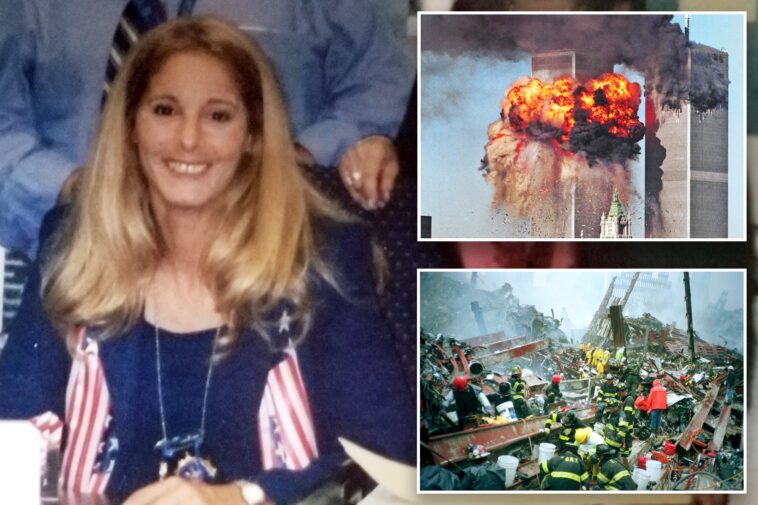
Former Manhattan Family Court clerk Christine Sakoutis had just come into the city from Staten Island when the first plane struck that morning.
The 63-year-old, who receives benefits through the program, ran toward the towers, she said.
“When the first building fell, there was this big cloud,” she said. “It was very black and you couldn’t breathe.”

She worked for the next 10 days, helping on the pile and then going to a nearby aid center, she said. The following year she received awards for her heroism from the court system and her union.
But in 2017, she fell gravely ill.
“I went to the doctor,” she said. “They found a spot and I ended up with 9/11 lung cancer.”

Her doctors removed the tumor and gave her chemotherapy, and she’s been almost cancer free since.
“I’m exceedingly lucky,” the Staten Island resident said. “They caught my cancer early so it was curable.”
Doug Mandelkow lost his dad — FDNY fire inspector James Mandelkow — to esophageal cancer in 2013, six months after he was diagnosed.

His father worked at a phone bank in lower Manhattan after the attack calling FDNY members’ families to inform them about their loved ones during recovery efforts.
When he learned he had cancer, he was reluctant to pursue benefits from the fund because he hadn’t worked on the pile, his son said.
“He was working wrongfully under the assumption that it was only the pile that mattered,” the son recalled. “At the end of the day, he acknowledged that the whole area was sick.”

James Mandelkow was just 54 when he died.
“The fact that that number is unfortunately going up every year is heartbreaking,” his son said. “The best thing would have been to be honest and up front about it that the air was toxic in 2001, but that’s not the reality.”