
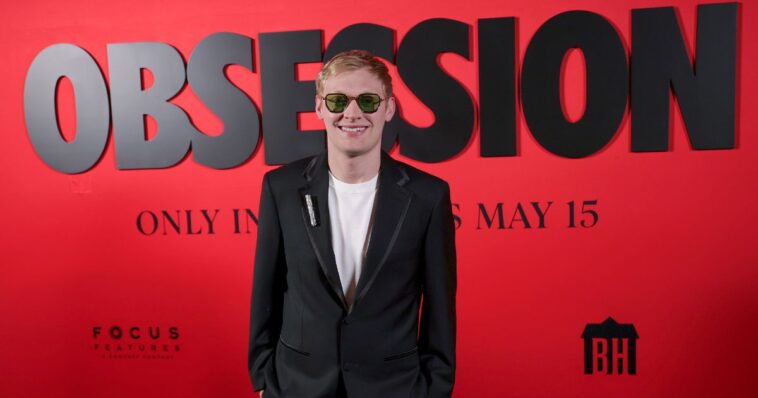

Curry Barker attends the Los Angeles Special Screening of his film “Obsession” at the Hollywood Legion Theater in Los Angeles on May 11, 2026. (Frazer Harrison / Getty Images)

By Bryan Chai June 10, 2026 at 6:00am
Hollywood has spent years operating under a fairly simple assumption: Bigger is better. Bigger budgets. Bigger stars. Bigger special effects. Bigger franchises. In fact, if a studio can spend $200 million on a movie and attach it to an existing intellectual property, all the better.
Which is what makes the success of “Obsession” so fascinating. According to Forbes, the horror-romance film was produced on a reported budget of just $750,000 — a rounding error by most Hollywood standards.
Yet, the movie has suddenly found itself at the center of the cultural conversation and box office success while major studios continue pouring fortunes into sequels, reboots, spin-offs, and adaptations that audiences increasingly seem content to ignore.
(Did anyone really need a sequel to “The Devil Wears Prada”?)
Now, to be clear, this is not necessarily an endorsement of the film itself. Horror movies are not everyone’s cup of tea, and reasonable people can disagree about whether entertainment built around demonic themes is worth consuming in the first place.
But the movie’s remarkable success does raise an interesting question: Why has this particular film connected with audiences when so many far more expensive productions have struggled to do the same?
Before we get to those why’s, a quick synopsis of “Obsession” (light spoiler warnings): A young, awkward man struggles to tell his lifelong crush how he feels about her, despite having numerous opportunities to do so. Instead, he finds an item that will supposedly grant a wish. In classic monkey paw-style wish-making, the young man wishes for his crush to reciprocate his feelings. What he gets instead is a darkly obsessed and jealous version of his crush, and things spiral violently and grotesquely out of control from there.
(If you like cats, I would actually highly recommend avoiding this film.)
Suffice it to say, this is not a lighthearted date-night movie. But that’s almost besides the point.
The actual takeaway should be less about the movie itself and more about what its success says about the current state of Hollywood. After all, “Obsession” wasn’t supposed to be one of the biggest stories in entertainment this year. It wasn’t based on a beloved franchise, didn’t have a nine-figure marketing budget, and wasn’t backed by a major cinematic universe.
Yet audiences showed up anyway. The question isn’t whether everyone should watch “Obsession.” The question is why so many people did.
The first reason may also be the simplest: “Obsession” is something audiences rarely get these days — an original idea.
Modern Hollywood has become increasingly dependent on sequels, reboots, remakes, adaptations, and cinematic universes. Every year seems to bring another revival of a decades-old property that nobody was particularly asking for. That’s not to say sequels are inherently bad; some are excellent.
But audiences appear to be growing weary of being served the same intellectual property over and over again. Love it or hate it, “Obsession” offered viewers something they hadn’t seen before, and that novelty alone made it stand out in a crowded marketplace.
The second reason is one that Hollywood executives may find more difficult to hear: “Obsession” isn’t a political movie.
It isn’t trying to make a statement about contemporary social issues. It isn’t interested in lecturing its audience, signaling virtue, or picking sides in America’s endless culture war.
The film simply tells its story and trusts audiences to come along for the ride.
In an era where many entertainment products seem determined to remind viewers of whatever political debate is currently dominating social media, there’s something refreshing about a movie that remains completely focused on its premise. Whether you’re conservative, liberal, or somewhere in between, sometimes people simply want two hours of escapism.
Finally, the film’s reported $750,000 budget may have been an advantage rather than a limitation.
For years, Hollywood has operated under the assumption that more money automatically produces a better product. Yet audiences increasingly seem exhausted by endless CGI spectacles where every scene feels like a computer-generated fireworks display.
A smaller budget forces filmmakers to rely on creativity, storytelling, atmosphere, and practical effects instead of throwing visual effects at every problem. Ironically, by lacking the resources to become another bloated blockbuster, “Obsession” may have ended up feeling more authentic and memorable than many films that cost hundreds of times more to produce.
None of this necessarily means Hollywood needs to abandon big budgets, familiar franchises, or even political storytelling altogether. Audiences are more than capable of embracing those things when they’re done well.
But the unexpected success of “Obsession” does suggest a quieter shift in what people are responding to right now: originality over repetition, storytelling over signaling, and constraint over excess. In a media landscape increasingly defined by algorithmic predictability and franchise fatigue, even a modestly made, unconventional film can break through simply by feeling different.
The broader lesson may be less about horror movies specifically and more about attention itself.
Viewers are not a monolith, and they’re not easily fooled by scale or spectacle alone. Sometimes they just want something that feels new, focused, and unapologetically committed to its own premise. If Hollywood is paying attention, the success of a $750,000 film shouldn’t be treated as an anomaly, but rather a guiding star.
I’m not going to hold my breath.
Advertise with The Western Journal and reach millions of highly engaged readers, while supporting our work. Advertise Today.
Bryan Chai has written news and sports for The Western Journal for more than five years and has produced more than 1,300 stories. He specializes in the NBA and NFL as well as politics.
Bryan Chai has written news and sports for The Western Journal for more than five years and has produced more than 1,300 stories. He specializes in the NBA and NFL as well as politics. He graduated with a BA in Creative Writing from the University of Arizona. He is an avid fan of sports, video games, politics and debate.
Birthplace
Hawaii
Education
Class of 2010 University of Arizona. BEAR DOWN.
Location
Phoenix, Arizona
Languages Spoken
English, Korean
Topics of Expertise
Sports, Entertainment, Science/Tech