Forward Guidance Gets a Nobel at Dusk
The Royal Swedish Academy of Sciences, acting on the recommendation of its Economic Sciences Prize Committee, has honored the godfather of forward guidance just as central bankers are putting his most famous policy prescription into retirement.
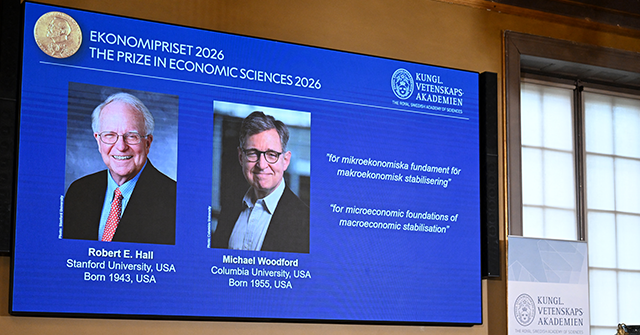
On Monday, Columbia University economist Michael Woodford shared the economics prize with Stanford University’s Robert Hall for their work on the foundations of economic stabilization. Both have made important contributions to economics and are inarguably deserving of the high honor. Woodford helped develop the New Keynesian framework that became the common language of academic macroeconomics and central banking.
Coming five months after Kevin Warsh took over the Federal Reserve and began abandoning forward guidance, it’s hard not to see the decision to give the award to the godfather of forward guidance as an implicit rebuke to the new chairman. The committee has bestowed the profession’s highest honor on the man whose work inspired the policy Warsh is officially laying aside. Its members can hardly have missed the contrast.
The End of the Age of Forward Guidance
Yet the award may also mark the closing of an era. To put it philosophically, Hegel tells us that the owl of Minerva flies at dusk: understanding arrives when a form of life has grown old. The economics profession may be celebrating forward guidance just as its practical importance is fading.
In his 2005 paper “Central Bank Communication and Policy Effectiveness,” presented at the Kansas City Fed’s Jackson Hole symposium, Woodford explained how central bankers could influence economic activity by changing expectations about future policy.
The case for forward guidance is especially compelling when interest rates reach zero and the economy remains weak. At that point, a central bank is in a quandary since it cannot effectively provide more stimulus by lowering rates. Woodford’s work showed that a credible promise to keep rates low well into the recovery could encourage investment and spending immediately. The central bank could provide additional stimulus even after exhausting conventional rate cuts.
At the time, the concern was more theoretical for the U.S. and Europe. But then the global financial crisis saw central banks plunging their policy rates toward zero and struggling to keep their economies from sinking into a depression. The Fed adopted forward guidance as official policy. And in the nearly two decades after the crisis hit, forward guidance became a regular feature of monetary policy, and markets learned to scrutinize each statement for clues about decisions months or years ahead.
Warsh has acknowledged its usefulness in that emergency. His argument is that the practice outlived the conditions that justified it.
Promises about future rates can inhibit necessary changes when new information arrives. Warsh has pointed to the possibility that forward guidance delayed the Fed’s response to inflation in 2021. He also worries that markets dominated by Fed signals become less useful sources of independent information for policymakers.
These are substantial objections to making an emergency instrument part of everyday central banking.
Warsh Has Company
The European Central Bank has reached a similar conclusion. At its Sintra conference in June, President Christine Lagarde described forward guidance as something the ECB had set aside. Decisions would be made meeting by meeting, guided by incoming data.
“In times of uncertainty, forward guidance loses its value,” she said.
The ECB continues explaining its policy framework. It has stepped away from promises about the future path of interest rates. Its September policy statement reiterated that it was making no commitment to a particular rate path.
Pierre-Olivier Gourinchas, then the outgoing chief economist of the International Monetary Fund, likewise told Reuters in June that moving away from strong forms of forward guidance was “entirely appropriate.”
Warsh’s position belongs to a wider reassessment of monetary policy after the inflation shock. In normal times, when central banks can raise or lower rates, the need for additional stimulus through promises diminishes. And uncertainty makes those promises harder to keep and potentially more costly.
Woodford deserves recognition for explaining why future policy matters today. Warsh has good reason to question whether the Fed should keep promising that future.
The Nobel can serve as forward guidance’s swan song. The Warsh era has just begun.