
The Weekly Wrap: It’s the End of Everything
Is it Friday yet? We regret to inform you that this will be the final edition of the Breitbart Business Digest Weekly Wrap. Under orders from the new DSA masters of Capitol Hill, the old wrap will be replaced with a They/Them DEI Communique. At least until we are assured that the co-authors of this newsletter have been preemptively pardoned for the hate crimes of reporting on the American manufacturing boom, highlighting the best labor market that has ever existed, and defending President Trump’s trade policies.
Let’s proceed with caution and respect but only after more diverse voices than our own have spoken.
The Midterm Blu-Nami
The Democrats beat expectations in the midterm elections this week, taking back the House and the Senate and trouncing Republicans in state governments in traditionally Republican states. As JD Vance pointed out, lots of Trump voters made it to the polls and then voted for Democratic candidates.
The Dems flipped at least seven Senate seats: Kansas, Iowa, Texas, Ohio, Maine, North Carolina, and South Carolina. Alaska and Mississippi are still uncalled. That will leave the Democrats with a majority of at least 54 and perhaps 56 (counting the phony independents who always vote with the Dems). Republicans might have as few as 44 Senate seats, the lowest post-election total since the GOP had just 41 following the financial crisis and Obama’s election of 2008. Prior to that, you have to go back to the 1990 Bush midterms and Clinton’s 1992 victories to see that few GOP senators.
Losing seven Senate seats is pretty bad but not altogether that rare and certainly not a record. Republicans took nine seats in 2014, Democrats took eight in 2008, Republicans took eight in 1994, Democrats took eight in the 1986 midterm, and Republicans took 12 in the Reagan election of 1980. The 2006 midterm saw the Democrats gain six seats, and the 2010 midterms saw Republicans gain six.
For what it’s worth, across the 20 midterm elections from 1946 through 2022, the average Senate swing in either direction was 4.7 seats, and the median was 3.5 seats. Counting both gains and losses, the president’s party lost an average of about 3.6 seats. In the 13 midterms when the president’s party lost Senate seats, the average loss was 6.3. The president’s party gained seats six times and broke even once.
In the House, the Democrats flipped at least 43 Republican-held seats, and the Republicans flipped one or two Democrat seats. At least it wasn’t a shutout! There are dozens of races still uncalled, so perhaps Republicans will do slightly better when all the votes are counted.
This was also worse than an ordinary midterm setback for Republicans. Across the 20 midterms from 1946 through 2022, the president’s party lost an average of about 26 House seats, with a median loss of 22. The largest losses were in 2010, when Democrats lost 63 seats; 1946, when Democrats lost 56; and 1994, when Democrats lost 54. In Trump’s first midterm election, Republicans lost 41.
That’s all pretty depressing if you are a Republican or someone who roots for them. If there’s a silver lining here, it is that only two of the Republican senators who lost were elected incumbents—Susan Collins in Maine and Roger Marshall in Kansas. Collins, of course, was famously a squish, and nobody knows enough about Marshall to remember his politics. The guy in Ohio was appointed to his seat when JD Vance was elected vice president, and Darline Graham somehow inherited her seat when her brother died. Iowa, North Carolina, Michigan, and Texas were open seats. So, yay for the power of incumbency! It could have been even worse without it.
What Went Wrong for the Republicans?
The consensus among political scientists for decades has been that the biggest variable influencing midterm elections is the popularity of the president. Gallup’s 2018 analysis found presidents under 50 percent lose an average of 37 House seats, versus about 14 above 50 percent. But there’s so much variability, and the sample size is so small, it would be a stretch to call that a rule or something that can be used to reliably forecast future elections.
Going into the midterms, President Trump’s approval rating was subpar, around 38 percent according to the New York Times average of polls. That’s below his 2018 midterm approval rating of 44 percent and very close to Bush’s 2006 rating. That made it likely the GOP would lose the House, but it doesn’t explain the wipeout in the Senate and the size of the House victory.
The White House has put out its theory of why the results were worse than expected: the war with Iran.
“The reason we lost is the war. The president himself said so last night,” Vice President JD Vance wrote on X. “If you’d like to argue it was worth it, that losing the Senate for the next 6 years was worth it, then do so. Argue it was a worthwhile cost to pay. Agree or disagree, that’s at least honest.”
When asked about Vance’s theory, President Trump described it as “largely true.” Which makes sense, since Vance made it clear in his post that he was articulating what the president had said on election night. And it’s highly unlikely Vance would make a public declaration like that without consulting the president.
What’s more, both the pre-election polling and the exit polls back this up. As we explained yesterday, the president’s approval rating took a significant hit a few months after the start of the war when it became clear that the war would last longer than anticipated and that high gasoline prices would also stick around. It was a kind of double-betrayal of the promise of Donald Trump to bring about an era of peace and energy abundance. NBC’s exit polls showed that about 74 percent of voters said the war was a “crucial or major” factor in their vote, and 63 percent of them voted for Democrats.
If anything, that likely undercounts the drag of the Iran war. Famously, affordability was the top concern of many voters, and gasoline played a huge role there. In September, the consumer price index rose 0.6 percent compared with August. Gasoline, which rose 9.1 percent in the month, accounted for around 56 percent of that increase. On a year-over-year basis, gasoline’s 34.2 percent increase was responsible for around one-third of the total increase of 3.7 percent in the CPI.
Even that understates the drag of gasoline. Gasoline is one of the most salient prices in terms of politics and consumer sentiment because almost no other price is encountered so frequently. While you might buy a new computer every few years and a new couch every decade, gas tanks get filled every week. Even when you aren’t filling your tank, prices are displayed prominently on roadside signs. And purchases of gasoline cannot be put off or avoided the way purchases for other products can.
This idea scandalized certain corners of the Republican Party. The Wall Street Journal described this as Vance’s “break with Trump.” Vance was accused of a “stunning act of disloyalty” by Washington Post columnist Marc Thiessen. And those were among the gentler reactions. Many of the folks scandalized by the Trump-Vance theory bizarrely went on to blame tariffs for the loss.
Let’s not pass over just how weird it is for people who think blaming the Iran war is a betrayal of the president—even though he agrees—to blame the election losses on Trump’s signature economic policy. Trump believes in fossil fuel extraction, tax cuts, and deregulation—but those are standard Republican positions with which he agrees. Tariffs are the defining issue of Trump’s policy views—and have been for as long as he has been a public figure. He supports tariffs with a deep and unwavering conviction. The only thing that may come close is immigration restriction—but even there he’s less dogmatic. If you are attacking tariffs, you are attacking Donald Trump.
More importantly, the contribution of tariffs to inflation and affordability pales in comparison to the contribution of gasoline. The work of Mary Amiti of the New York Fed and her cabal of anti-tariff economists implies that the tariffs added around 0.6 to 0.8 percentage points to CPI at the peak—way back in February. By August of this year, tariffs had stopped adding to inflation at all. To claim that tariffs drove affordability concerns more than the price of gasoline is a triumph of innumeracy in the name of ideology.
The Greatest Jobs Economy Ever
Today’s jobs report showed private payrolls rising by 159,000 and the unemployment rate falling to 4.1 percent last month. Harvard’s Jason Furman pointed out on X that the unemployment rate has been at or below 4.5 percent for 60 straight months, a record in statistics going back to 1950. As we’ve pointed out many times, jobless claims are at their lowest level since 1969.
Durable goods manufacturing added 25,000 jobs in October, crushing estimates for basically zero growth. Weekly wages—average hourly earnings times average hours worked—are up 6.9 percent year-over-year for durable goods production workers. Hourly wages for construction workers are up 5.2 percent.
What’s more, the household survey shows a hiring wave that the payroll numbers understate. People are coming off the sidelines and into full-time jobs, and fewer of them need a second job. Household employment is up 1.44 million since July, with usual full-time workers up 1.54 million.
The Coming Cartelization of AI
The market had a wild week, especially the tech sector. On the day after the election, investors appeared to have decided that the obvious animosity of voters to data centers would be bad for the hardware folks and good for the hyperscalers. It would slow down the data center arms race that was seeing the likes of Google, Amazon, and Meta burn through their cash and turn to debt markets.
That’s quite extraordinary. If those companies agreed on their own to slow spending, it would be a conspiracy in restraint of trade that would likely violate antitrust laws. But if politicians force a slowdown, it’s perfectly legal. Basically, investors were anticipating the cartelization of AI at the hands of regulators.
On Thursday, however, it dawned on investors that this probably would not be good in the long run for these companies. The entire premise of the investment race was to produce bigger returns in the future. Further government control of that investment and its deployment was likely to hinder innovation and hold down financial returns.
Even worse, it became clear that the Democrat AI agenda wasn’t just about slowing down data center development but freezing AI in place and seizing control of the means of production.
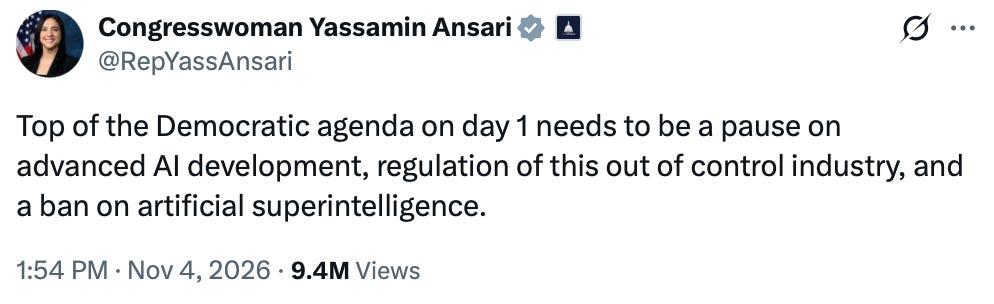
The irony is that—with the exception of Elon Musk and some of the folks who work for him—the big AI companies are all Democrats and liberals. Or perhaps that’s not ironic at all. Putting strict regulations around AI development would entrench the incumbents in the space by locking out upstart competitors. So perhaps AI Masters of the Universe support the Democrat agenda out of Effective Selfishness.

Traders work on the floor of the American Stock Exchange (AMEX) at the New York Stock Exchange (NYSE) on Friday, Nov. 6, 2026. A rebound in chipmakers buoyed Wall Street as dip buyers emerged despite economic data that reinforced speculation the Federal Reserve will boost interest rates in December. (Michael Nagle/Bloomberg via Getty Images)
Breitbart Business History: Happy Birthday to the 401(k)
On November 6, 1978, President Jimmy Carter signed the Revenue Act of 1978, adding a little provision to the tax code that would eventually change how Americans saved for retirement: Section 401(k). Today it turns 48—still too young to withdraw its own money without a penalty.
The modern workplace savings plan took some entrepreneurial imagination. Benefits consultant Ted Benna saw that the provision could allow employees to put part of their pay into retirement accounts before income taxes, with employers offering matching contributions to encourage participation. The bank client he pitched rejected the idea because its lawyer was uncomfortable doing something unprecedented.
In November 1981, proposed IRS regulations clarified the treatment of salary contributions, helping open the gates to widespread adoption. And so an obscure subsection became a household name—and gave American workers a reason to check the stock market during office hours. Which means that today’s financial television, including Fox Business and CNBC, was arguably made possible by the arrival of the 401(k).