
See more of our coverage in your search results.

The zoo is branching out.
The Bronx Zoo introduced a “functionally extinct” tree species at its grounds Monday — more than a century after the institution’s own scientist discovered a deadly fungus was decimating the plants.
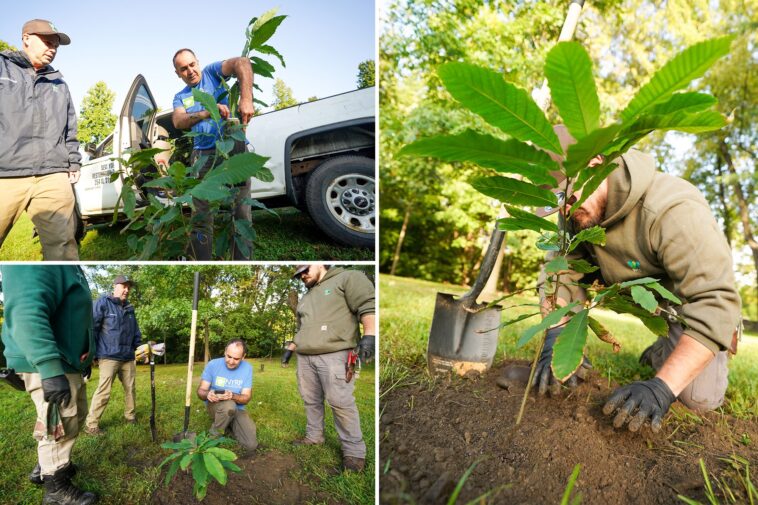
Twenty American Chestnut saplings were scattered across three sites at the sprawling conservation center, including at the footsteps of Tiger Mountain, as part of a city-wide effort to breathe life back into the species.

“It’s historic for us. We haven’t had chestnuts on property here for a hundred years,” Craig Piper, the interim director of the Bronx Zoo, told The Post as he watched his team tenderly plant the tiny trees.
“The thought of bringing them back and bringing them to once again be part of the hardwood forests of New York City, that’s exciting for us,” he said.
The zoo’s mini forest, erected in conjunction with the New York Restoration Project (NYRP), marks the first time American Chestnuts have been on the zoo’s property since its former Chief Forester discovered a “deadly fungus” was eating away at the gorgeous, 100-foot-tall trees.
Hermann Merkel was the first to document the blight in 1904 — writing that “unless some radical measures are taken, or a natural enemy of this fungus develops, it is safe to predict that not a live specimen of the American Chestnut will be found two years hence in the neighborhood of the Zoological Park,” the former name of the Bronx Zoo.
The blight would go on to decimate nearly 4 billion American chestnut trees across North America, rendering it “functionally extinct.”

But the 20 saplings aren’t exactly the same trees whose canopy once blanketed the US — the 3-foot-tall trees planted Monday are a hybrid mix that horticulturalists hope will make them stronger against the blight they expect to eventually creep onto the trees.
“These trees most likely will get the disease, and it will impact them. But we also expect them to grow,” said Jason Smith, the NYRP’s Director, Northern Manhattan Parks, saying that the “worst-case scenario” would be that the trees wouldn’t flower and reproduce.
“These trees are now a huge milestone … [The American Chestnut] was our most abundant, largest tree, very important part of our forest ecosystem. It was a huge ecological catastrophe for the nation. And so the opportunity to bring it back is wonderful.”


The trees will also serve as a research opportunity — they will be under constant observation by the zoo’s horticulture staff to see how the saplings are faring.
Seventeen were planted across two plots along the Bronx River in order to receive maximum sunlight and less traffic, while three live in the shadier footpath north of Tiger Mountain where they are essentially on exhibit like their neighboring felines — visitors will get a first-hand look at their growth and zoologists will point out their story as they take families through the park.
“We’re inviting New Yorkers to engage in hands-on, important work to address the biodiversity crisis by bringing back a tree that was on the brink of extinction,” said Smith.
Just around 400 American Chestnut trees exist in the five boroughs, nearly all of which were planted by the NYRP with the help of the American Chestnut Foundation.