
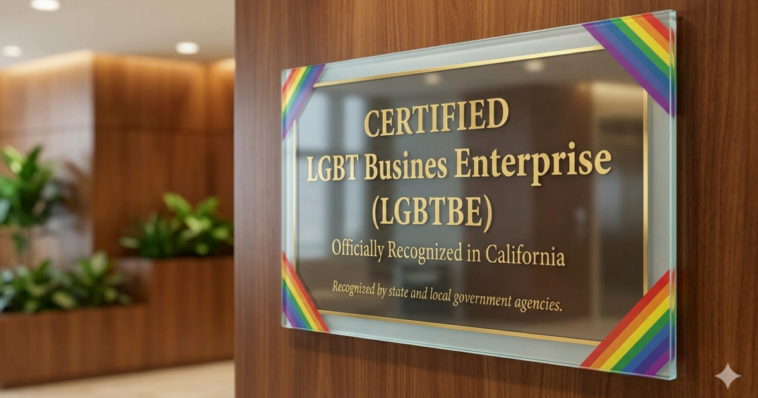

The California Public Utilities Commission (CPUC) runs a procurement preference program for businesses owned by lesbian, gay, bisexual, or transgender individuals, operating under General Order 156. A business qualifies as an LGBT Business Enterprise if it is at least 51 percent owned and controlled by LGBT individuals.
In California, “utilities” are privately owned companies that hold near-monopolies delivering essential services such as electricity, natural gas, water, or internet and phone service, and are therefore regulated by the state through the CPUC. To operate, utilities purchase goods and services from outside vendors, construction, engineering, fuel, IT, and similar services.
Under CPUC’s Supplier Diversity Program, utilities are given goals for directing a share of that vendor spending to certified women-, minority-, disabled-veteran-, and LGBT-owned businesses, giving LGBT-certified firms a procurement advantage in competing for utility contracts.
There are both indirect and procedural incentives for utility compliance with CPUC’s LGBT procurement goals. The CPUC controls matters that are consequential to utilities, including rate approvals, infrastructure proceedings, and merger approvals.
One example is the Verizon-Frontier merger. A CPUC administrative law judge recommended approval of the $20 billion deal only if new diversity conditions were attached. This recommendation came even after Verizon had already committed to the FCC to eliminate its workforce and supplier-diversity goals.
Utilities that resist these procurement goals risk creating friction in these higher-stakes proceedings.
Compliance is also reinforced through reporting requirements. Utilities must file annual plans, collect demographic data on vendors, and explain in writing any shortfall against the stated goals.
Certified firms enter a supplier database administered by the Supplier Clearinghouse and used by participating utilities for procurement decisions, with certification valid for three years. CPUC’s category-specific contracting goals now stand at 15 percent for minority-owned firms, 5 percent for women-owned firms, 1.5 percent for disabled-veteran-owned firms, and 1.5 percent for LGBT-owned firms.
The LGBT category sits within a broader supplier-diversity framework dating to 1986, when Governor George Deukmejian signed Assembly Bill 3678, requiring CPUC-regulated utilities to submit annual plans for purchasing from woman- and minority-owned companies; CPUC created its Supplier Diversity Program two years later to enforce the law and set contracting goals. In September 2014, Governor Jerry Brown signed legislation requiring CPUC to recognize LGBT-owned businesses as eligible for supplier-diversity benefits, and the CPUC added LGBT businesses to General Order 156 the following year.
Governor Newsom expanded the program in 2019, encouraging energy-sector companies to award contracts to gay-owned firms. The LGBT procurement target phased in at 0.5 percent in 2022 and 1 percent in 2023, reaching the current 1.5 percent goal by unanimous CPUC vote in April 2022. During the rollout, advocacy groups pushed CPUC toward fuller implementation.
BuildOUT California, an LGBT building-industry organization since rebranded, told the commission that homophobia persisted within utility companies’ ranks, and the state legislature’s LGBTQ caucus wrote in 2021 that lowering gay-procurement targets would insult the LGBTQ+ community.
To certify, applicants check at least one box on a 13-item checklist maintained by the Clearinghouse. Acceptable documentation includes a same-sex marriage, civil union, or domestic partnership record; evidence of family-building efforts with a same-sex partner, including in vitro fertilization or surrogacy; a letter from an LGBT organization attesting to the applicant’s sexual orientation; proof of media identification as LGBT; or three letters from personal contacts, submitted on company letterhead, attesting to the applicant’s orientation.
The Clearinghouse separately accepts certification letters from the National LGBTQ+ & Allied Chamber of Commerce, which maintains its own qualifying-document list, including human-resources complaints or police reports alleging LGBT discrimination. Misrepresenting LGBT status carries a penalty of up to one year in county jail.
One certified owner’s experience illustrates the documentation process. Mary Ann Horton, an early internet figure credited with helping develop the email attachment, is a transgender woman married to a woman. Her company, Red Ace, is registered in California as both woman- and LGBT-owned.
Horton has described the application as requiring extensive paperwork: a domestic-partner affidavit to establish lesbian ownership, a reissued Washington State birth certificate to establish woman ownership, and a therapist letter to establish transgender status.
After certification, San Diego Gas & Electric brought Red Ace on as a part-time cybersecurity contractor; Horton said a company official indicated the diversity listing eased the contract’s approval. SDG&E reported $8.6 million, or 0.36 percent of procurement, in spending with LGBT businesses in 2022, a category that has included a firm producing a supplier-diversity training video, a sign-language interpreter, a kombucha maker, and a coaching firm offering services related to managing reactions to election cycles.
The certification has spread beyond CPUC. Los Angeles County added an LGBTQQ+ category to its Community Business Enterprise program, requiring 51 percent LGBT ownership and control along with active certification through either the National LGBTQ Chamber of Commerce or the CPUC Supplier Clearinghouse. The county’s broader CBE program sets a 25-percent participation goal for county contracts overall.
The Valley Transportation Authority runs a parallel LGBT Business Enterprise program for locally funded projects alongside its minority- and women-owned business programs, requiring applicants to upload tax returns and sign an affidavit.
CPUC’s Supplier Diversity Program, covering more than 30 major utilities including AT&T, PG&E, SDG&E, Southern California Edison, SoCalGas, Comcast, and Verizon, directed $13.1 billion in contracts toward certified diverse suppliers across all categories, women, minority, disabled veteran, and LGBT businesses, in 2024, representing 30.1 percent of total utility procurement, up from 28.8 percent in 2023.
The Verizon-Frontier merger, discussed earlier, also produced a direct conflict between the program and federal DEI policy. Verizon’s rollback of its diversity programs to satisfy the FCC and the Trump administration prompted CPUC to warn of a possible conflict with Public Utilities Code Section 8283, which requires large telecoms to file annual supplier-diversity plans. CPUC approved the merger 5–0 in January 2026, attaching conditions designed to replace the diversity commitments Verizon had dropped.
On the legal question, the program intersects with Proposition 209, codified as Article I, Section 31 of the California Constitution, which bars the state from discriminating against or granting preferential treatment to any individual or group on the basis of race, sex, color, ethnicity, or national origin in public contracting. Sexual orientation is not among the enumerated categories, which is likely why CPUC’s program has not been directly challenged on those grounds. California courts have struck down comparable race- and sex-based preference schemes under Section 31, including in Hi-Voltage Wire Works v. City of San Jose (2000) and Coral Construction v. City and County of San Francisco (2010), though neither involved LGBT status.
The more directly relevant precedent involves a separate statute. In April 2022, a Los Angeles Superior Court struck down AB 979, which had required corporate boards to satisfy racial, ethnic, and LGBT quotas, finding it violated the California Constitution’s Equal Protection Clause. A companion law mandating female board representation, SB 826, was struck down weeks later on the same grounds. That precedent has not been applied to CPUC’s procurement goals, which are aspirational rather than mandatory and apply to private utilities rather than direct state contracting, distinctions that may explain why the program remains unchallenged on equal protection grounds.
Ad block users: Some site features may not work correctly while an ad blocker is enabled, because they break scripts and content this website depends on. If you can’t see comments below, for example, please disable your ad blocker.