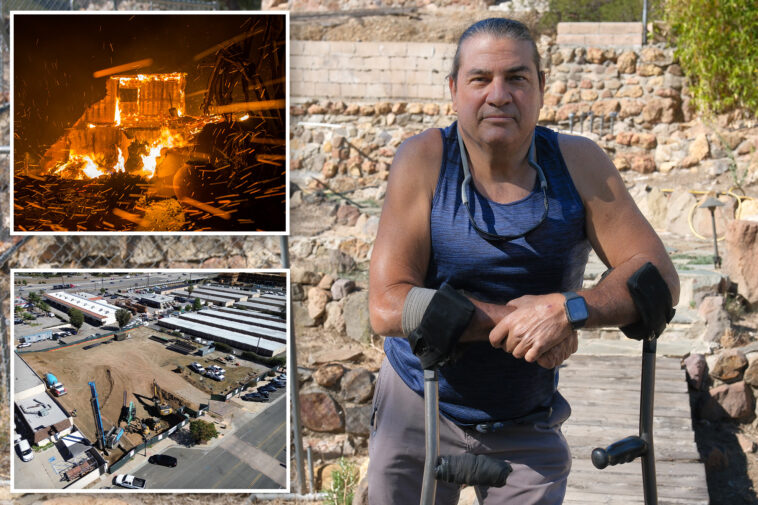
California funneled nearly $369 million in federal aid intended for victims of its deadliest wildfire year to low-income housing developers — without requiring them to house a single wildfire survivor, a California Post investigation found.
The staggering sum was awarded to developers while thousands of Californians struggled to rebuild their lives after the devastating 2018 fires, which killed 103 people and damaged or destroyed more than 24,000 structures.
Among them is motivational speaker and comedian, Mickey Schechter, 62, who lost his Cornell home and $60,000 in plumbing tools when the Woolsey Fire tore through the Santa Monica Mountains, destroying 37 homes in his community.
Sign up for the California Morning Report newsletter
The biggest news, opinion and culture shaping California right now.
Thanks for signing up!


Nearly eight years later, he is still living in a cramped, 350-square-foot guesthouse that survived the blaze, unable to afford the estimated $2 million it would now cost to rebuild his home.
Schechter was furious when told where a large chunk of the federal cash had gone.
“That’s our money. We’re the ones that suffer for it. Give us our damn money. That’s bulls—t. I’m pissed,” Schechter told the California Post.


“Now I wanna know how can I possibly get money from that grant?” he said.
“That’s not your money. That’s our money.”
The federal government allocated more than $1 billion to California to help communities recover from the 2018 wildfires, including the Camp Fire that killed 85 people in Paradise and the Woolsey Fire that devastated communities north of Los Angeles.

The Woolsey Fire killed three people, destroyed 1,643 structures and caused more than $6 billion in damage.
The $1,017,399,000 allocation from the US Department of Housing and Urban Development (HUD) was intended to cover recovery costs not paid by insurance or other assistance.
California’s Department of Housing and Community Development (HCD) oversees the money, dividing it between helping homeowners rebuild and financing affordable rental housing in fire-ravaged communities.
Download The California Post App, follow us on social, and subscribe to our newsletters
California Post News: Facebook, Instagram, TikTok, X, YouTube, WhatsApp, LinkedIn
California Post Sports Facebook, Instagram, TikTok, YouTube, X
California Post Opinion
California Post Newsletters: Sign up here!
California Post App: Download here!
Home delivery: Sign up here!
Page Six Hollywood: Sign up here!
Of the $222.4 million earmarked for homeowners, just $38 million had been spent rebuilding 110 homes by the end of 2023, according to state records. The Camp Fire alone destroyed 14,000 homes.
Developers, meanwhile, were awarded $368.7 million for low-income housing projects, without any requirement to house wildfire survivors.

In one funding round last year, the state awarded $146.9 million to 14 developments from Santa Cruz to Covina, with a combined price tag of $632 million, roughly $754,000 per apartment.
HCD could not provide a count of how many, if any, wildfire survivors live in the apartments.
Meanwhile, Schechter says he has been left facing a financial nightmare.
He said the county charged roughly $178,000 for debris cleanup, while he has spent another $300,000 maintaining the property.
Insurance paid just $450,000 for his $750,000 home, which he estimates would now cost $2 million to rebuild.

But state rebuilding aid was restricted to low and moderate income homeowners, with insurance payouts reducing eligibility. Schechter says never received the help he needed.
The Woolsey Fire recovery program provides a stark example of how developers secured millions as survivors like Schechter struggled to rebuild.
In July 2024, California offered $26.7 million in Woolsey Fire recovery funds. Only one developer applied.
Rancho Cucamonga nonprofit National CORE proposed an 81-unit apartment complex in Agoura Hills, scoring just 90 points, barely above the 88-point minimum and the lowest among projects funded that round. Others scored as high as 117.
National CORE secured nearly the entire pot, $26.1 million, despite no requirement to house a single Woolsey Fire survivor.
The project’s location has also raised questions about evacuation routes in the fire-prone Santa Monica Mountains.

The apartments are just miles away from last week’s Bryson Fire that sent residents scrambling to evacuate, reigniting fears that adding more housing along one of only two major escape routes could turn an already dangerous bottleneck into a death trap.
“They are building apartments on the only way we can get out of here,” Schechter told the California Post. “During the Woolsey Fire, people were sitting in their cars for two hours trying to get out.


“With all these extra people, people will die.”
The project shrank to 54 units after officials denied a density bonus, but its $26.1 million award remained untouched, including $484,000 in federal disaster aid.
Agoura Hills officials said they had no say in the project or its multimillion-dollar funding award.
“The City did not have any role in selecting the project, the site, or the funding amount,” Community Development Director Robby Nesovic told the California Post.

HCD defended the spending, arguing that new apartments replace homes lost to the fires.
Displaced renters “generally choose to move to another existing rental housing unit,” spokeswoman Jennifer Hanson said.
But developers aren’t required to house fire survivors, who are instead grouped with Section 8 tenants as “least likely to apply” and targeted only through advertising.
State rules prohibit residency-based preferences, citing fair-housing laws. HCD wouldn’t say whether it considered prioritizing fire survivors.
Hundreds of miles north, officials in Butte County, where the Camp Fire leveled Paradise, said they were also shut out of the funding decisions.
“The County had no role in selecting these projects nor their funding amounts,” Deputy County Counsel Andrea Woodward-Sollesnes told the California Post.
Eaglepointe Apartments opened in Paradise last year with $7.3 million in disaster aid. Just seven of its 42 units, or one in six, went to Camp Fire survivors, according to local news reports.
Butte County has identified about 1,200 emails about the projects and is reviewing them for release under a public records request.
HUD, which approved California’s recovery plans and oversees the money, did not respond to the California Post’s request for comment.