

California’s earthquake time bomb may be ticking faster than scientists realized.
Just a week after a magnitude 3.9 quake rattled Oakland’s Hayward Fault, researchers at San Jose State University have uncovered evidence suggesting the San Andreas Fault has been slipping at a faster, more consistent pace than previously believed.
The finding comes from research at Sanborn County Park, where scientists examined the landscape for clues left behind by ancient earthquakes.


Their conclusion: The fault’s movement rate appears to have stayed constant for roughly 10,000 years instead of slowing down.
SJSU professor Kim Blisniuk said the rate is similar to what researchers have measured farther north along the San Andreas Fault.
“And so the great aspect of this work is that it is a rate of which the landform preserves previous earthquakes along the fault,” Blisniuk told ABC7.
Sign up for the California Morning Report newsletter
California’s top news, sports and entertainment delivered to your inbox every day.
Thanks for signing up!
“And the rate is similar to the rate that we get for the San Andreas Fault to the north in the north coast section. But prior to the work that my colleagues and I did at Sanborn County Park, the rate appears to not decrease along the San Andreas Fault, but it appears to be constant over this 10,000-year window that we were able to document.”
Why should anyone care?
Because faults that move faster can generally unleash earthquakes more often.

And California has already learned the hard way what the San Andreas Fault is capable of, especially now that recent studies reveal its southern section near Los Angeles sits at its highest stress level in 1,000 years.
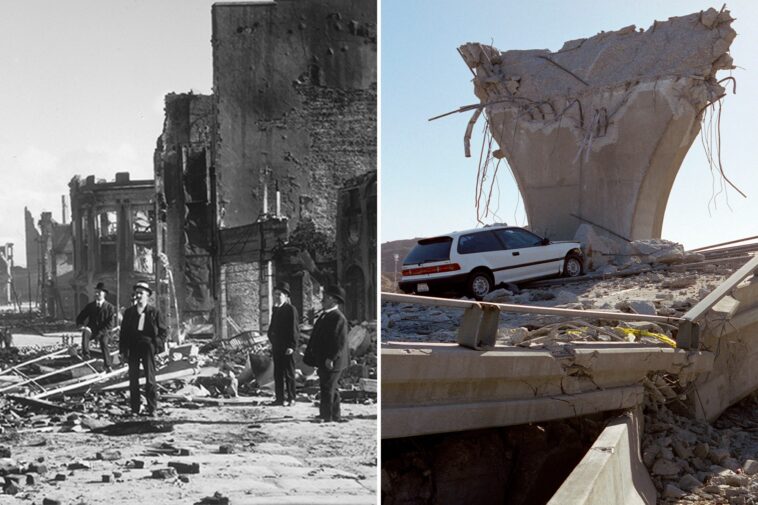
The devastating 1906 San Francisco earthquake and the 1989 Loma Prieta earthquake both occurred along the San Andreas Fault zone.
“So we do have historical earthquakes along this fault, and we will have them in the future,” Blisniuk said.
Blisniuk said the findings shouldn’t come as a huge surprise to Californians, who live smack dab on a major plate boundary.
“We know that we live on a plate boundary, and we are always surprised when we hear, ‘Oh my gosh, an earthquake occurred in Japan or Colombia,’ but we are going to have an earthquake in California, and we should be prepared,” Blisniuk said.
“I don’t think the idea that the slip rates are and constant along the San Andreas Fault, where we have studied, it is a big surprise to a lot of people. We just didn’t have that data before.”

There’s one important caveat: The research has not yet been published or peer-reviewed.
Still, Blisniuk said Californians should take it as another warning to get ready before the ground starts shaking.
His advice? Think of earthquake preparedness like insurance, you hope you never need it, but you’ll want it when disaster hits.
“I always use the example of insurance. We always want auto insurance. We buy auto insurance, home insurance. We never want to use it, but it’s there for us,” Blisniuk said. “And so, having an earthquake preparedness kit to prepare us for a potential disaster when an earthquake occurs will really help us deal with the trauma of having an earthquake.”
Download The California Post App, follow us on social, and subscribe to our newsletters
California Post News: Facebook, Instagram, TikTok, X, YouTube, WhatsApp, LinkedIn
California Post Sports Facebook, Instagram, TikTok, YouTube, X
California Post Opinion
California Post Newsletters: Sign up here!
California Post App: Download here!
Home delivery: Sign up here!
Page Six Hollywood: Sign up here!