
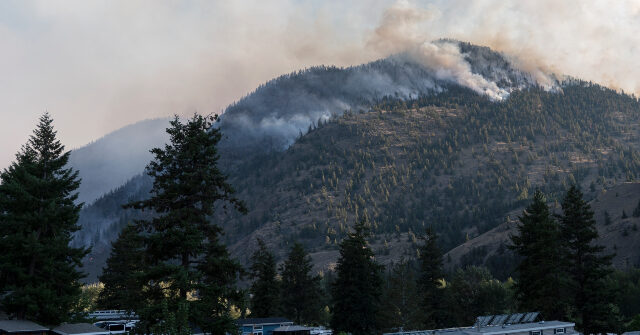
Fast-moving wildfires in Ontario, Canada, destroyed an entire indigenous community this week whose leaders said politicians delayed evacuation orders, failed to help find lodging for the displaced, and ignored calls for help as the flames engulfed them.
Ontario formally requested federal assistance this week as dozens of wildfires threatened northern communities, some of which had already begun evacuating themselves or fleeing by boat. Canada does not have a federal emergency management agency or a federal fire authority, however, rendering its national government largely unable to address the country’s annual massive wildfires.
In a letter to federal Emergency Management and Community Resilience Minister Eleanor Olszewski, Dunlop said 15 communities were evacuating or considering evacuations. She warned that simultaneous air evacuations could exceed Ontario’s available aircraft and requested a federal response within 24 hours instead of the usual 48.
Federal officials did not immediately respond to a request for comment, Canadian newspaper Globe and Mail reported.
The request came after a fast-moving blaze devastated Namaygoosisagagun First Nation, also known as Collins First Nation, north of Thunder Bay. Chief Helen Paavola said residents escaped in small boats while watching flames swallow trees beside their homes. Some fled wearing only the clothes on their backs.
Paavola said the community had lost everything and that a request for evacuation assistance to Ontario’s Ministry of Natural Resources went unanswered before the fire overtook the settlement.
“Her request for evacuation assistance to the provincial Ministry of Natural Resources went unheeded before flames overtook the settlement,” the Globe and Mail reported.
Shawna Perry Carson, a member of Pic River First Nations who offered her home to evacuees, told the Toronto Star she had heard Collins First Nation was “totally gone.”
“The people in those communities have lost everything,” Carson said. “They’re going to need all the help they can get to rebuild.”
Other evacuees struggled to find shelter. Kiashke Zaaging Anishinaabek, also known as Gull Bay First Nation, reported hotel rooms in Thunder Bay were unavailable after residents received a mandatory evacuation order.
“There are no accommodations in Thunder Bay,” the First Nation said. “Hotel rooms are non-existent.”
Some residents instead faced traveling to Toronto, where leaders warned that families might not be housed together.
Whitesand First Nation Chief Lawrence Wanakamik said his community began evacuating before the Ministry of Natural Resources issued an order. About 475 residents were staying at the Superior Inn in Thunder Bay.
Wanakamik said the Ministry of Natural Resources told the community to wait when leaders sought guidance as black smoke approached.
“They said to wait,” he said. “I’m disappointed in their slow action.”
A Ministry of Natural Resources spokesperson said all available aircraft were supporting wildfire suppression. Ontario Premier Doug Ford said more than 150 fire crews and nearly 50 aircraft were working to protect northern communities.
New Democrat lawmaker Lise Vaugeois also criticized the response, saying her office was overwhelmed with requests for help.
“Basically I got blown off by the Ministry of Emergency Preparedness,” she said.
Evacuation orders affected Armstrong, Lac La Croix First Nation, Whitesand First Nation, Gull Bay First Nation, and Lac des Mille Lacs First Nation.
Authorities had documented 136 active wildfires in Ontario as of Wednesday evening. Smoke spread across the Great Lakes, Midwest, Northeast, and mid-Atlantic, prompting air-quality warnings for millions of Americans.
Officials warned that wildfire smoke posed particular risks to children, elderly people, pregnant women, and those with respiratory conditions.
President Donald Trump said on Friday that the United States would hold Canada responsible for the resulting costs and add them to tariffs, accusing Ottawa of “willful negligence” in forest management. Sen. Bernie Moreno (R-OH) called for a compensation fund and announced legislation to sanction Canada and responsible officials, while Rep. Nick Langworthy (R-NY) demanded “meaningful action” from Canada “to prevent these catastrophic wildfires and protect both Canadians and Americans.”
Michigan Republican Reps. Jack Bergman, John James, Lisa McClain, and John Moolenaar also pressed Prime Minister Mark Carney for measurable investments in forest thinning, fuel reduction, prescribed burns, and arson enforcement, warning that U.S. agencies could pursue direct cross-border involvement. U.S. Ambassador Pete Hoekstra, however, praised cooperation between the two countries, while Carney emphasized climate change and clean energy policy and said responsibility extended to the United States.
Canada has no single national authority overseeing wildfire preparedness, response, and recovery, leaving provinces and territories to manage suppression while federal departments provide coordination, advice, and funding. A Canadian Senate report from May recommended prescribed and cultural burning, proactive fuel management, improved evacuation capacity, modernized infrastructure, early-warning systems, and expanded aerial and satellite technology. Indigenous leaders have also advocated removing dry undergrowth and restoring controlled-burning practices.