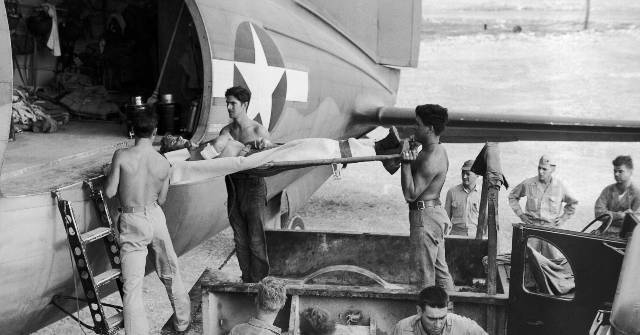
Military officials from China and the United States met at a ceremony in Chengdu, China on Tuesday for the ceremonial return of the remains of American airmen who were killed during Himalayan supply missions in World War II.
The ceremony was the culmination of decades of effort by American and Chinese officials to locate all of the air crews who died while flying “The Hump,” a supply route from India to southwestern China that was crucial for Chinese and American forces fighting against Imperial Japan.
Japanese forces were able to cut off the land supply routes through Burma in the spring of 1942, leaving the U.S. with no choice but to fly an incredibly dangerous aerial supply route over the Himalayas. The very first of these missions carried fuel that was used by the Doolittle Raid, the legendary bombing attack on Tokyo and other Japanese cities that shattered the aura of invincibility around Japan’s home islands.
The Hump got its name from the formidable flight plan pilots had to follow. They would take off from airfields in India that were barely a hundred feet above sea level, then climb to 18,000 feet to get over the Himalayas, and finally plunge 12,000 feet to reach destinations in the mountains of China.
The climb rate to get over the Himalayas was about 300 feet per minute, which was very difficult for heavily-laden cargo planes, and the weather over the Himalayas could be as dangerous as anti-aircraft fire.
American pilots sometimes took off from clear skies in India, only to find themselves battling blizzards, dust storms, and hundred-mile-per-hour winds over the mountains, turning a nominal three-hour flight into a ten-hour battle for survival. A shortage of adequate radio gear to get signals through the rough terrain meant pilots could not count on much help from ground crews.
The plane best suited to fly that grueling route at the outset was the Curtiss C-46 Commando, a massive twin-engine plane that was among the largest aircraft in the world at the time, and the only big cargo plane with enough horsepower to reach 18,000 feet.
The Curtiss Commando was tough, but finicky, and it was pressed into urgent service above the Himalayas before all the gremlins had been flushed out. Airmen nicknamed it “Ol’ Dumbo” because it was as plump and awkward as the flying baby elephant from the Disney cartoon. It could fly with one engine out — and it all too often did, as the engines had a tendency to freeze up when switching fuel feeds. Crews learned to take extra barrels of hydraulic fluid along for the ride so they could refill the plane’s leaky hydraulic systems. This earned the C-46 another nickname: “Leaky Tiki.”
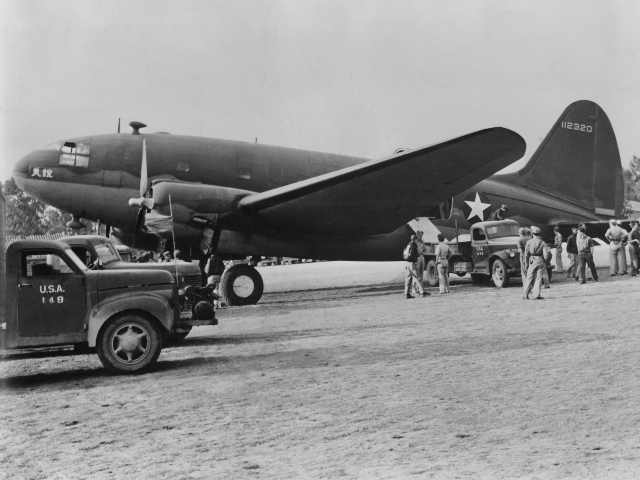
The first Curtiss C-46 commando to fly the Himalayan “hump” from India is unloaded by U.S., army personnel in Kunming, China in an undated photo. This big ship blazed the trail for a fleet of commandos which now make up 75 percent of the planes flying from India to China for the army air transport command. (AP Photo)
A contemporaneous Army Air Forces training manual referred to the notoriously dangerous Himalayan route while singing the praises of the Curtiss Commando: “Day in, day out, good weather and bad, Commandos are delivering the goods over the Hump — the roughest, toughest 600 miles of airway in the world.”
Many of the aircrews brave enough to challenge The Hump did not survive. Pilots in the China theater spoke of running into “granite clouds” as they tried to clear the Himalayan mountains. The Hump became known as the “Aluminum Trail” because of all the wreckage strewn across its rocky fangs.
At its peak, the treacherous supply route had 332 planes assigned to it and they moved over 71 tons of cargo, which would be impressive even for a modern operation. Ol’ Dumbo moved so much material that troops on the China side of the mountains had to open up more distribution centers to handle the goods. They used elephants to load cargo in India when they didn’t have enough forklifts.
Thirty-one of the 230 Curtiss Commandos assigned to the Hump exploded in flight due to bizarre fuel leaks that were eventually discovered and repaired by the crews. The massive four-bladed props on the C-46’s powerful engines had a tendency to become corroded while the planes were on the ground in humid India. Pilots learned to keep one hand on the override switches for those cranky propellers during takeoff.
In the later days of the war, after new routes opened and made flying The Hump unnecessary, the Air Transport Command tallied over 500 crashes and 1,300 crew lost. The U.S. government officially lists 690 American personnel as missing and unaccounted for. Those who survived crashes found themselves stranded in the forbidding Himalayas, or the almost equally hostile jungles on the far side of the mountains.
The Chinese forces on the receiving end of these heroic efforts were not the forerunners of today’s ruling Chinese Communist Party, but rather the forces of the Republic of China (ROC) led by Chiang Kai-shek — in other words, the proto-Taiwanese.
The ROC did most of the fighting against Imperial Japan, a fact that the propagandists of today’s Chinese Communist regime invest a great deal of effort in denying. The pilots of the Aluminum Trail were not always delighted to be working for the erratic Chiang and his wife, who became known as the “Dragon Lady.” Surviving pilots recalled being asked to risk their lives to ferry luxury goods for the Chiangs along with vital war material.
On the other hand, Beijing rarely misses an opportunity to berate Japan over World War II, as Chinese officials did several times during the Chengdu handover ceremony.
Political considerations have often interfered with efforts to recover the remains of those who died on The Hump, including everything from bouts of frosty U.S.-China relations to the Wuhan coronavirus pandemic. American and Chinese representatives held a summit in November 2023 to work out their differences and resume the recovery work in earnest.
The effort was aided by a Chinese property tycoon named Fan Jianchuan, who financed high-altitude searches for World War II wreckage in the Himalayas, plus museums in Chengdu to display what he found.
“The Chinese nation values gratitude and reciprocity, and we hope that the friendship forged between China and the U.S. during the World Anti-Fascist War will endure,” Fan said at the ceremony on Tuesday.
In January 2024, the U.S. Defense POW/MIA Accounting Agency (DPAA) conducted its first on-site recovery missions since the pandemic, with assistance from the Chinese military.
The Chinese Defense Ministry said at Tuesday’s handover ceremony that it was willing to continue working with American teams to find more wartime remains, to honor the shared history of America and China as partners against Imperial Japan.
“Eighty years after they crossed the Himalayas to aid China’s resistance against Japanese aggression, these heroes are finally homeward bound — a return made possible with China’s humanitarian assistance,” said Chinese Foreign Ministry spokeswoman Mao Ning in a Tuesday post on X.