
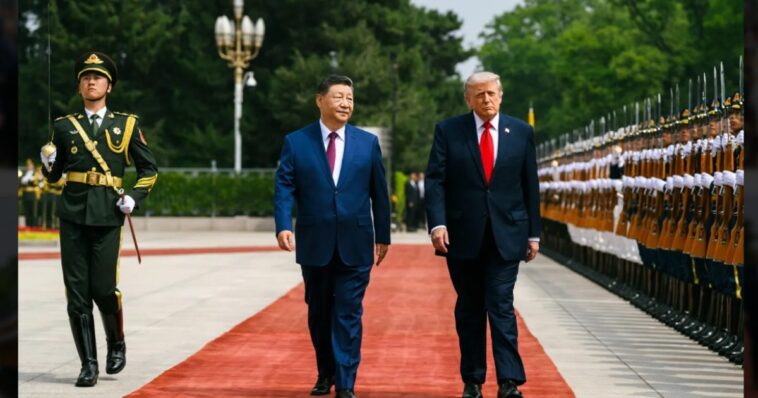

The takeaway from the Trump-Xi meeting was a number of statements made by Xi Jinping to President Trump. Mainstream media claimed that Trump made a bad deal because he foolishly believed Xi’s words. In reality, there was no deal. Trump yielded nothing. And Xi’s words in this case are consistent with Beijing’s previous policies.
According to the White House statement and President Trump’s media interviews, Xi told Trump that Iran must never obtain a nuclear weapon. He also said that the Strait of Hormuz must remain open, that China opposes militarization of the Strait, and that China opposes any tolling system on the Strait. Xi further stated that China would not provide military equipment to Iran.
The White House statement claims China agreed that Iran must never obtain a nuclear weapon. Instead, according to Al Jazeera, the Chinese statement calls for steady de-escalation, a political settlement, and dialogue “that accommodates the concerns of all parties” on the Iranian nuclear issue.
Despite the somewhat more ambiguous language reported by Al Jazeera, the position is consistent with longstanding Chinese policy. The U.S.-China Economic and Security Review Commission confirms that Beijing has opposed Iran developing nuclear weapons and supported the Joint Comprehensive Plan of Action (JCPOA).
Beijing’s own Five-Point Proposition on the Iranian nuclear issue, issued by Foreign Minister Wang Yi in March 2025, called on Iran to honor “its commitment to not developing nuclear weapons” while preserving its right to peaceful nuclear energy under the Non-Proliferation Treaty.
Chatham House notes that Beijing’s concern about a nuclear-armed Iran stems in part from the risk of a regional war that would block vital shipping lanes and disrupt Gulf oil imports, which points directly to why China’s stated desire to reopen the Strait of Hormuz is credible, if self-interested.
China is a net oil importer. The United States is a net exporter. The closure of the Strait has, paradoxically, benefited the U.S., increasing both the volume and revenue of American oil and natural gas exports to Europe.
China, however, depends on imported oil to sustain its manufacturing sector, where industrial profit margins have been declining steadily since the trade war began during Trump’s first term and are now paper-thin. A 10 to 20 percent increase in energy costs could eliminate those margins entirely.
And this leads into the discussion of the IRGC imposing a tolling system, which Xi claims to oppose. What China would prefer, and what it appeared to pursue in the early weeks of the war, was preferential access. Beijing wanted the Strait open for Chinese vessels but effectively closed to others. That arrangement has proven unachievable.
Iran, despite repeated assurances, has not granted Chinese ships free transit, and the U.S. naval blockade has largely severed the flow of Iranian oil to Chinese buyers regardless. Trump understands that China would resume purchasing Iranian oil the moment it became physically possible to do so. For now, it is not.
Trump stated that Xi Jinping pledged that China would not provide military equipment to Iran. As far as the U.S. has been able to confirm, China has not directly transferred assembled weapons systems to Iran during the conflict.
What has moved are dual-use materials, most significantly sodium perchlorate, a chemical precursor for solid rocket fuel. In early March 2026, the Washington Post reported that two sanctioned Iranian vessels, the Shabdis and the Barzin, had departed China’s Gaolan port in Zhuhai loaded with cargo assessed by tracking analysts as likely sodium perchlorate, based on prior shipping patterns and the vessels’ sanctioned status, though no direct confirmation of the cargo was available.
By early April, four ships in total had docked at Iranian ports since the start of the war, with a fifth, the Zardis, loitering offshore near Iranian waters. Most of the vessels turned off their Automated Identification System at some point during their journey, and two falsely reported their destination as Vietnam.
Nothing in Beijing’s official statement was literally false. No assembled missile was aboard and the PLA did not charter the ship.
Beyond chemicals, U.S. intelligence indicated that China was preparing to transfer shoulder-fired anti-aircraft missile systems known as MANPADs to Iran, with two sources telling CNN that Beijing was working to route the shipments through third countries to mask their origin.
The Chinese Embassy in Washington denied this categorically: “China has never provided weapons to any party to the conflict; the information in question is untrue.”
Chinese-made weapons have appeared on the Iranian battlefield, though most arrived through intermediaries and third-party networks prior to Xi’s pledge and do not constitute a violation of it. U.S. intelligence indicates that Chinese firms and Iranian representatives discussed potential transfers of military equipment, with plans to route any shipments through third-party intermediaries to mask their origin, though discussions are not deliveries, and no confirmed transfer has been documented.
The U.S. Treasury has sanctioned multiple entities in Asia, the Middle East, and Eastern Europe for acting as procurement intermediaries for Iran’s missile and drone programs, with Chinese-based firms named among the facilitators, a pattern that predates Xi’s commitment by months.
Whether Beijing honors its two-day-old pledge going forward remains to be seen, but no existing evidence directly contradicts it. Of all Beijing’s pledges, the one most certain to be honored is that China wants the Strait of Hormuz open, at least for China-bound vessels, and has no intention of paying tolls. China’s dependence on Gulf oil makes this less a political position than simple arithmetic.
It is also largely true that Beijing does not want Iran to have nuclear weapons, a position consistent with its participation in the JCPOA and its own Five-Point Proposition on the Iranian nuclear issue, issued just two months before the summit, though China has previously transferred dual-use technology to Iran with potential nuclear applications, a pattern documented by U.S. Treasury sanctions that Beijing disputes.
The weapons pledge is where Beijing’s behavior is least likely to change dramatically. China has a documented history of selling Iran dual-use technologies, components, and chemicals applicable to weapons production, and possibly direct weapons systems, though this has not been conclusively proven. That pattern will likely continue, but only to the extent that it remains possible and convenient.
With the Strait closed, China dependent on U.S. willingness to reopen it, and sanctions and tariffs looming, Beijing has strong incentive to act at least as prudently as it has until now. As Chatham House notes, Beijing consistently calibrates its Iran support to avoid direct confrontation with Washington, and an overt weapons shipment in the middle of an active armed conflict would cross that line unambiguously.
Ad block users: Some site features may not work correctly while an ad blocker is enabled, because they break scripts and content this website depends on. If you can’t see comments below, for example, please disable your ad blocker.