
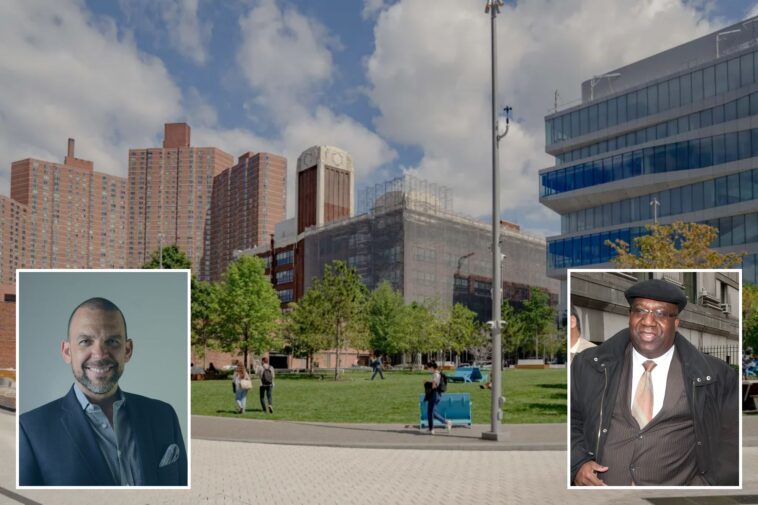
A nearly $100 million fund intended to revitalize West Harlem has been mired in mismanagement, racism and inertia, The Post has found — with not one major project either conceived or built with the money in nearly two decades.
In 2009, Columbia University signed a deal handing more than $96 million to a newly formed nonprofit, the West Harlem Local Development Corporation, to make amends for the displacement of local residents during an expansion.
The school’s incursion into the Manhattanville neighborhood — from West 125th to West 134th streets, between Broadway and 12th Avenue — included constructing new arts and science centers, a business school and conference venue, at a cost of $6.3 billion.

Controversially, it seized existing buildings by eminent domain, pitting the wealthy school against local small business and property owners who were refusing to budge.
Things got so heated that when Columbia University’s president Lee Bollinger and Julio Batista — chair of the new nonprofit — went to sign the agreement, they had to navigate through a group of rowdy protestors with hand-printed signs proclaiming “West Harlem is not for sale” who had to be held back by the NYPD.
Despite the uproar, the university hailed it “an opportunity for the University and our local community to enhance our collective work . . . while helping local citizens and businesses be full participants in the new economic opportunities created by Columbia’s commitment to local growth.”

Seventeen years later, sources say the controversial fund has been continually mismanaged and “a generational opportunity” for improvement has been squandered.
Columbia sources tell The Post the university made its final payment last year and has since abandoned the fund, which has dwindled to $56 million.
The Post found that almost none of the $20 million earmarked for affordable housing has been spent, and rather than meaningful community development, locals are fobbed off with token grants to theater groups, dance companies and the local chamber of commerce.
In past years, the fund gave out 1,000 turkeys to residents at Thanksgiving and cheap school supplies to local children, according to a former board member.

The group’s “senior programs” consisted of buying $127,000 in Broadway tickets for elderly citizens and chartering a bus to take them to shows in 2024, a source told The Post.
The nonprofit, now renamed the West Harlem Development Corporation (WHDC), is beset by chronic disfunction on its board and has been rocked by recent allegations of racism and antisemitism.
The board operates “as though it were a neighborhood bodega rather than a nonprofit corporation with substantial community assets,” Larry English, a Harlem lawyer and current WHDC board member who represents Democratic Congressman Adriano Espaillat on the board, told The Post.

He also charged that board members have “refused to retain a competent firm” to put a plan in place “for this once-in-a-generation opportunity to preserve and grow the original endowment established under the Community Benefits Agreement.”
Sources noted that, if invested properly, the original $76 million endowment and $20 million affordable housing fund would have grown exponentially by now.
“The board’s failure to take these steps constitutes a breach of its fiduciary duty,” English alleged, adding his frustration that none of the money for affordable housing, “a critical concern in West Harlem,” is being used.
Instead, the WHDC is fighting a federal lawsuit brought by a former board member and employee over allegations of racism by its current Executive Director, Zead Ramadan. He is alleged to have “engaged in a pattern of unprofessional and discriminatory behavior in the workplace, including racist, antisemitic, and otherwise ethnically offensive remarks,” per court papers.

Ramadan, who is also a board member of the Council on American and Islamic Relations (CAIR) in New York City, is one of the only paid employees of WHDC, making $225,000 in 2024, public filings show.
Since 2013 the board has been headed by powerful retired judge Milton Tingling, who is also the New York County Clerk. Last month, Tingling was appointed to the Mayor’s Committee on the Judiciary, set up to recommend judicial candidates.
Concerns about the community benefits agreement surfaced even as it was being drafted in December 2007. At that point, five West Harlem board members resigned, upset over the heavy-handedness of the politicians involved in negotiating with Columbia.

The university’s funding, which was allocated in several tranches over the years, has been regularly jeopardized by mismanagement, numerous sources have claimed.
As far back as 2010, then Manhattan Borough President Scott Stringer charged the organization had failed to establish guidelines for distributing the cash and ensuring accountability.
Several board members resigned at that time, including board chair Batista, over concerns the nonprofit was becoming a “slush fund” for Manhattan politicians through their board representatives.
The board had spent hundreds of thousands on “do-nothing” consultants and the representatives of the lawmakers on the board were steering cash to their pet projects, all while having “whittled down” the broader community initiatives, which included better housing and subsidized transportation for seniors, former board members told The Post.

And still the mismanagement continued. In 2014, former board chair Donald Notice, who had sat on it since 2009, resigned amid allegations of nepotism just before the board voted to award a nonprofit run by his sister administration of a $10 million housing fund, according to a report.
“The money never trickled down to the community,” said Derrick Haynes, an activist who helps juvenile offenders in Harlem. “The community continues to lag behind in progress. The residents are continuing to be squeezed out.”
Haynes had expected to receive money from the WHDC for juvenile justice issues, but never did.
The university gave the group its last $17 million tranche last year. Executives at the Ivy League college have been frustrated with the group’s inability to come up with a strategic plan for the cash, according to a former board member.
Columbia University declined to comment to The Post this week.

Meanwhile, WHDC has kept a tight hold on its purse strings, donating only around $2 million to local nonprofits per year. In 2024, it gave out $2.5 million, including $10,000 to the Greater Harlem Chamber of Commerce (GHCC) where Tingling is on the executive committee of the board.
WHDC’s largest annual grant is $125,000 per year for the Harlem Arts Alliance, a group created by GHCC executives, used to put on a summer music festival, according to public documents.
Tingling and the board changed WHDC’s bylaws in an emergency session in 2020, allowing members to serve double their two-year terms, citing the COVID pandemic.
Despite the pandemic being over, he remains in charge.
Former board member and employee Vincent Morgan, who is the plaintiff in the federal lawsuit against the group, was an early whistleblower describing the chronic mismanagement in 2010.
When he spoke up again a few years ago, recording alleged antisemitic outbursts by Ramadan and urging the board to hammer out a strategic plan for the remainder of the cash, he was fired, he claims in the federal suit against WHDC.
Tingling, Ramadan and WHDC did not respond to The Post’s requests for comment.