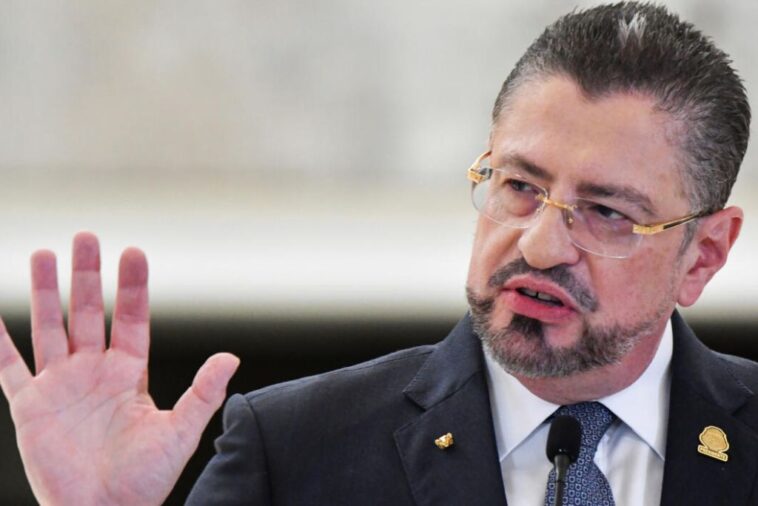

Costa Rican President Rodrigo Chaves declared that his government does not recognize the legitimacy of the communist regime in Cuba.
During a press conference in Peñas Blancas, on the northern border with Nicaragua, Chaves ordered the definitive closure of the Costa Rican embassy in Havana and demanded the immediate withdrawal of Cuban diplomatic personnel in San José, limiting relations to the consular sphere starting April 1.
“The Government of Costa Rica does not recognize the legitimacy of the communist regime in Cuba in view of the mistreatment, repression, and undignified conditions endured by the inhabitants of that beautiful island,” Chaves stated firmly.
CR ROMPE RELACIONES CON CUBA “EL COMUNISMO FRACASO”
Rodrigo Chaves, presidente saliente de Costa Rica, zurdo de corazón, cambió drásticamente de posición al anunciar la ruptura de relaciones diplomáticas con Cuba y el cierre de la embajada tica en La Habana, argumentando que el… pic.twitter.com/NrnxjbmrvU
— 5toPoder La Verdad sin Miedo (@5toPoderSM) March 19, 2026
He added that “we must clean the hemisphere of communists” and that “we will not give legitimacy to the regime that oppresses and tortures nearly 10 million Cubans today.” The president, who will leave office on May 8, made the decision jointly with President-elect Laura Fernández.
Foreign Minister Arnoldo André Tinoco explained that the Costa Rican embassy in Havana has been operating without diplomatic personnel since February 5 due to the “progressive deterioration of living conditions” in Cuba: shortages of food, medicine, basic services, and a humanitarian context that makes it impossible to maintain adequate representation.
The measure also responds to the “increase in acts of repression against citizens, activists, and opponents,” according to international reports.
Costa Rica will maintain only consular functions to serve its citizens from Panama, while Cuba will be allowed to keep a minimal team to assist its approximately 10,000 residents in Costa Rican territory.
This rupture is framed within Chaves’ alignment with the pressure policy of the United States under Donald Trump, who has intensified the energy blockade against the island.
The Cuban regime immediately rejected the decision through an official statement from the Ministry of Foreign Affairs. Havana described it as a “unilateral” and “arbitrary” decision, asserting that it was adopted “under pressure from the United States” without any justification.
It accused Chaves of “grossly manipulating the history and reality of Cuba” and ignoring the impact of the U.S. blockade, which it described as the main cause of the economic deterioration. “It is an arbitrary decision, evidently adopted under pressure and without taking into consideration the national interests and those of that brotherly people,” it concluded.
Protests were reported in front of the Cuban embassy in San José, where demonstrators expressed rejection of the decision, according to reports from local media such as La Nación, which published videos of the ongoing protests.
On X, Chaves’ emblematic phrase —“we must clean the hemisphere of communists”— has been widely highlighted and shared. Other accounts have amplified the president’s message, including posts that emphasize his call not to legitimize oppressive regimes, with echoes in profiles that celebrate alignment with regional pressure policies against Castroism.
This courageous measure by Costa Rica joins previous breaks in the region, such as that of Ecuador, and reflects a frontal rejection of the dictatorship that oppresses its people. Costa Rica sets an example of firmness against totalitarianism.
About The Author
Joana Campos
Joana Campos es abogada y editora con más de 10 años de experiencia en la gestión de proyectos de desarrollo internacional, enfocada en la sostenibilidad y el impacto social positivo. Anteriormente, trabajó como abogada corporativa. Egresada de la Universidad de Guadalajara.