
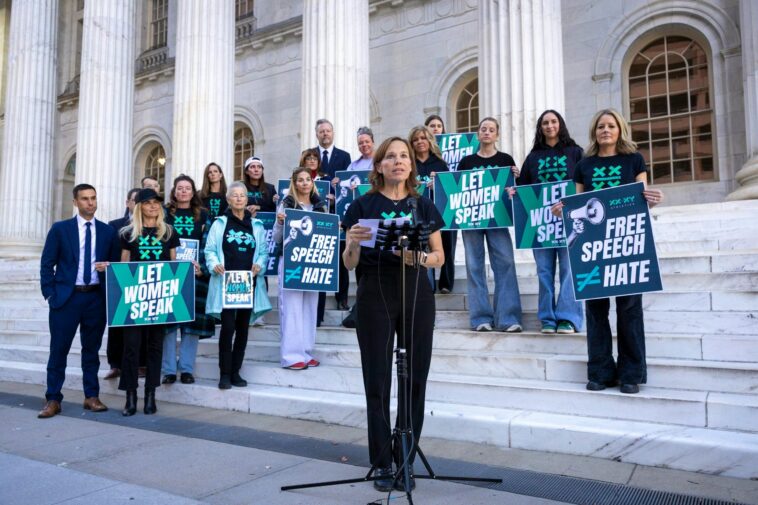
If we cannot call a boy a boy, how can we debate whether it is just or fair for boys to compete in girls’ sports? That question sits at the center of the lawsuit my company, XX-XY Athletics, brought against the state of Colorado.
House Bill 1312, the Kelly Loving Act, expands the Colorado Anti-Discrimination Act so that “gender expression” now includes a person’s “chosen name” and “how the individual chooses to be addressed.” In practice, it puts businesses and everyday citizens at risk of civil fines of up to $3,500 per violation — and, for certain advertising or publication violations, a Class 2 misdemeanor that can mean up to 120 days in jail — simply for using accurate language about biological sex.
XX-XY Athletics exists to protect women’s sports. Our advertising and social media say what biology and common sense confirm: men are men, women are women, and women deserve sports of their own. One social media post cited in our case described a male high-school runner competing in girls’ track: “When boys run girls’ track, they win. And girls lose.” Under the expanded law, referring to that athlete by his biological sex, or declining to use preferred pronouns in customer interactions or advertising, can be treated as evidence of discrimination in public accommodations. The law does not merely regulate conduct. It regulates our speech.
The law forces citizens and businesses to adopt language that obscures biological reality to serve an ideology. This is compelled speech. The Supreme Court has repeatedly held that the government cannot compel private speakers to convey a message they reject. Colorado has lost related cases before — Masterpiece Cakeshop, 303 Creative, and Chiles v. Salazar among them. HB 1312 tests the same principle again.
The state’s defense is essentially “trust us, bro.” Officials from the Colorado Civil Rights Division told the Tenth Circuit that businesses face no credible threat of enforcement, claiming the Division looks for a denial of goods or services or conduct rising to harassment, not misgendering or deadnaming alone. They note that no action has been taken against us yet. That is cold comfort. As our attorney Hal Frampton put it, the Supreme Court has been clear that Americans do not have to wait to be prosecuted to challenge unconstitutional laws. The mere existence of the statute chills speech; people and businesses self-censor rather than risk investigations and penalties. “Trust us” is not a constitutional safeguard.
Colorado has already shown it is willing to disregard the expressed will of its voters. Earlier this month, Proposition 134 passed with roughly 52% support. It requires school and collegiate athletic teams to be designated male, female, or coed, with eligibility based on biological sex. I helped lead the grassroots effort behind it.
Governor-elect Phil Weiser has already signaled that the legislature may adjust or rewrite the statute. And, since the passage of Prop 134 on November 3, Colorado’s state education department has directed schools to ignore it and obey the state’s “non-bullying and discrimination” laws instead. When a state signals it will overturn a clear popular vote protecting girls’ sports, why should any business trust that the same state would not impose the full penalties available under the Colorado Anti-Discrimination Act for speech it dislikes?
Repeated $3,500 fines for accurate sex-based language could bankrupt my business.
The lower court has already found that we have standing: our intended conduct is arguably proscribed by the law, creating a real possibility of enforcement.
That is why we argued Monday before the Tenth Circuit for a preliminary injunction. While the case proceeds, we should be free to continue speaking as we always have — truthfully about sex, without the constant threat of state action hanging over every post, news appearance, ad, or customer interaction. The loss of First Amendment freedoms, even for minimal periods, is irreparable harm.
Opponents of sex-based categories in sports have a consistent pattern. When they cannot win the argument on fairness, safety, or biology, they move to silence it. They threaten cancellation, form online mobs, and, when they hold power, write the preferred language into law. Former ACLU lawyer and women’s advocate Kara Dansky has said that if we can be heard, we will win. Proposition 134’s passage in a deep-blue state proves the point. The response has been panic and an effort to manufacture consensus through censorship. HB 1312 is part of that effort. It makes the underlying issue undiscussable by requiring speakers to treat the disputed premise as settled fact.
We will not let it stand. XX-XY Athletics was built to give voice to those defending women’s sports. We will keep speaking the truth about biological differences. The right to speak and think freely is foundational to this country. Compelling citizens to affirm an ideology under threat of fines and potential jail time is not consistent with that right. Is this America, or not? The courts will decide, but the answer should be clear.
***
Jennifer Sey is the CEO of XX-XY Athletics. She is an author, filmmaker, and retired national champion gymnast.