America is spending hundreds of billions of dollars to build data centers in an attempt to lead the development of new artificial intelligence technology. Both lobbyists and lawmakers argue constantly about who could or should make the chips inside them, but there are far fewer people who ask about the components that connect those chips to each other and the outside world. That’s a big mistake because many of those components are made in China.
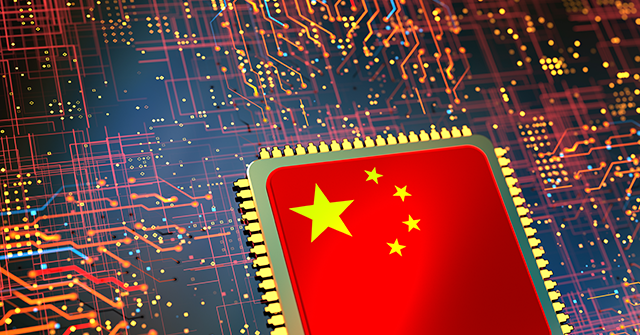
Optical transceivers are a major part of data center infrastructure, enabling high-speed data transfer between servers, racks and facilities. Nearly every major AI cluster in the country depends on them to operate, and China is the main supplier. In fact, Johns Hopkins Associate Professor Yury Dvorkin recently told Breitbart that China supplies approximately two-thirds of global optical transceivers.
Chinese companies such as Innolight, which got added to the Department of War’s Chinese Military Companies list this year, and Eoptolink are among the leading suppliers. Would any serious country allow an adversary to dominate an industry on which it is increasingly reliant?
None of this is accidental. China’s strategy is well documented: rely on state money and industrial policy to research critical technologies; undercut foreign competition; and, when they’ve taken the market, use it for leverage. This has happened for years in industries from solar panels to batteries – which means we should’ve learned this lesson already.
Rural carriers across America bought cheap Huawei and ZTE equipment for years. When Congress finally woke up to the threat, they had to allocate $5 billion in taxpayer funds to rip it out and replace it, which still hasn’t been finished. We could make the same mistake again; and this time, the scale and stakes are far larger.
Chinese companies have also been getting better at avoiding the rules we already have and are increasingly routing goods through third countries to avoid tariffs. The White House itself has estimated that transshipment strategies have resulted in a $19 to $26 billion loss.
But now, Washington is moving. Over the summer, it was reported that the Federal Communications Commission (FCC) is poised to move quickly to ban Chinese optical transceivers imports to protect our AI infrastructure. Chairman Brendan Carr and his team have shown that they take national security seriously and should follow through. More recently, bipartisan legislation was introduced in the Senate to keep Chinese optical transceivers out of the federal government’s most sensitive national security systems. While good, these efforts are receiving pushback from industry.
Major companies and associations representing the biggest names in tech have advocated against proposed actions. Yet an open letter signed by some of those companies warned of the need for a more secure digital ecosystem in the AI era. If security really is a topic of concern, they should care about data center components and AI infrastructure.
An AI model is only as secure as the hardware it runs on, and you can’t build an AI stack that is trustworthy on a foundation supplied by companies bound by the Chinese government. If Big Tech really cared about security, they would recognize that the physical infrastructure in data centers has to be part of that equation.
Theodore Roosevelt understood that a nation that can’t secure its own industrial base cannot truly govern itself. The AI race will be won or lost on infrastructure, and that means optical transceivers matter just as much as chips. To keep America safe, the FCC should finalize its ban, Congress should pass a bill, and technology companies should stop lobbying to support Chinese hardware.
We already paid once to rip out Huawei. We shouldn’t have to again.
Aiden Buzzetti is the President of the Bull Moose Project.