
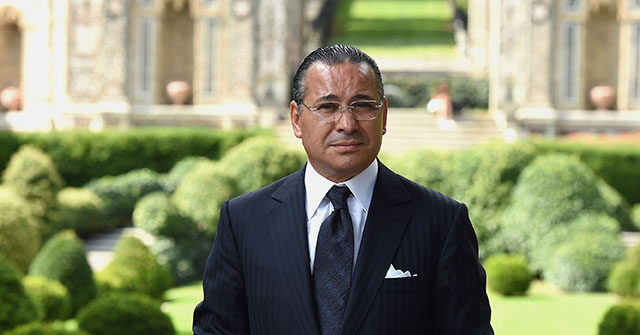
Kamel Ghribi, the international investment executive behind one of Europe’s largest private healthcare networks, sees a “huge opportunity” to expand cooperation with the United States in medical technology, hospital development, and research as his organization pursues an ambitious international growth strategy through 2030.
Ghribi, president of GKSD Investment Holding and vice president of Italy’s Gruppo San Donato, outlined his plans in an exclusive interview with Breitbart News in New York during September’s United Nations General Assembly, where he also hosted an international summit on economic development and healthcare cooperation.
Describing the United States as a “huge opportunity,” Ghribi pointed to the longstanding relationship between Washington and Rome and his organization’s interest in strengthening ties with American companies and medical institutions.
“Italy and the U.S. are really, really close,” he said. “We have great relationships. We look forward to doing more with the U.S.”
Those ambitions include exploring opportunities in the American hospital market, although Ghribi emphasized that the organization is still evaluating potential locations.
“We are studying the markets, places like Texas, places like Florida, places like California,” he said. “So we are right now mapping the markets to see where the opportunities are.”
Beyond the American market itself, Ghribi envisions greater cooperation with U.S. companies and research institutions, including partnerships that could bring advanced medical technologies to developing healthcare markets abroad.
“There’s a great desire to do more with the U.S. for our group,” he said. “We see opportunities in the United States. We see opportunities in Africa with the United States involved with technology.”
He said the goal is to combine the organization’s medical expertise with American technological capabilities to create economic and social benefits while expanding access to specialized health care.
The ambitions draw on an extensive healthcare network that, according to figures provided during the interview, encompasses approximately 161 facilities, more than 11,000 physicians, and services reaching roughly 6.5 million patients.
Gruppo San Donato, Italy’s largest private hospital group, operates a network that combines patient care, medical education, and scientific research, with an expanding international presence that includes Poland, the Middle East, and Africa.
Among the network’s flagship institutions is Milan’s San Raffaele Hospital, a major center for specialized medical treatment, scientific research, and physician training, whose work includes advances in regenerative medicine, robotic surgery, and other emerging medical technologies.
Across the network, that approach extends to the use of three-dimensional anatomical models to help surgeons prepare for complex procedures, including pediatric cardiac surgery, alongside research into artificial intelligence and technologies designed to restore lost neurological functions.
Asked what distinguishes the group’s approach to health care, Ghribi offered a striking description.
“I would say it’s the Rolls-Royce of health care,” he said.
Yet the model extends beyond the hospitals themselves, incorporating physician training, research institutions, and specialized technologies intended to improve care while maintaining consistent standards as the network expands.
That approach forms the foundation of Ghribi’s vision for 2030, which calls for extending the group’s international reach while developing new capabilities in precision medicine, regenerative treatments, and AI-assisted health care.
“Our vision for 2030 really is to now expand our borders, our coverage,” he said, identifying Albania, Kenya, Iraq, Libya, and the United States among the markets involved in or being considered for the group’s international strategy.
He stressed that expansion must be accompanied by investment in the medical professionals and technologies needed to sustain high-quality treatment.
“We have to do this expansion in a very controlled manner because quality is key,” he said.
Artificial intelligence (AI) is already playing an increasingly important role in the organization’s research, according to Ghribi, who described work involving Microsoft on AI-related medical applications and preliminary discussions with Google about potential cooperation.
He also emphasized the risks associated with introducing new technologies into health care, where untested systems or improperly used medical data can have serious consequences for patients.
“AI is all great, but it comes with risks,” he cautioned, emphasizing that new medical technologies must be thoroughly tested before being incorporated into treatment.
“Ethics is key,” he added. “If it gets in the wrong hands, it can create havoc. So, this whole thing needs to be regulated.”
Ghribi’s emphasis on international partnerships also underpins the European Corporate Council on Africa and the Middle East (ECAM), the nonprofit organization he founded to promote economic cooperation, investment, and development across the three regions.
On September 24, he hosted the eighth ECAM Council Summit at The Plaza Hotel in New York, bringing together international leaders including Kenyan President William Ruto, Albanian Prime Minister Edi Rama, and Italian Foreign Minister Antonio Tajani.
The gathering featured the unveiling of the ECAM Charter on Africa, a nine-principle framework emphasizing African ownership, local economic development, transparent partnerships, and long-term investment.
“Africa does not need charity; it needs partners,” Ghribi declared at the summit. “Africa is not the continent of tomorrow. It is the continent of today.”
In his interview with Breitbart News, Ghribi argued that American and European expertise, combined with Middle Eastern investment and African participation, could accelerate development across the continent.
He said expanding healthcare infrastructure across Africa could deliver benefits extending well beyond medical treatment, creating jobs, training local professionals, and stimulating economic activity in communities where opportunities have historically been limited.
Those investments, he argued, could also help address illegal immigration by giving more people the means to build their futures at home rather than seeking opportunities abroad.
“We want to create economic value with the Africans being a part of it,” he said. “It will tackle the problem of illegal immigration.”
“We feel that with the U.S. alignment, the U.S. companies or European companies, together we can do much more, accelerate the pace,” he added.
That approach is reflected in a proposed $419 million initiative involving 15 hospitals in Kenya, announced in September through a letter of intent with the country’s Ministry of Health. Ghribi said his organization was already examining how its design and engineering expertise could be applied to the planned facilities.
The group has also established hospital-management operations in Iraq, including facilities in Basra and Najaf, where its representatives described efforts to expand specialized treatment and pediatric cardiac surgery. In Libya, it has reported taking over operations at a hospital in Benghazi while pursuing additional work in Tripoli.
Ghribi has also maintained ties with American political and diplomatic circles, receiving a Global Leadership Award at a July ceremony at the Library of Congress marking America’s 250th anniversary of independence. During September’s U.N. General Assembly, he joined Rep. Abraham Hamadeh (R-AZ) in presenting a global health leadership award to World Health Organization Director-General Tedros Adhanom Ghebreyesus at a Project Legacy gathering in New York.
More recently, Ghribi attended President Donald Trump’s Columbus Day celebration at the White House on Friday.
Ezra Friedlander, founder and CEO of Project Legacy, praised Ghribi’s efforts to strengthen international cooperation through healthcare investment, arguing that the United States stands to benefit from closer engagement with him.
“The United States should fully embrace and engage with Kamel Ghribi’s leadership,” Friedlander said in a statement to Breitbart News, citing his extensive network across Africa, Europe, and the Middle East as a means of “unlocking new pathways to mutual prosperity, economic stability, and international cooperation.”
Ultimately, Ghribi said, his vision extends beyond expanding hospitals or entering new markets, emphasizing the importance of combining medical expertise, technological innovation, and international investment to improve health care and make advanced treatment more accessible.
“We totally respect the intellectual capital in the U.S.,” he said, expressing confidence in the potential for greater cooperation in health care both within the United States and internationally.
“But also together, we can go across so many borders,” he added, underscoring his belief that access to quality medical care should transcend national boundaries. “Everybody should have good quality health care.”
Joshua Klein is a reporter for Breitbart News. Email him at jklein@breitbart.com. Follow him on Twitter @JoshuaKlein.