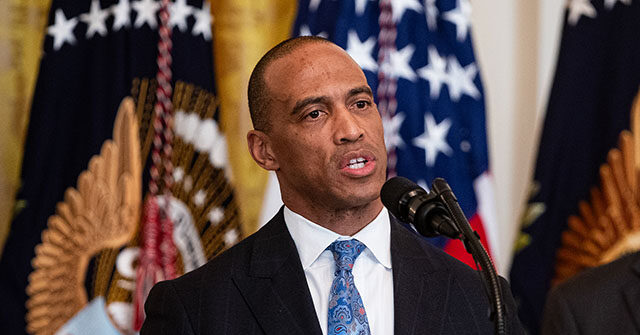
Housing and Urban Development (HUD) Secretary Scott Turner defended the Trump administration’s efforts to address housing affordability in an exclusive statement to Breitbart News on Monday, as newly released data showed confidence among U.S. homebuilders falling to its lowest level since June 2012 amid rising mortgage rates, construction costs, and weakening buyer demand.
The National Association of Home Builders (NAHB)/Wells Fargo Housing Market Index (HMI), released October 19, showed builder confidence in the market for newly built single-family homes declined three points to 29 in October, down from 32 in September.
The latest figures mark the lowest reading in more than 14 years, as builders grapple with mortgage rates exceeding 7 percent, higher energy and construction costs, and worsening labor and lot conditions.
In a statement provided exclusively to Breitbart News, Turner remarked, “America cannot regulate its way to housing affordability, which is why the Trump Administration is clearing barriers to enable builders to build, buyers to buy, and ensure local communities have a voice. The Trump Administration has taken numerous, bold actions to address the housing market challenges caused by excessive regulation, high construction costs, and barriers to new housing supply to unlock the American Dream of homeownership for our citizens.”
All three major components of the index declined in October. Current sales conditions fell two points to 33, sales expectations over the next six months dropped five points to 32, and prospective buyer traffic declined five points to 18.
NAHB Chief Economist Robert Dietz attributed the decline to persistent affordability challenges and constraints on housing supply.
“Housing remains squeezed by supply-side constraints and significant affordability challenges,” Dietz said. “Demand persists, but higher mortgage rates, elevated construction costs and weaker consumer confidence are keeping more buyers on the sidelines.”
Dietz noted that prospective buyer traffic had reached its lowest level since April 2012, excluding the onset of the COVID-19 pandemic in April 2020.
The report also found that 43 percent of builders reduced home prices in October, the highest share recorded during the 2020–2026 period. The average price cut remained at 6 percent for the seventh consecutive month, while 65 percent of builders reported using sales incentives, marking the 19th consecutive month that at least 60 percent had done so.
NAHB Chairman Bill Owens cited rising mortgage rates, inflation, and construction expenses as major pressures on the housing industry, while acknowledging the Trump administration’s regulatory efforts.
“Though builders are also contending with higher costs for construction loans, building materials and diesel, the Trump administration’s efforts to advance regulatory reform are helping to ease some of the cost pressures they face,” Owens said.
Owens also reported that more than one-third of builders experienced immigration enforcement activity in their markets during the previous month, which he said caused construction delays and discouraged legal workers from reporting to work.
Builder confidence has declined from its 2026 peak of 38 in March to 29 in October, remaining below the threshold of 50 that indicates more builders view market conditions as favorable than unfavorable.
The Trump administration has maintained that excessive regulations, elevated construction expenses, and restrictions on new housing development are among the principal obstacles preventing Americans from purchasing homes.
The median home price in America is approximately $400,000, with an estimated $100,000 of that cost attributed to regulatory requirements. Reducing those expenses could make homes closer to $300,000 more attainable for prospective buyers, even with elevated mortgage rates.
On March 13, Trump signed Executive Order 14394, directing federal agencies to review regulations affecting residential construction, including environmental permitting, energy-efficiency requirements, and restrictions on manufactured housing. The order also directed HUD to develop recommendations for state and local governments to streamline permitting processes, limit fees, allow third-party inspections, and remove unnecessary barriers to development. These measures align with HUD’s “Build More, Faster, Cheaper” regulatory agenda, which seeks to reduce construction costs and accelerate housing development.
That same day, Trump signed Executive Order 14393, aimed at expanding access to mortgage credit by reducing regulatory burdens on banks and other lenders. The order directs federal financial regulators to consider changes to mortgage lending requirements, appraisal procedures, and digital closing processes, while encouraging greater participation from community banks and smaller financial institutions. It also addresses financing for residential construction, with the goal of improving access to credit for prospective homebuyers and builders.
On January 20, Trump signed Executive Order 14376, seeking to limit competition between individual homebuyers and large institutional investors. The order directs federal agencies to restrict certain federally supported acquisitions of single-family homes by large institutional investors, to the maximum extent permitted by law, while allowing exceptions for qualifying build-to-rent communities. It also calls for a legislative proposal to prevent large institutional investors from purchasing single-family homes that could otherwise be acquired by individual homeowners.
Beyond the executive orders, HUD has pursued additional measures intended to reduce housing costs and expand supply.
HUD rescinded requirements associated with the 2021 International Energy Conservation Code, a change that could save families up to $30,000.
On October 17, HUD changed FHA multifamily financing policy to allow qualifying communities of single-family homes, duplexes, and triplexes, including manufactured homes, to access FHA-insured financing. The change is intended to encourage additional housing construction and expand available supply.