
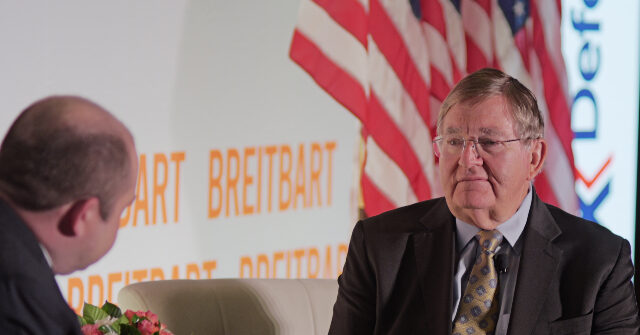
Dr. Michael Burgess, a physician and former congressman, took to the stage at Tuesday’s Breitbart News policy event to sound the alarm on the FDA’s “green list” that allows unchecked weight loss drugs into the United States.
GLP-1 drugs, named for the glucagon-like peptide-1 hormone they mimic, were first approved to treat Type 2 diabetes and are now widely prescribed for weight loss. Brand-name GLP-1s such as Mounjaro, Ozempic, Wegovy, and Zepbound are approved by the FDA and made under its oversight, and Burgess stressed that patients taking them have no reason for concern. His concern is with compounded copies: pharmacy-made versions that are not FDA-approved and are often made from bulk ingredients imported from overseas, some of which may not meet FDA standards or may even be counterfeit.
According to Gallup, the percentage of American adults currently taking GLP-1s for weight loss rose to 11 percent in 2026, up significantly from 3 percent in 2024. The percentage of Americans who have used it before but may not be currently taking it is 15 percent, the analysis found.
After delivering more than 3,000 babies over the course of his medical career and serving over two decades as a Republican representative from Texas, Burgess joined RX Border Defense as an adviser working to stop dangerous counterfeit drugs from harming Americans.
Speaking with Breitbart News Washington bureau chief Matthew Boyle before an audience in Washington, DC, Burgess made clear that FDA-approved GLP-1 medicines are not the problem. The risk, he said, comes from compounded GLP-1s made with ingredients imported from overseas, including China, that no one has verified.
“First off, let me just say the GLP-1 has been a transformational medicine. The question is not about GLP-1s. Someone in this audience may be on one — these are good,” the former congressman began.
But foreign ingredients can enter the country through the FDA’s GLP-1 “green list,” launched in September 2025 after nationwide shortages of the drugs. The list covers bulk active pharmaceutical ingredients (APIs) shipped from overseas facilities, the raw material pharmacies use to make compounded copies. FDA-approved brand-name medicines are made under their own FDA-approved manufacturing processes.
The FDA’s green list was designed to green-light ingredient imports from facilities the agency has “inspected or evaluated that appear to be in compliance with the FDA’s rigorous standards.” At least that was the plan.
The United States no longer has a GLP-1 shortage, but the green list remains. On that list are facilities across Europe and Asia, with China being the most heavily represented country by far.
The “green list” is not simply a directory of FDA-approved GLP-1 medications or pharmacies; it is essentially a list of overseas manufacturers that APIs can be imported from “with no checks, no balances,” Burgess said.
“This allowed for companies just to be waived through,” he explained. “Remember, Reagan always told us, ‘Trust, but verify.’ This was not only trust without verification — what do you think is going to happen? There are bad actors out there, and they’re able to exploit a perceived weakness or loophole.”
According to Burgess, there has already been a recorded instance of products coming into the country that were waived in via the FDA green list, but were actually produced in another location that was not on the list.
In an article he wrote for Breitbart News in September, Burgess reported that the FDA had disclosed that Harbin Jixianglong Biotech, a Chinese manufacturer that had been placed on the green list, obtained unapproved “semaglutide” API from a facility that was not on the list.
The Chinese manufacturer then slapped its own label on the material, altered manufacturing and retest information, and shipped it to the United States.
“It wasn’t caught before the fact; it was caught after the fact, and that’s a vulnerability for American patients,” Burgess told Boyle on Tuesday.
The RX Border Defense adviser emphasized to the audience what the bottom line is: “There are people out there who are willing to exploit weaknesses in our system, and that’s the very reason why we shouldn’t be developing more weaknesses —we should be closing loopholes.”
“Trust, but verify,” Burgess said again, quoting the late President Ronald Reagan.
Olivia Rondeau is a politics reporter for Breitbart News based in Washington, DC. Find her on X/Twitter and Instagram.