President Donald Trump’s bold decision to approve the mission to arrest former dictator Nicolás Maduro created the “path to hope” that Venezuelans are cautiously taking toward holding elections, Dinorah Figuera, the surgeon and former lawmaker representing the opposition in talks with post-Maduro socialists, told Breitbart News this week.
Figuera has risen to abrupt prominence in the past year after being chosen to lead the negotiations intended to build trustworthy institutions necessary for free and fair elections, such as the Supreme Court and National Electoral Council (CNE). Once a lawmaker in the National Assembly, Venezuela’s federal legislature, Figuera was forced into exile after advocating for justice in the case of Fernando Albán, a Caracas councilman who was arrested and swiftly killed in 2018 after denouncing human rights abuses before the United Nations. The Maduro regime insisted his death in the custody of the repressive secret police, the SEBIN, was a “suicide,” a claim inconsistent with the facts.
Eight years later, Figuera was working in facilities for the elderly in Spain, rebuilding her life and that of her family, when the State Department called and asked her to represent the true National Assembly in talks with the regime. Venezuela has not had a true free and fair election since 2015 when that Assembly had chosen her to be its president. Internationally, the 2015 National Assembly is still recognized as the power controlling various Venezuelan state international assets, most prominently a stash of gold kept in the United Kingdom. Figuera accepted the role, which requires her to lead talks directly across from Jorge Rodríguez, the president of the socialist National Assembly in power and brother of current dictator Delcy Rodríguez.
Speaking to Breitbart News from Caracas on Monday, Figuera described an atmosphere of cautious hope in Venezuela following the demise of Maduro — impossible, she asserted, without the public knowledge that the full force of the United States was securing the negotiations, contrary to previous talks under Marudo in which the socialists largely stalled for time while imprisoning and killing dissidents.
“I can say that in public opinion, with the people here, the expectations are enormous,” Figuera said in a conversation in Spanish. “They are positive — wherever we go, the people have their hopes up about the process that is happening to democratize the country.”
Figuera noted that a common sentiment expressed to her by fellow Venezuelans is, “We trust in you, don’t betray us” — the legacy of a long list of attempted talks with the socialist regime that only served to empower it further. The nature of those talks, however, was notably different: the guarantors were countries such as Norway, and the negotiators were often leaders of non-ruling, but still socialist, parties. The prelude to the negotiations Figuera is leading, she noted, was the full force of American law enforcement using the military to bring Maduro and wife Cilia Flores, whose government title was “first combatant,” to justice.
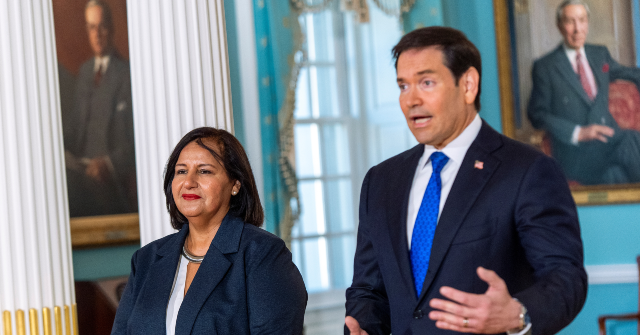
“The accompaniment of the United States and the words of [Secretary of State Marco Rubio] have been determinative,” she emphasized.
“I want to thank the United States, Marco Rubio, Donald Trump, for there being January 3,” Figuera shared. “Because after January 3 is when the path to hope was open.”
Figuera observed that, in Europe, the powers-that-be have “always been suspicious about United States politics,” another challenge she has personally, as a Spanish resident, helped address.
“We had to speak to each and every one of them, the European Union. And they are sensitive to it, they have publicly pronounced themselves: the European Union supports the dialogue among Venezuelans between the 2015 National Assembly and the interim government,” she said.
Figuera announced in August that the European Union had lent its official approval to the negotiation process she is leading, which she described as critical support for success.
For Americans with minimal background on Venezuela who may be uncertain as to why Washington is playing such a prominent role in helping bring the country back to democracy, Figuera noted that America has been among the countries most affected by the unprecedented continental migrant crisis socialism has caused. According to the United Nations, an estimated 7.9 million Venezuelans have been forced to flee socialism in their country, Figuera among them. Giving them the ability to return home, she observes, would have a tremendous social and economic impact on both Venezuela and the nations who welcomed its children.
“There was an economic and social impact, principally in the United States and in the closest Latin American countries,” she explained, noting that Venezuela’s neighbors, America among them, were forced to content with “the installation of a terrorist state, with the narco-trafficking issue,” and other perils.
The path to building institutions, she continued, has “an economic impact, an institutional impact, and a personal impact on Venezuelan families. We are grateful to the United States because they are lifting our morale, knowing that so many of us doctors… can return to the country and generate a strategic plan.”
Figuera also described a cautious but growing economic optimism as foreign investors study the possibility of rebuilding the nation’s industries, particularly oil and gas.
“I’m not an economist, but I can say that here there is a hopeful movement in terms of economy. There is fertile terrain for investment,” she asserted.
“What ties those economic interests to what we are doing?” Figuera explained. “The issue of legality. We are working to make the Supreme Court so there is a legal basis and elections that are legitimate, that will mark a presidency that will generate also economic policies and recovery policies with guarantees to investors.”
Investors have to know that “we will have a country with economic stability but also with legal stability to build a purpose as a country.”
Figuera also expressed personal hope in her nation.
“I’m a woman of faith, I’m a cancer survivor, I am strictly about faith,” she said, “and I think that this purpose, politics and institutionality aside, has a faith foundation that I see in the people stopping us, telling us they are praying for us, praying for Venezuela that this process is successful.”
The two parties to the negotiations announced on Wednesday that they had completed a third round of talks focused on four categories of topics: strengthening democracy and judicial power; freedom of expression, pluralist thinking, and rights to information; earthquake and recovery of the U.K. gold; and “political, economic, and social guarantees.”
A top priority listed in a joint statement from the legitimate and socialist National Assemblies is the creation of a detailed law on political parties to prevent the federal government from co-opting them through the imposition or removal of leaders or through force or intimidation.
This is the second part of a two-part interview with Figuera. In the first part, Figuera discusses the negotiation process, what needs to be fixed for elections to take place, and her experience sitting across from her former oppressor during the negotiations.