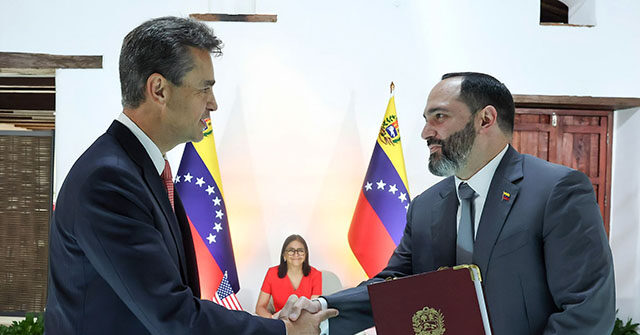
Texas-based ExxonMobil on Monday signed a memorandum of understanding with Venezuela that could lead to a potential return of the oil company to the country almost two decades after it had its assets stolen by the ruling socialist regime.
The agreement was signed between ExxonMobil and Venezuela’s state-owned oil company PDVSA in an official ceremony presided over by “acting President” Delcy Rodríguez. Bloomberg, citing information from a statement released by ExxonMobil, detailed that the text contemplates “potential upstream opportunities.”
“This memorandum is a meaningful first step, but any future investment would require stable policies, clear regulations, strong investment protections and competitive returns,” ExxonMobil reportedly said in the statement.
Bloomberg described the agreement as a step forward for the Trump administration’s efforts to help restore Venezuela’s rundown oil industry following the arrest of deposed socialist dictator Nicolás Maduro in January.
Per VTV, the Venezuelan regime’s main propaganda news channel, “acting President” Rodríguez celebrated the signing of the memorandum and, after “welcoming back” ExxonMobil, affirmed that the document should soon translate into concrete investments for the country of mutual benefit for both the U.S. and Venezuela.
“May the synergy develop and be beneficial to both countries,” Rodríguez said.
Rodríguez assured that Venezuela is now home to a “solid legal security framework” that safeguards the American company’s operations, with the expectation that the agreement leads to positive benefits for the Venezuelan economy and the lives of its citizens.
Venezuelan Hydrocarbons Minister Paula Henao detailed that the signing is “very significant” for Venezuela and the United States given what the return of ExxonMobil could mean. The minister acknowledged the company’s long history in the Venezuela oil industry, particularly in the Orinoco Belt, where the world’s largest accumulation of heavy and extra-heavy crude oil is located.
“We are on a path aimed at repeating and increasing production from our fields and, of course, moving toward a complementary model where we can maximize those production capacities with the technology that ExxonMobil will bring to the table and, of course, increase the recovery factor for the heavy and extra-heavy crudes in the belt, which is precisely what we are seeking through these partnerships,” Henao said during the ceremony, according to VTV.
ExxonMobil was among the companies most affected by the massive wave of government thefts and forced “nationalization” of hundreds of local and international companies ordered by late socialist dictator Hugo Chávez in the mid-to-late 2000s. The expropriations of numerous companies, housing constructions, and over 3.6 million hectares’ worth of land were among the cornerstone objectives in Chávez’s plans to implement so-called “Bolivarian socialism” in Venezuela in the years prior to the collapse of socialism during the 2010s, which led to what is now known as the worst migrant crisis in the Western Hemisphere.

Venezuelan acting president Delcy Rodriguez, center, waves to supporters during an event to mark the start of the Christmas season at Paseo de Los Proceres in Caracas, Venezuela, Sunday, November 1, 2026. (AP Photo/Pedro Mattey)
ExxonMobil, alongside fellow Texas-based oil company ConocoPhillips, were expelled from Venezuela by the socialist regime in 2007 — disregarding decades of investment and development that both companies poured into the Venezuelan oil industry while seizing billions’ worth of assets without due repayment. Bloomberg pointed out on Monday that ExxonMobil had also been the target of a separate expropriation process in the 1970s, long before Chávez’s rise to power.
Reuters detailed that, before Chávez’s expropriations, ExxonMobil held a 41.67 percent stake in Cerro Negro, a heavy crude oil project in the Orinoco Belt presently known as “PetroMonagas.” Additionally, the company also held a 50-percent interest in La Ceiba, an oil project in the southern area of the Maracaibo basin in northwestern Venezuela.
Although some rulings were issued in favor of the affected American companies, the Venezuelan regime reportedly still owes several billions of dollars to the claimants. In February, during his official visit to Caracas, U.S. Department of Energy Secretary Chris Wright detailed that some of the affected oil companies were in talks with the socialist regime to recover some of the lost assets.
Additionally, years after it was expelled from Venezuela, ExxonMobil became the target of Nicolás Maduro’s repeated threats over the oil company’s operations in the water of neighboring Guyana’s Essequibo region — a territory that represents about two-thirds of Guyana and which is subject to a historic, over 120-year-old territorial dispute between both nations that remains fully unresolved at press time.
Following Maduro’s arrest in January, the Venezuelan socialist regime implemented reforms to the nation’s hydrocarbon and mining laws, rescinding the stringent socialist restrictions to those sectors implemented during the Chávez era of the still-ruling socialist regime, seeking to attract U.S. and other foreign investment. Rodríguez affirmed this year that the reforms also contained new legal safeguards for foreign investors, particularly those from the U.S.
Christian K. Caruzo is a Venezuelan writer and documents life under socialism. You can follow him on Twitter here.