
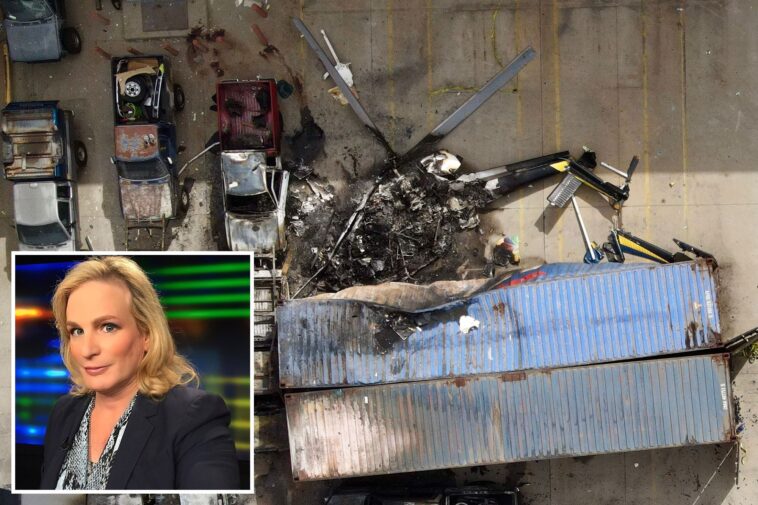

A prominent Los Angeles helicopter pilot believes a crucial delay of just five seconds may have turned an apparent in-flight emergency aboard an NBC news chopper into a deadly plunge.
Zoey Tur, a longtime helicopter pilot and former pilot-reporter for KCBS and KNBC, said video of the Airbus AS350 B2 crash appeared to show a dramatic loss of rotor speed as the aircraft hovered over Chatsworth on Tuesday.
Tur, who has more than 10,000 flight hours and has owned two AS350 B2 helicopters and a JetRanger, analyzed the crash video and audio based on her experience flying the same aircraft model.

“I think there was a good chance the aircraft could have been brought down safely if the pilot reacted quickly enough,” Tur said.
“I’m going to get a lot of heat over this, but I’m a reporter, this is my experience, and I’m seldom wrong when it comes to these situations.”
The helicopter was covering an earlier deadly crash involving an SUV and a Metro bus when it plunged to the ground, killing NBC4 and Telemundo 52 reporter Eliana Moreno, pilot George Marciniw and 29-year-old pedestrian Edy Gutierrez Mejia, who was on the ground.
The two crashes happened within hours of each other Tuesday night, claiming five lives.
According to Tur, the chopper appeared to be hovering when its engine began winding down.
Then came an ominous warning sound known as the klaxon – a horn designed to alert the pilot to either low rotor RPM or a loss of hydraulic pressure.

Tur said the video and audio appeared to point to low rotor RPM – rotations per minute – rather than a hydraulic failure.
The pilot controls rotor speed with the collective, a lever operated with the left hand that changes the pitch – or angle – of the rotor blades.
That control becomes critical when an engine loses power, according to Tur.
“You don’t want to hear any of these things when the horn goes off in flight because it means that you have just a second or two to lower that collective,” she said.

Tur believes the warning horn can be heard for roughly five to six seconds in the footage.
Crew audio captured one person saying “uh oh,” followed by “You can’t pull up?” as the aircraft rapidly descended.
“You know, you listen to the klaxon, I think you can hear the horn for at least 5 seconds, maybe 6 seconds,” she said. “And in that time before he reacted, you should just hear it like for a moment, and then you should already be lowering the collective.”
The maneuver Tur described is known as autorotation – an emergency procedure in which the helicopter’s rotor continues turning from the airflow passing through it rather than being driven by the engine.
In simple terms, lowering the collective reduces the blades’ pitch and allows them to keep spinning as the helicopter descends, preserving the rotor speed needed to flare and land.

“Had he reacted quickly, he might have brought down the aircraft. It may not have been pretty. He may have damaged the tail rotor or damaged the aircraft, but I think it would have been survivable,” she said.
Tur said the helicopter was already in a particularly vulnerable position because it was hovering.
“When you’re in a hover, you’re using more power, making more noise, and you have less time to react in an emergency,” she said.
She believes the footage shows the rotor blades slowing before the helicopter rapidly descended.
“Five seconds of inaction is enough,” Tur said. “You can even hear the pilot say, ‘Oh f***.’ He knew what a bad situation he was in at that point and was unable to recover from it.”

Tur stressed that her assessment is not a formal finding in the crash investigation and that the ultimate cause remains to be determined.
She said possible explanations include the helicopter running out of fuel or a mechanical problem blocking fuel from reaching the engine.
The NTSB is still investigating the crash.