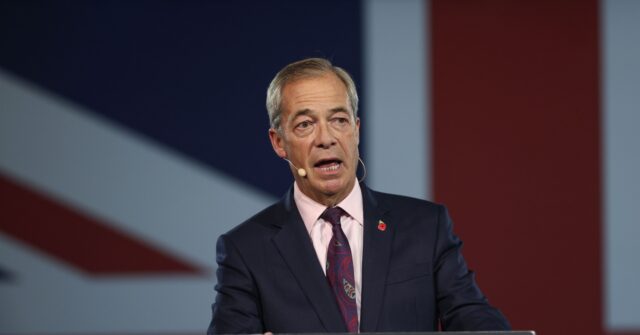
Reform UK leader Nigel Farage has urged the British public to reject the establishment ethos of “managed decline” and to back a muscular approach to the United Kingdom’s problems at home and abroad.
Laying out his broad vision for national defence and power projection on the world stage in the wake of selecting 40-year military veteran Angus MacIntyre as the party’s first Shadow Armed Forces Minister, Mr Farage warned that the threats facing Britain “are no longer abstract”.
“Lone-wolf terrorists and state-sponsored actors, many of them working at the behest of the Islamic Republic in Tehran, are entering our homeland through porous borders. I have warned about this for years, only for my concerns to fall on the deaf ears of a complicit political class,” Mr Farage wrote in The Express.
“Britain’s role in the world has been diminished over decades. But the power we once projected across the globe does not have to give way to the establishment doctrine of managed decline. On national and international security, Reform UK has a plan to put Britain back in the driving seat at home, in our region and around the world,” he continued.
Mr Farage said that a Reform UK government’s top priority in terms of national defence would be to secure Britain’s borders, arguing that “being respected starts at home”. In addition to policing the nation’s borders, Mr Farage also said that if elected, Reform UK would leave the European Court of Human Rights, the International Criminal Court, and the Refugee Convention, in order to regain full sovereignty over Britain’s borders and to ensure that no international court can override British law.
Additionally, protecting the homeland would also include banning Islamist groups like the Muslim Brotherhood, which has been accused of fomenting separatism and undermining Western power structures with the ultimate aim of instituting Sharia in the West.
However, the Brexit boss noted that “Britain’s national security does not end at the 12-mile line” and therefore it is also imperative to re-establish the military might which once defined the nation.
Mr Farage said that this would include increasing defence spending to three per cent of GDP by 2030 and 3.5 per cent by 2035, with a specific focus on critical areas such as Britain’s nuclear deterrent, undersea defence, and cyber/space-based threats, rather than “simply hurling money at the same flawed MoD procurement processes that have left our forces threadbare.”
Although he stressed the importance of reinvesting in the UK’s armed forces, the Reform chief said that one of the top aims of his party will be to be a force for peace on the world stage, noting that it is through peace that energy prices will come down, and if shipping lanes are opened, traded commodities would also become cheaper for Britons.
Farage also noted, however, that investing in defence is not merely about having a strong military, but also about strengthening the resilience of critical infrastructure at home.
“Vladimir Putin sees our weaknesses and exploits them. Our airports, hospitals, energy, food security and wider infrastructure are off limits. More than that, we will invest heavily in them to ensure that any and all attempts to attack us fail,” he said.
“These foundations of everyday life are chronically vulnerable. In so many ways, we have placed global ‘well-being’ above our own. We have promoted diversity, equity and inclusion overseas, at great cost, while neglecting our own national prosperity and strength.”
Other key national security priorities identified by the Reform leader included reasserting Britain’s sovereignty over the Falklands, the Chagos Islands, and Gibraltar, and rejecting demands from former colonies for reparations.
Farage also argued that countering Communist China’s desire to conquer Taiwan will be critical, given the current dependence on the Taiwan Semiconductor Manufacturing Company (TSMC), which accounts for around 70 per cent of the global semiconductor market.
Mr Farage concluded: “To help bring peace abroad, we must build strength at home. You cannot simply declare yourself a world power; you have to create one. That comes through hard-headed, pro-British policies that show the world, and above all our enemies, that we mean business. It also means committing ourselves, as a nation, to upholding our sovereignty, protecting our people at home and abroad, and securing the conditions for prosperity by actively promoting British business and inward investment.
“Reform UK rejects the idea that we must be a nation in decline. We can be a nation on the rise once again. Not just for our own benefit, but because of something I know most Britons agree on: the world is a better place when Britain is a better place, a safer place when Britain is safer, and a more peaceful place when Britain is at its best.”