
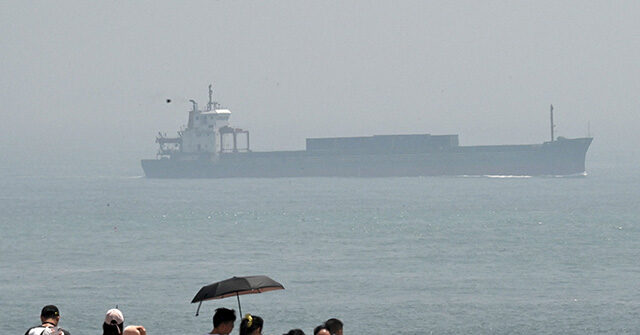
The Philippine Coast Guard (PCG) said on Sunday that Chinese research vessels have been spotted in the waters near the Philippines, Taiwan, and Japan, apparently surveying the routes of vital undersea cables without permission from the regional governments.
The PCG pointed to a Chinese ship called Jia Hai Ke 7, which spent several days inside the exclusive economic zone (EEZ) around the Batanes Islands without permission from the Philippines. When the PCG sent patrol craft to escort the “privately owned” Chinese vessel away, two Chinese Coast Guard ships suddenly appeared to defend it.
The Batanes Islands are Manila’s northernmost territories, less than 100 miles from Taiwan at their closest point. China has long coveted the islands, and Manila grew nervous over the summer when the Chinese Academy of Social Sciences asserted at a June symposium that the Batanes should be seen as part of Taiwan – and, therefore, subject to Beijing’s rule.
The Japan News noted that Chinese research vessels have been making weird sharp turns in the waters off Japan since 2024, seemingly while tracking undersea internet cables. In February 2025, a Chinese cargo ship following such a “zigzag” course over an undersea cable managed to sever the cable by dropping and dragging its anchor.
“In a September report prepared for a panel advising the U.S. Congress, the U.K.-based China Strategic Risks Institute found that Beijing could attack undersea cables using robotics and unmanned underwater vehicles through collaboration between the military and private sector,” Japan News recalled.
On Sunday, four Chinese survey ships were spotted off the coast of Taiwan making “irregular moves” that suggested they were mapping undersea cables. All four ships have essentially been sailing back and forth, or in circles, over the same waters for months.
China’s interest is focused on what strategists refer to as the “First Island Chain,” the arc of islands that stretches from Japan down to the Philippines and Indonesia. The islands were a buffer against Imperial Japan during World War II, and today they serve a similar function as chokepoints against Chinese naval power.
The First Island Chain has also become a nexus for trans-Pacific Internet communications thanks to those undersea cables, and the People’s Liberation Army Navy (PLAN) has clearly noticed that defending thousands of miles of vulnerable cable would be a formidable challenge for Japan, Taiwan, the Philippines, and their American allies. If the cables were destroyed by a coordinated attack, they could knock out over 90 percent of the world’s online communications.
Japan and the Philippines have responded by increasing their surveillance capabilities over the undersea cables. Japanese Prime Minister Takaichi Sanae identified them as “indispensable critical infrastructure for our country” in a recent speech and has budgeted for increased military surveillance of the cable routes.
The Philippine government began carefully coordinating with Taiwan and Japan on cable protection this year, while taking pains not to antagonize China. Philippine statements on “gray-zone” tactics – such as vaguely menacing efforts to map vital undersea infrastructure for possible sabotage – refrain from criticizing China by name, instead referring broadly to “South China Sea tensions.”
When Beijing got wind of Filipino-Taiwanese coordination on cable security last month, it sent a threatening reminder to Manila that it should “strictly adhere to the One-China Principle,” meaning China’s ownership of Taiwan.
For the moment, there is little to be done about China’s provocative cable mapping. The U.N. Convention on the Law of the Sea (UNCLOS) frowns upon such activities but contains no serious legal enforcement mechanism for stopping it. Other regional governments are unlikely to take direct action against Chinese research vessels. Beijing dismisses complaints about the activities of these “privately owned” ships with a shrug.
On Monday, the PCG said it would intensify it coastal patrols in several regions, ostensibly in the interest of public safety during the Undas holiday, a Philippine tradition to honor departed loved ones that is observed in early November.