
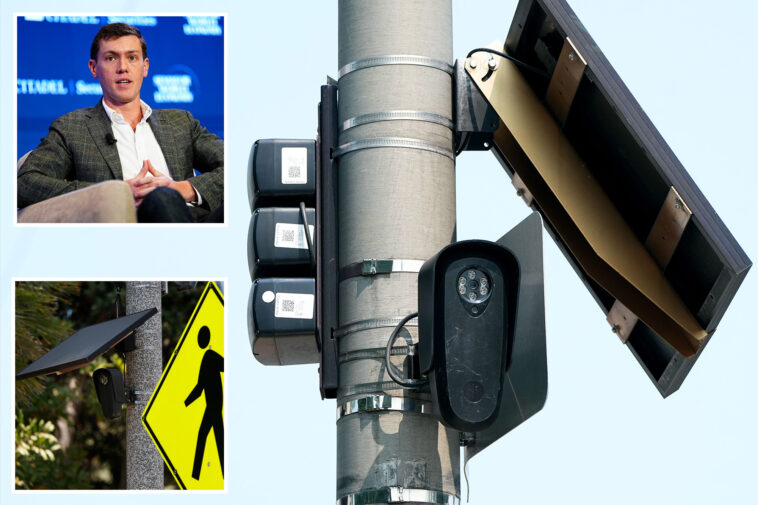
Flock Safety is slashing how long its license-plate cameras store data from 30 days to just seven — while forcing cops to justify every search — amid mounting scrutiny from privacy advocates and politicians.
CEO Garrett Langley told The California Post the overhaul amounts to the toughest license-plate-reader policy in the country. About 90% of investigative searches on Flock’s system already occur within seven days, Langley said.
“I’ve realized communities need my help,” Langley said, explaining the company’s decision to move beyond simply giving police departments privacy tools and instead make some safeguards mandatory.

“They need flock to set the standard for how this kind of technology should be deployed,” he added. “I think sadly, police abuse has been a problem for longer than people want to talk about.”
The changes come as Flock faces growing criticism over the spread of its automated license plate readers, which can capture information about vehicles traveling through communities and make it searchable by law enforcement.
The American Civil Liberties Union has accused Flock and other ALPR companies of helping create a nationwide mass-surveillance network, arguing that the technology can reveal where people live, work, worship and travel. The ACLU says Flock cameras number roughly 120,000 nationwide.
Flock, meanwhile, argues its technology is an important investigative tool — and that stronger safeguards can address concerns about abuse without eliminating the technology altogether.
Sign up for the California Morning Report newsletter
California’s top news, sports and entertainment delivered to your inbox every day.
Thanks for signing up!
“The ACLU has pushed for case code as a requirement in the search for years. We built it,” the leading executive of Flock said in announcing the change. “So things like case code, things like audit assistance, those are gonna be hard requirements now.”
Under the new policy, case codes will be required for every search. The company first introduced the requirement as an optional feature in July 2025.
There will be an emergency override for situations such as a missing child, but those searches will automatically be flagged for review.

The company is also making its Audit Assistance system mandatory for law enforcement customers.
The tool looks for unusual search activity and flags potentially problematic behavior. Flock said roughly one-third of agencies had voluntarily activated the feature after it was introduced earlier this year — and that identifying misuse increased when agencies did so.
Now, when the system detects abnormal activity, the user can be locked out while an administrator reviews the searches.

Langley said the goal is to catch potential misconduct before it becomes widespread rather than simply documenting it after the fact.
“The solution is not to remove the tools they need to do their job, the solution is to hold them accountable,” he said. “Not enough cities are running audits. Not enough cities are actually checking what’s happening. So we’re just gonna force it.”
Flock is also introducing Evidence Mode, allowing information connected to a case number to be preserved rather than automatically disappearing after seven days. Agencies can also establish longer retention periods when required by state or local law.
Langley said the seven-day figure was chosen after analyzing how quickly investigators typically search the system.

He acknowledged that some people may argue for an even shorter window.
“You could argue it should be 48 hours,” he said. “And that would mean that maybe 50% of crime gets solved. And in seven days, you’re at 90%.”
The changes also come as California lawmakers consider new statewide rules governing ALPR technology.
Senate Bill 1013, authored by state Sen. Sabrina Cervantes, would require public agencies using license-plate readers to train officers, maintain search logs, undergo annual audits and delete data after 30 days unless it is connected to an active criminal investigation. The measure has passed the state Senate and is now before the Assembly.

As flock strengthens its standards around data security, the company is facing one of its biggest political challenge in Los Angeles.
Mayor Karen Bass recently called for an end to LAPD’s contract with Flock, saying the company had lost the trust of Angelenos.
Langley pushed back, saying the mayor’s description of how the system works was inaccurate.
“LAPD owns the data, they always have. LAPD controls who has access to it, not Flock. So it was definitely disappointing to see her say that,” he said.
Flock maintains it has reached out to Bass’ office and is working to schedule a meeting with the mayor.
Langley also questioned why Bass’ position had changed.
“What’s changed?” he said, pointing to previous support for the technology. “I’ve been running the same business for nine years.”

Bass’ office did not immediately respond to The Post’s request for comment.
Langley said the company remains optimistic about working with LAPD and stressed that the department’s contract has no monetary value to Flock.
“The contract is really clear,” Langley said. “The customer owns the data, not Flock.”
Langley also pointed to Flock’s response to the devastating Palisades Fire, saying the company donated more than 50 cameras to the affected community and that the technology helped produce recoveries.
“Thousands of officers were relying on Flock every single day,” he said of LAPD. “Today, they have nothing.”

Langley said he hopes the department ultimately reinstates the system with the new safeguards in place.
“My team has [spoken with LAPD],” he said. “I think they’re going to be quite happy with these changes.”
The privacy debate is unlikely to disappear.
The ACLU argues that ALPR systems can track innocent drivers and have been misused by law enforcement, while police agencies say the technology helps them recover stolen vehicles, identify suspects and solve crimes.
Langley says the company is willing to keep tightening the rules as the technology improves.